Mapping Iran’s Interlocking Centers of Power
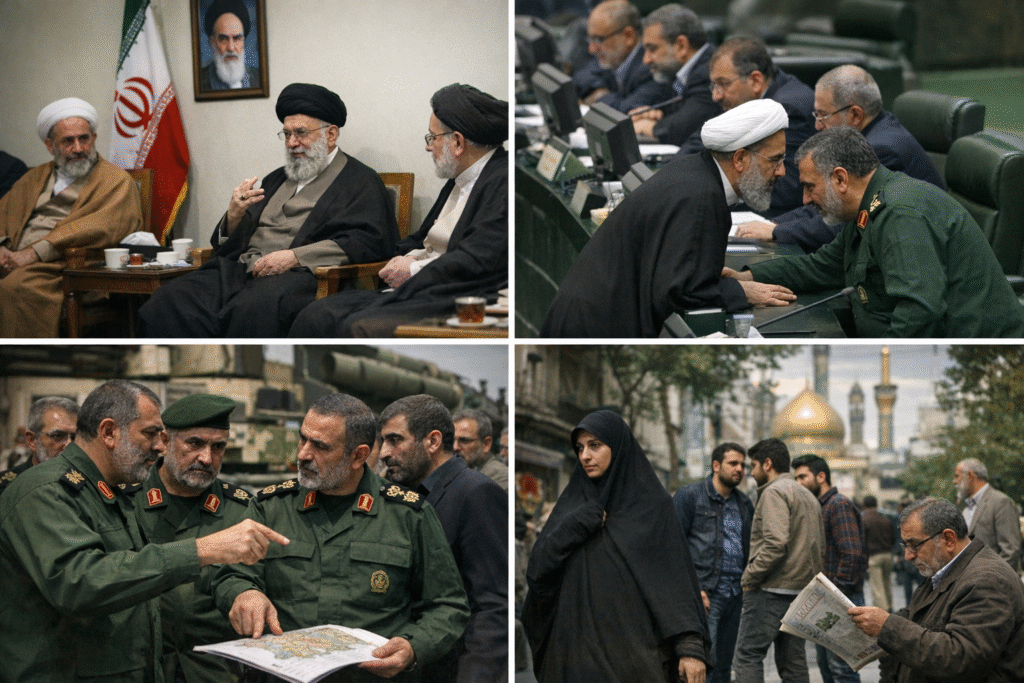
A recent analysis published on Spencer Guard’s Substack, titled “What Are Iran’s Centers of Gravity?”, offers a structured examination of the strategic assets underpinning the Islamic Republic’s regional influence and internal resilience, framing them through a military and geopolitical lens often associated with classical strategic theory.
The concept of “centers of gravity,” rooted in the writings of Carl von Clausewitz, refers to the sources of power that provide a state or actor with strength, cohesion, and the ability to sustain operations. In the case of Iran, the Substack article argues that these centers are not singular or static but instead form a layered network spanning military capabilities, political institutions, economic resources, and ideological influence.
Foremost among these is Iran’s regional proxy network, which the article identifies as a cornerstone of Tehran’s power projection strategy. Groups such as Hezbollah in Lebanon and various militias in Iraq and Syria enable Iran to exert influence far beyond its borders while maintaining a degree of deniability. This network also complicates adversaries’ operational planning, as any direct confrontation with Iran risks escalation across multiple fronts.
Closely tied to this external apparatus is the Islamic Revolutionary Guard Corps (IRGC), described as both a military force and a political-economic actor embedded deeply within Iran’s governance structure. The IRGC’s control over key sectors of the economy and its role in shaping foreign policy allow it to function as a stabilizing and, at times, dominating center of gravity. According to the analysis, its resilience lies in its adaptability and its integration into both state and non-state spheres.
The article also highlights Iran’s missile and drone capabilities as another critical component. These systems provide a deterrent against regional adversaries and offer asymmetric advantages that compensate for the country’s conventional military limitations. Their demonstrated use across the Middle East in recent years has underscored their strategic value, particularly in signaling resolve and imposing costs without engaging in full-scale war.
Domestically, the piece points to the regime’s ideological foundation and internal security mechanisms as vital pillars. The Islamic Republic’s governing model, combining religious authority with republican institutions, remains central to its legitimacy among core supporters. Meanwhile, internal security services and surveillance structures help maintain regime continuity amid periodic unrest and economic dissatisfaction.
Economic durability, though more contested, is presented as another key factor. Despite sanctions and structural inefficiencies, Iran has managed to sustain its core functions and fund its regional activities. The Substack article suggests that this endurance, rather than robust growth, constitutes a form of strategic strength, enabling Tehran to outlast external pressure campaigns.
Importantly, the analysis emphasizes that these centers of gravity are interdependent. Weakening one does not necessarily produce systemic collapse if others remain intact. For example, targeting economic infrastructure may strain the regime, but without undermining the security apparatus or ideological cohesion, such pressure may not achieve decisive effects.
The article ultimately argues that understanding Iran requires moving beyond simplistic metrics of power. Its strength derives from a hybrid model that blends state authority, non-state partnerships, and ideological commitment. This complexity, the author contends, makes Iran a uniquely resilient actor in the Middle East, capable of absorbing shocks while maintaining strategic initiative.
By framing Iran through the lens of multiple, reinforcing centers of gravity, the piece on Spencer Guard’s Substack contributes to a more nuanced discussion of how power operates in the region. It suggests that any effort to counter or engage Iran must account for the breadth and interconnectedness of these elements, rather than focusing on a single domain of competition.