Why Work in America Feels Increasingly Joyless
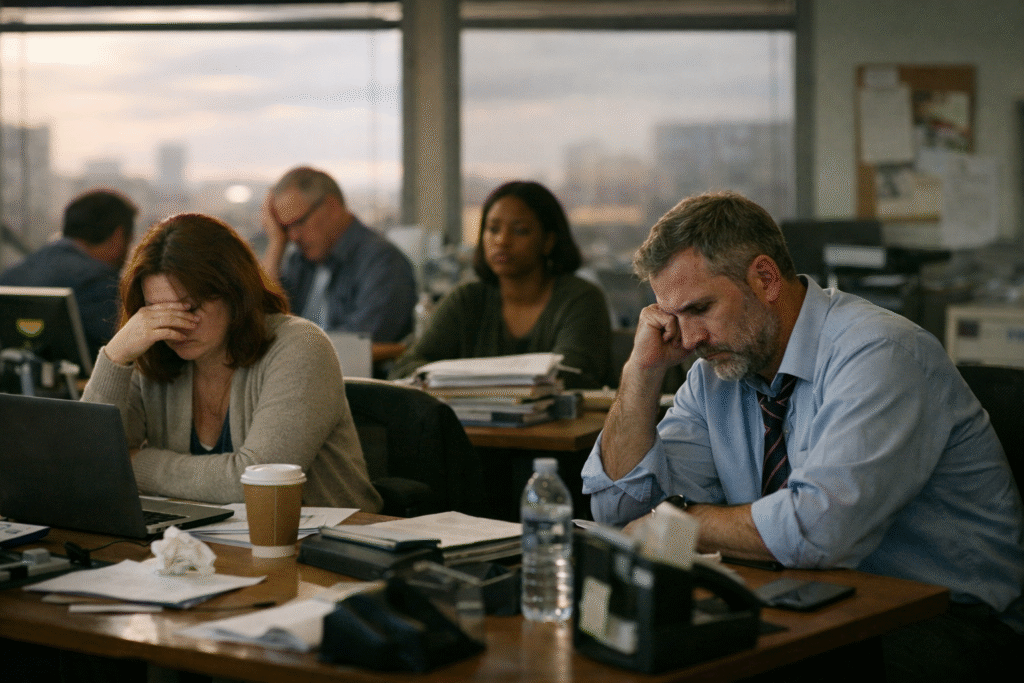
A recent Wall Street Journal article, “How Working in America Became So Joyless,” examines a growing sense of dissatisfaction among American workers, tracing a shift in the nature of employment that has left many feeling disengaged, overextended, and undervalued despite historically low unemployment and steady wage growth.
The report highlights how structural changes in the labor market, accelerated by the pandemic and technological transformation, have reshaped expectations on both sides of the employment relationship. While companies emphasize efficiency, flexibility, and performance metrics, workers increasingly report that these priorities have come at the expense of meaning, stability, and workplace cohesion. The result is a widening gap between economic indicators that suggest strength and lived experiences that feel far more strained.
One of the central tensions identified is the erosion of clear boundaries between work and personal life. Remote and hybrid arrangements, initially celebrated as liberating, have in many cases blurred distinctions in ways that encourage longer hours and constant availability. Digital tools that enable productivity have also intensified monitoring and accountability, contributing to a sense that work is both omnipresent and inescapable.
At the same time, the article points to a decline in traditional sources of workplace satisfaction, including long-term job security and clear career progression. Frequent restructuring, short tenures, and the normalization of layoffs have weakened employees’ sense of loyalty and belonging. Even in higher-paying roles, workers report feeling replaceable, a perception that undermines engagement and trust.
Management practices have also come under scrutiny. The emphasis on data-driven performance measurement and productivity tracking can leave employees feeling reduced to metrics rather than recognized for broader contributions. While such systems are often designed to improve efficiency, they may also strip work of its human dimension, making it harder for individuals to find purpose or pride in what they do.
The Wall Street Journal article further notes that generational expectations are reshaping the debate. Younger workers, in particular, are less willing to accept demanding conditions without corresponding fulfillment or autonomy. Their willingness to change jobs or disengage from unsatisfying roles has contributed to what some analysts describe as a recalibration of workplace norms, though not necessarily an improvement in daily experience.
Employers, for their part, face competing pressures. The need to remain competitive in a globalized, fast-moving economy often drives cost control and performance optimization, leaving limited room for investments in workplace culture that do not yield immediate financial returns. Yet the persistence of low morale and rising burnout suggests that neglecting these factors carries its own long-term risks.
The broader implication, as outlined in “How Working in America Became So Joyless,” is that the problem is not confined to any single industry or demographic group. Rather, it reflects a deeper transformation in how work is organized, evaluated, and experienced. Addressing it may require more than incremental changes, demanding instead a reassessment of the balance between productivity and well-being that defines modern employment.
In the absence of such shifts, the disconnect between economic performance and worker sentiment is likely to persist, leaving the question not of whether Americans are working, but whether their work continues to feel worthwhile.