Inside Ukraine’s Wartime Military Transformation Through Innovation, Drones, and Decentralized Command
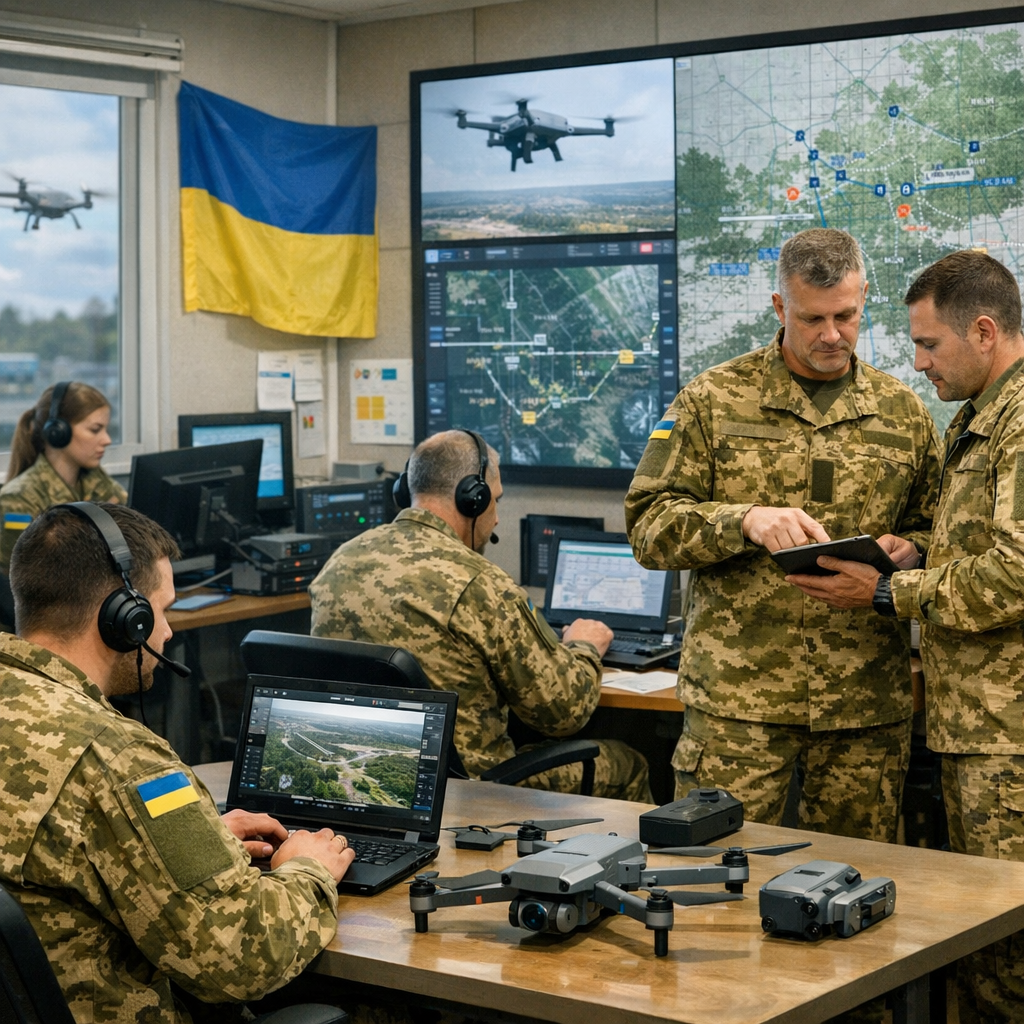
A recent report by Breaking Defense, titled “How Ukraine’s military is adapting after four years of war with Russia,” (source) examines how Kyiv has reshaped its armed forces in response to the grinding, high-intensity conflict that has defined regional security since 2022. The article portrays a military that, while strained by years of attrition, has undergone significant transformation in doctrine, technology adoption, and organizational structure.
According to Breaking Defense, Ukraine’s evolution has been driven less by sweeping modernization programs and more by rapid, iterative adaptation on the battlefield. Facing a larger adversary with significant industrial capacity, Ukrainian units have prioritized flexibility, decentralization, and speed of innovation. This has led to an operational culture in which frontline commanders and technical specialists play an outsized role in refining tactics and integrating new tools, particularly in the domain of unmanned systems, a trend also analyzed by the Center for Strategic and International Studies.
The widespread use of drones stands out as a defining feature of Ukraine’s approach. What began as an ad hoc reliance on commercially available quadcopters has developed into a layered ecosystem of reconnaissance, strike, and electronic warfare platforms. Breaking Defense describes how Ukrainian forces have integrated drones into nearly every echelon, enabling constant surveillance of Russian positions and rapid targeting. This persistent visibility has altered battlefield dynamics, making concealment more difficult and increasing the lethality of even small units, echoing findings from the Royal United Services Institute.
At the same time, Ukraine has refined its use of electronic warfare, both to disrupt Russian systems and to protect its own drone networks. The interplay between drones and electronic countermeasures has created a continuous cycle of adaptation, with each side seeking to blind or outmaneuver the other. The result, as highlighted in the Breaking Defense report, is a highly contested electromagnetic environment where technical agility can be as decisive as firepower, a dynamic also discussed by RAND Corporation.
Organizationally, Ukraine has moved toward a more decentralized command structure, a shift that contrasts with the more hierarchical model traditionally associated with Russian forces. This decentralization has enabled quicker decision-making and allowed units to exploit fleeting opportunities. However, it has also placed greater demands on junior officers and non-commissioned officers, who must operate with a high degree of autonomy in complex and rapidly changing situations, reflecting broader NATO discussions on mission command principles (NATO Mission Command).
Logistics and sustainment remain persistent challenges. After years of war, maintaining equipment, supplying ammunition, and rotating personnel have become increasingly difficult. Breaking Defense notes that Ukraine has worked to streamline its logistics networks and expand domestic defense production, but constraints remain. The country continues to rely heavily on Western support, both for advanced systems and for the steady flow of basic supplies needed to sustain prolonged operations, an issue tracked by the International Institute for Strategic Studies.
Training has also undergone significant changes. Ukrainian forces have blended Western training methods with hard-earned battlefield experience, creating a hybrid approach that emphasizes practical skills and adaptability. Rotational training programs, often conducted abroad, are supplemented by in-country instruction that incorporates lessons learned from ongoing combat. This feedback loop has allowed Ukraine to update its tactics more rapidly than would be possible in peacetime conditions.
The human dimension of the conflict is a recurring theme. Sustaining morale and managing fatigue after years of continuous fighting pose serious challenges. Breaking Defense underscores that while Ukraine’s forces have demonstrated resilience, the cumulative toll of casualties and exhaustion cannot be ignored. Efforts to expand recruitment and improve support for soldiers and their families are ongoing, but the strain is evident.
Looking ahead, the report suggests that Ukraine’s ability to continue adapting will be critical to its long-term effectiveness. The war has become a proving ground for new forms of warfare, particularly the integration of low-cost technologies into conventional operations. Ukraine’s experience, as described by Breaking Defense, is likely to influence military thinking well beyond the region, offering lessons on how smaller or less-resourced forces can counter a numerically superior adversary through innovation and agility.
Ultimately, the transformation of Ukraine’s military reflects a broader shift in modern warfare, where success depends not only on traditional metrics of power but also on the capacity to learn, iterate, and respond under pressure.