Harvard Historian Richard Pipes and the Intellectual Roots of Reagan’s Cold War Strategy
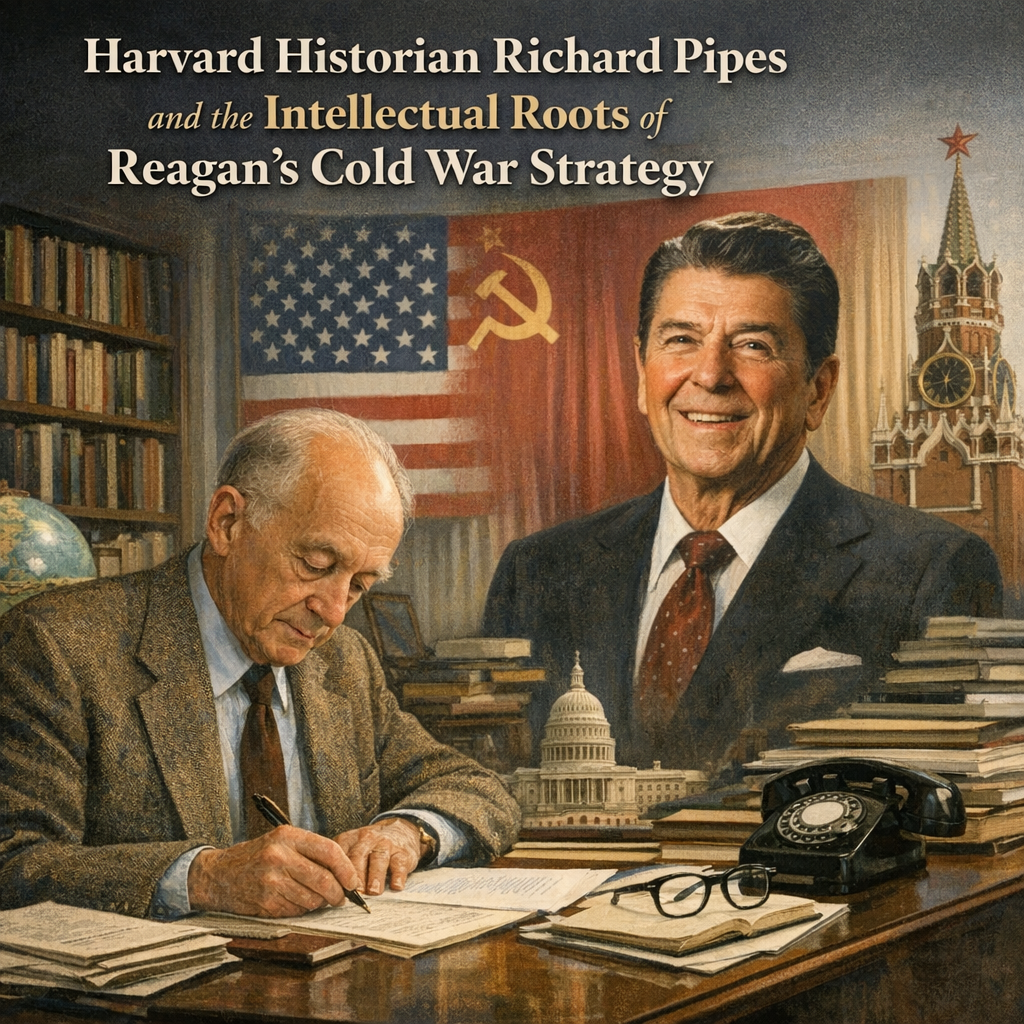
A new account of Cold War strategy is drawing renewed attention to the role of academic theory in shaping U.S. policy toward the Soviet Union, highlighting the influence of a Harvard historian whose ideas helped inform President Ronald Reagan’s approach to confronting communism.
In an article titled “In the End, I Was Right”: How a Harvard Historian Helped Reagan Topple Soviet Communism, published by the Washington Free Beacon, historian Richard Pipes emerges as a central figure in the intellectual architecture behind Reagan’s hardline stance against Moscow. Pipes, a Polish-born scholar specializing in Russian history, argued for years that the Soviet system was inherently brittle and could be pressured into collapse—an assessment that ran counter to prevailing views among many policymakers and academics who believed the superpower was stable and durable.
According to the Free Beacon’s account, Pipes’ influence reached its peak during his tenure on the National Security Council in the early 1980s, where he advised Reagan’s administration. His analysis challenged the dominant doctrine of détente, which sought to manage tensions between the United States and the Soviet Union through diplomacy and arms control. Pipes maintained that the Soviet leadership operated from a fundamentally expansionist ideology and that the United States should respond not with accommodation but with sustained political, economic, and military pressure.
Reagan’s policies reflected aspects of this thinking. His administration pursued a major military buildup, increased rhetorical pressure on Soviet leadership, and implemented economic measures designed to strain the USSR’s already struggling system. Programs such as the Strategic Defense Initiative, combined with efforts to restrict Soviet access to critical technologies and global financial systems, were aimed at exploiting what some advisers, including Pipes, viewed as structural weaknesses.
The Free Beacon article describes Pipes as a controversial figure at the time, with critics arguing that his views risked escalating tensions and prolonging the Cold War. However, as the Soviet Union began to unravel in the late 1980s, Pipes and his supporters pointed to those developments as validation of their analysis. The dissolution of the USSR in 1991, following years of economic stagnation, political upheaval, and reform efforts under Mikhail Gorbachev, marked the end of a geopolitical rivalry that had defined global politics for decades.
Historians continue to debate the extent to which Reagan’s policies hastened the Soviet collapse, versus internal factors such as economic inefficiencies, nationalist movements within Soviet republics, and systemic governance failures. Pipes himself maintained that external pressure played a decisive role by intensifying these internal crises.
The Free Beacon’s reporting situates Pipes within a broader narrative about the intersection of academic scholarship and policymaking, illustrating how ideas developed in universities can influence decisions at the highest levels of government. It also revisits enduring questions about the effectiveness of confrontational versus conciliatory strategies in international relations.
As relations between major powers once again dominate global headlines, the article underscores the continued relevance of Cold War debates. The legacy of figures like Pipes serves as a reminder that strategic assumptions—about adversaries’ strengths, weaknesses, and intentions—can shape history in profound and often unpredictable ways.