China Expands Military Reach in South China Sea
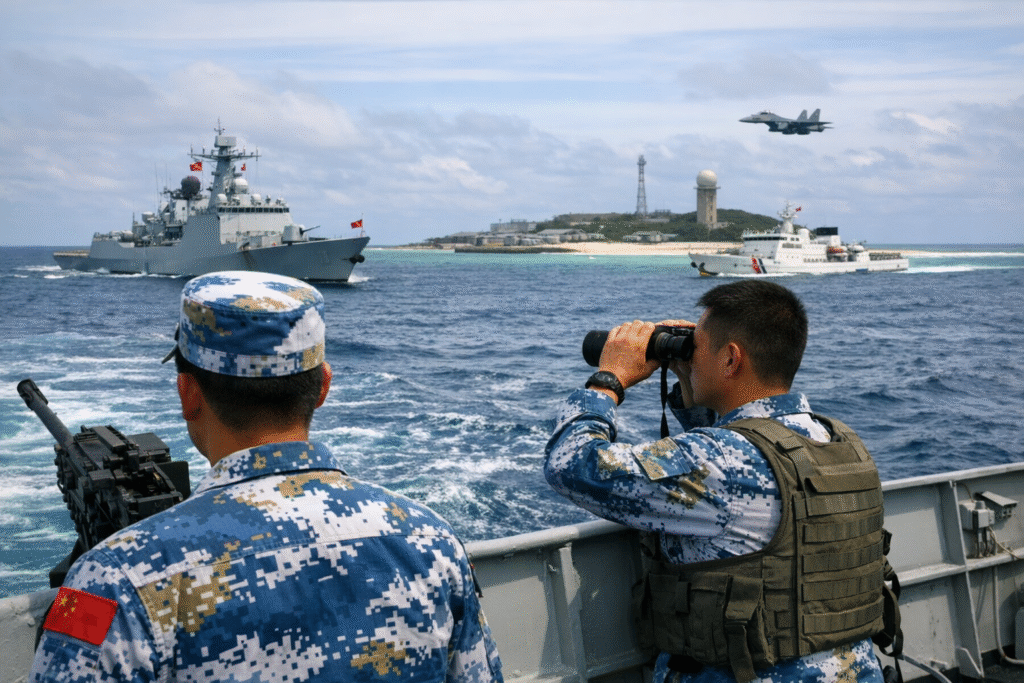
China is incrementally expanding its military footprint across the South China Sea, reinforcing concerns among regional governments and Western analysts about Beijing’s long-term strategic ambitions in one of the world’s most contested waterways. A report by The Wall Street Journal, titled “China Builds Up Military Presence in South China Sea,” details how recent construction and deployment efforts signal a shift from symbolic claims to more durable and operationally capable positions.
According to the Journal’s reporting, satellite imagery and regional intelligence assessments indicate upgrades to airstrips, radar systems, and port facilities across several artificial islands and disputed reefs. These enhancements appear designed not only to support routine patrols but also to sustain longer deployments of naval and air assets, potentially extending China’s reach far beyond its mainland coastline.
The developments are unfolding against a backdrop of heightened geopolitical tension. The South China Sea remains a critical artery for global trade, with trillions of dollars in goods passing through annually. Several Southeast Asian nations, including the Philippines and Vietnam, maintain overlapping territorial claims with Beijing. The growing militarization of disputed features has raised fears that China could more effectively enforce its claims, either through coercion or by establishing de facto control over key areas.
U.S. officials, while not directly involved in the territorial disputes, have repeatedly emphasized the importance of freedom of navigation in the region. The expansion described in the Journal’s article is likely to intensify scrutiny from Washington, which has conducted regular naval operations intended to challenge what it considers excessive maritime claims. Analysts warn that the risk of miscalculation increases as military assets from multiple countries operate in close proximity.
China, for its part, has consistently defended its actions as legitimate and necessary for national defense. Officials argue that the infrastructure improvements serve to protect sovereignty and ensure stability, rejecting accusations that they are intended to intimidate neighboring states. However, the scale and pace of construction outlined in the Journal’s reporting suggest a level of strategic planning that extends beyond defensive posturing.
Regional reactions have been cautious but increasingly vocal. Governments in Southeast Asia have sought to balance economic ties with China against concerns about security and autonomy. Some have quietly strengthened their own military capabilities or deepened cooperation with external partners, including the United States, Japan, and Australia.
The evolving situation underscores the difficulty of managing competing interests in a region where economic interdependence coexists with deep strategic mistrust. As highlighted in The Wall Street Journal’s coverage, China’s expanding presence is not a sudden shift but part of a gradual consolidation that could reshape the balance of power in maritime Asia for years to come.
The trajectory of these developments suggests that the South China Sea will remain a focal point of international tension, with implications extending well beyond the region.