Air Force Revokes 135 Promotions After Administrative Error, Raising Concerns Over Personnel System Integrity
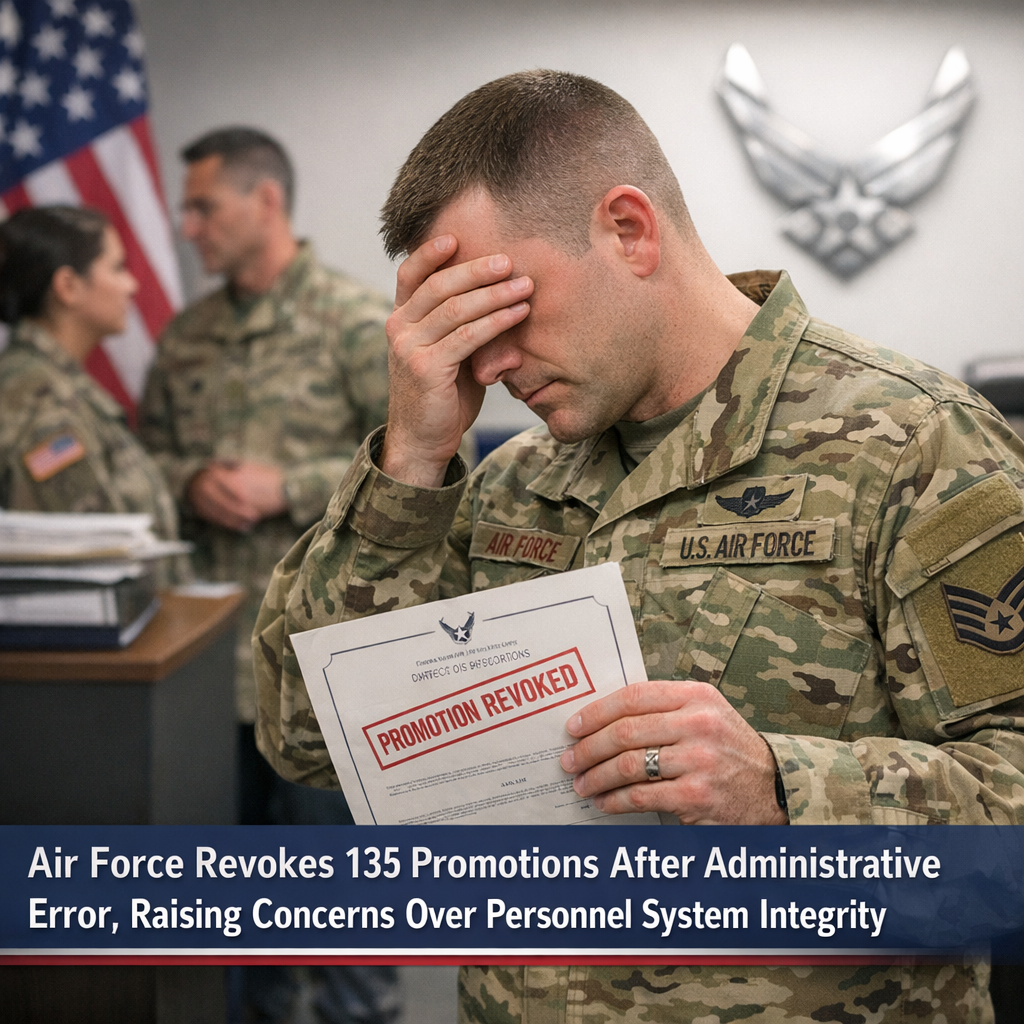
The Air Force has rescinded 135 previously announced promotions after identifying what officials described as an administrative error, an unusual reversal that has disrupted career trajectories and raised questions about internal personnel processes.
According to reporting by Military Times in its article “ ‘Hard for everyone’: Air Force rescinds 135 promotions after admin flub,” the affected service members had already been notified of their selection for advancement when the mistake came to light. The error, attributed to a miscalculation or administrative oversight in the promotion system, prompted the service to invalidate the results and initiate corrective measures.
Air Force officials acknowledged the impact of the decision, noting that revoking promotions is both rare and consequential. For many of the affected airmen, promotion carries not only increased responsibility and pay but also broader implications for long-term career progression. Losing that advancement, even temporarily, can alter assignment opportunities, leadership roles, and retirement timelines.
The service has not publicly detailed the precise nature of the error, but it indicated that the issue was significant enough to compromise the integrity of the selection process. Officials stated that maintaining fairness and accuracy required retracting the affected promotions rather than attempting partial fixes. Promotion systems within the service are governed by structured policies such as those outlined by the U.S. Air Force and broader personnel guidelines from the Department of Defense.
The development has drawn attention within the ranks, where promotion systems are closely scrutinized and often viewed as a reflection of institutional credibility. While administrative mistakes are not unheard of in large bureaucracies, the scale of this incident stands out. Military personnel systems rely heavily on standardized data inputs, evaluation records, and centralized review boards, processes similar to those described in official guidance on Air Force Personnel Center career management, making any breakdown particularly sensitive.
Air Force leadership has emphasized that steps are being taken to correct the problem and prevent recurrence. That includes reviewing procedures and verifying data used in promotion calculations. In the interim, the service faces the task of re-running selection processes or otherwise revalidating outcomes to ensure that future promotion announcements are accurate. Broader modernization efforts in military personnel systems have also been discussed in defense initiatives such as the Human Resources modernization efforts across federal agencies.
For those directly affected, however, the immediate concern is uncertainty. Some may be reconsidered in a corrected selection process, while others could ultimately lose the advancement altogether. The lack of clarity has added to frustration among airmen who had already begun preparing for new roles and responsibilities.
The episode also underscores broader challenges in managing personnel systems across a force as large and complex as the Air Force. Even as the military continues to modernize its administrative infrastructure, errors of this kind can have outsized effects, particularly when they intersect with career-defining milestones. Issues of trust and transparency in military promotions have been examined in defense oversight contexts such as reports from the Government Accountability Office.
As noted in the Military Times report, officials recognize that the situation is “hard for everyone,” reflecting both the personal toll on service members and the institutional stakes involved. How quickly and transparently the Air Force resolves the issue may shape perceptions of fairness and trust in the promotion system going forward.