Active-Duty Air Force Officer Arrested at Capitol Protest Sparks Debate Over Military Political Limits
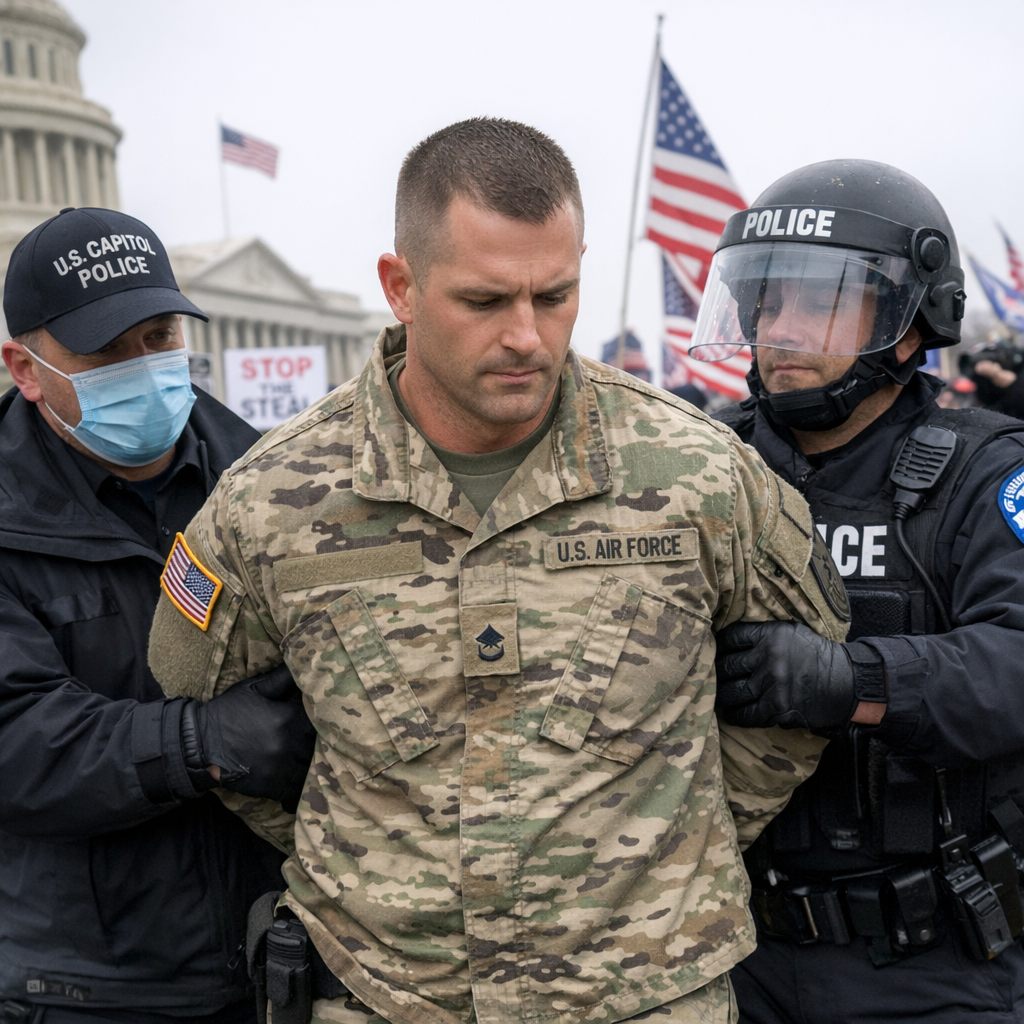
An active-duty U.S. Air Force officer was arrested on the steps of the U.S. Capitol during a protest calling for the impeachment of former President Donald Trump, an incident that has drawn renewed attention to the boundaries of political expression for military personnel.
The case was first reported in Military Times in an article titled “Air Force major arrested on Capitol steps during protest calling for Trump impeachment.” According to that report, the officer, identified as a major, was taken into custody by Capitol Police after participating in a demonstration that authorities said violated regulations governing protests on Capitol grounds. (original report)
Witness accounts and official statements indicate that the demonstration was part of a broader gathering of activists advocating for renewed impeachment proceedings against Trump, who remains a polarizing figure in U.S. national politics. The major reportedly stood among protesters displaying signs and chanting slogans, prompting a response by law enforcement tasked with enforcing restrictions on demonstrations in designated areas around the Capitol complex (Capitol Police demonstration rules).
Military officials confirmed that the individual is currently serving on active duty, a status that introduces additional legal and disciplinary considerations. Under Department of Defense policies on political activity, service members are permitted to hold personal political views but face strict limits on partisan political activity, particularly in public settings that could be perceived as undermining the military’s apolitical stance.
The Air Force has not publicly disclosed whether the officer was in uniform at the time of the arrest, a detail that could significantly affect the scope of potential consequences. Regulations prohibit service members from participating in partisan political activities while in uniform or in a manner that implies official endorsement by the military (Air Force guidance on political activities).
Legal experts note that even when off duty and out of uniform, military personnel can face repercussions if their conduct is deemed prejudicial to good order and discipline or discrediting to the armed forces. Depending on the findings of any internal review, the officer could face administrative measures, reprimand, or more serious disciplinary action under the Uniform Code of Military Justice.
Capitol Police stated that the arrest was made in accordance with standard procedures after individuals failed to comply with orders to disperse or relocate to authorized demonstration areas. Charges in such cases are typically misdemeanor offenses, such as unlawful demonstration or crowding, obstructing, or incommoding (40 U.S. Code § 5104).
The incident underscores the ongoing tension between individual rights and institutional expectations within the military. Service members retain constitutional protections, including freedom of speech, but those rights are balanced against the need to preserve the armed forces’ political neutrality and operational effectiveness.
In recent years, military leaders have repeatedly emphasized the importance of maintaining that neutrality, particularly in a highly polarized political environment. Guidance circulated by the Pentagon ahead of election cycles has reinforced that active-duty personnel must avoid activities that could be interpreted as partisan advocacy, especially in visible or public forums.
The Air Force said it is aware of the situation and is reviewing the matter, but declined to comment further pending the outcome of the investigation.
The episode is likely to renew debate within military and policy circles about how existing rules are applied and enforced, as well as how service members navigate their roles as both citizens and representatives of a nonpartisan institution.