Pentagon Eyes Low-Cost Mobile Tactics After Ukrainian Unit Hunts Down Shahed Drone
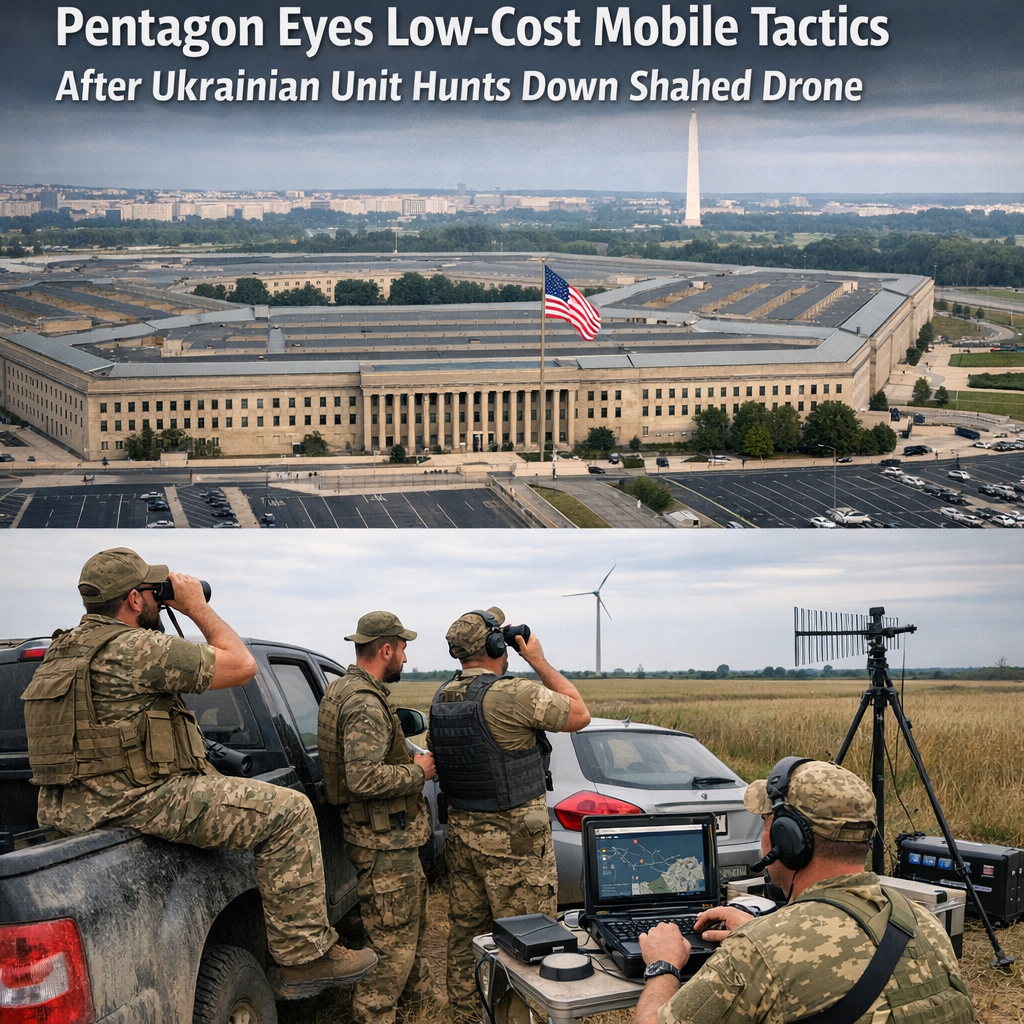
A recently circulated battlefield video has drawn renewed attention to the evolving nature of counter-drone warfare, highlighting a low-cost, highly mobile tactic that defense officials in Washington are now studying closely. The footage, described in Defense News’ report “Video shows a Ukrainian unit running down a Russian Shahed — the kind of kill the US is racing to reproduce”, shows a Ukrainian unit pursuing and destroying an incoming Shahed-type drone using a ground vehicle, rather than relying on traditional air defense systems.
The incident underscores a growing challenge for modern militaries: how to defeat relatively inexpensive, mass-produced unmanned aerial systems without expending costly missiles or overextending sophisticated air defense networks. Shahed drones, widely deployed by Russian forces in Ukraine, are designed to be both expendable and effective, forcing defenders into an unfavorable cost exchange when intercepted with high-end systems.
In the video, Ukrainian forces appear to use speed, coordination, and relatively simple weaponry to close the distance and neutralize the drone. While details about the exact platform and armaments remain limited, the approach reflects a broader shift toward improvised and mobile countermeasures on the battlefield. Instead of relying solely on layered air defense, units are increasingly experimenting with tactics that blend mobility, situational awareness, and direct engagement.
U.S. defense planners are paying close attention. As Defense News reports, the Pentagon is actively seeking ways to replicate such outcomes in a more systematic and scalable manner. The goal is to develop counter-drone solutions that are both cost-effective and adaptable, particularly for scenarios where adversaries deploy large numbers of drones simultaneously.
The issue has taken on urgency as American and allied forces prepare for potential conflicts in which drone swarms could overwhelm conventional defenses. Systems like the Shahed are relatively simple to produce and can be launched in large quantities, complicating interception efforts. This has prompted a surge of interest in alternative approaches, including electronic warfare and counter-drone systems research, directed energy weapons, and kinetic solutions that operate at lower cost.
The Ukrainian example illustrates the value of battlefield improvisation, but it also exposes the limitations of ad hoc tactics. While mobile teams can be effective under certain conditions, scaling such efforts across larger theaters or integrating them into formal military doctrine presents significant challenges. Factors such as coordination, training, and interoperability with existing systems all play a role in determining whether such tactics can move beyond isolated successes.
At the same time, the video highlights a broader trend: innovation in warfare is increasingly being driven from the field upward, rather than from centralized procurement programs. Ukrainian forces, operating under constant pressure and resource constraints, have repeatedly adapted commercial and military technologies in unexpected ways. Their experiences have become a valuable source of insight for Western militaries grappling with similar threats, as noted by analysis from organizations like the Center for Strategic and International Studies.
For the United States, the question is not simply how to reproduce a single tactic, but how to integrate its underlying principles into a comprehensive defense strategy. That includes balancing cost, effectiveness, and scalability while ensuring that new solutions can operate seamlessly alongside existing air and missile defense systems, such as those outlined by the U.S. Department of Defense.
As drone warfare continues to evolve, the lessons drawn from incidents like the one described by Defense News are likely to shape future procurement and doctrine. What was once considered an improvised battlefield response may soon inform a new generation of counter-drone capabilities, reflecting the changing economics and dynamics of modern conflict.