Portable Factories Redefine Battlefield Defense
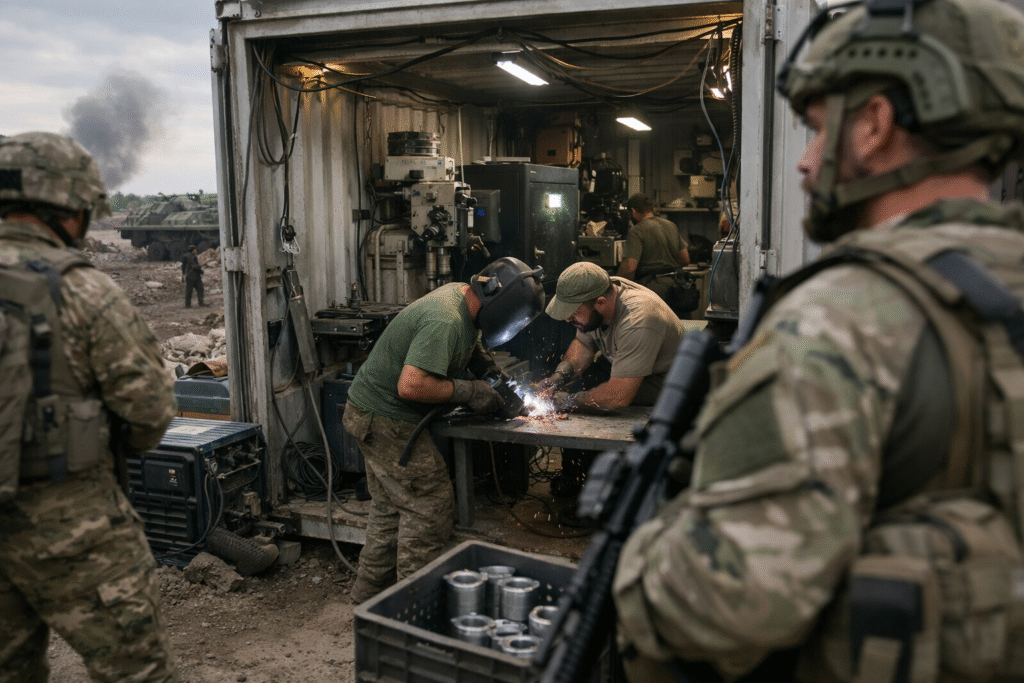
“Infrastructure is the weapon” is no longer a metaphor but an operational reality, according to a recent report by Military Times titled “Infrastructure is the weapon: Inside the race to build portable interceptor factories.” The article highlights a rapidly evolving defense priority: the ability to manufacture advanced missile interceptors close to the battlefield, rather than relying solely on distant, centralized production lines.
As modern conflicts increasingly emphasize speed, adaptability, and sustained supply, defense planners are reevaluating long-standing assumptions about logistics. The Military Times report describes how U.S. military and industry leaders are investing in modular, transportable production facilities that can be deployed near contested regions. These mobile factories are designed to produce critical components for air and missile defense systems, reducing dependence on vulnerable supply chains and long transit times.
The shift reflects lessons drawn from recent conflicts, where high demand for interceptors has strained existing manufacturing capacity. Traditional production models, often concentrated in a handful of fixed locations, have proven difficult to scale quickly under wartime conditions. By contrast, portable facilities promise to decentralize manufacturing, making it more resilient to disruption and better aligned with operational needs.
According to the Military Times piece, these factories are not fully self-contained in the traditional sense. Instead, they rely on a networked approach, combining pre-positioned equipment, digital design files, and specialized personnel who can assemble production capabilities on short notice. Advances in additive manufacturing and automated assembly are key enablers, allowing complex components to be fabricated with reduced infrastructure.
Defense officials quoted in the report suggest that the strategic value of such systems lies not only in production speed but also in deterrence. An adversary facing a force capable of rapidly replenishing its defensive systems may find it more difficult to achieve the kind of saturation attacks that have characterized recent missile engagements.
However, the concept is not without challenges. Establishing secure, reliable production in forward areas raises concerns about vulnerability to attack, cybersecurity risks, and the technical limits of portable manufacturing. The Military Times article notes that ensuring consistent quality control in dispersed environments remains a significant hurdle, particularly for highly sensitive interceptor technologies.
There are also broader industrial implications. Moving toward distributed production may require changes in defense contracting, workforce training, and supply chain management. Companies accustomed to centralized manufacturing will need to adapt to more flexible, modular approaches, while the Pentagon must balance innovation with the need for standardization and oversight.
Ultimately, as outlined in “Infrastructure is the weapon,” the push for portable interceptor factories represents a broader rethinking of how military power is generated and sustained. In an era where logistics can determine the outcome of conflict as much as firepower, the ability to build weapons where and when they are needed may become a defining feature of future warfare.