Trump Signals Talks and Threatens Energy Strikes
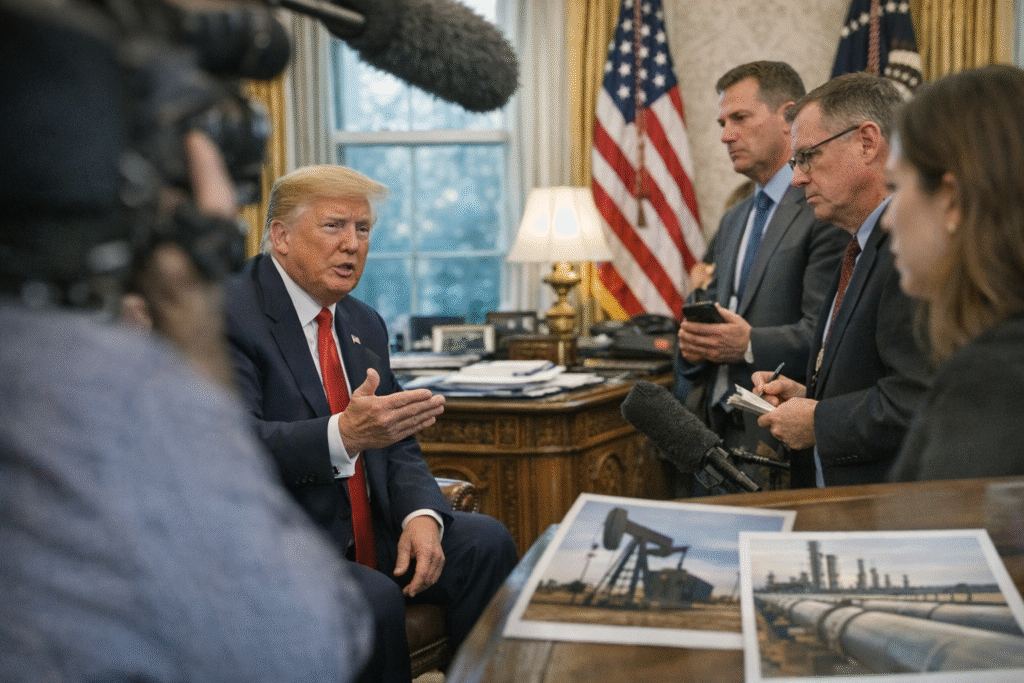
Former President Donald Trump said the United States is engaged in negotiations with what he described as a “new and more reasonable regime,” while also warning that failure to reach an agreement could lead to military strikes targeting energy infrastructure, according to a report by the Washington Free Beacon titled “U.S. Negotiating With ‘New and More Reasonable Regime,’ Trump Says, but Will Strike Energy Infrastructure Without a Deal.”
Speaking publicly about the talks, Trump characterized the current leadership involved in negotiations as more pragmatic than its predecessors, suggesting there may be an opening for a diplomatic breakthrough. At the same time, he underscored that any agreement must meet U.S. expectations, framing the negotiations as conditional and time-sensitive rather than open-ended.
The Washington Free Beacon reported that Trump paired his description of diplomatic progress with a stark warning: if negotiations fail to produce an acceptable deal, the United States would be prepared to escalate, including potential strikes on critical energy assets. Such remarks reflect a dual-track approach that combines engagement with explicit deterrence, a strategy that has been a hallmark of Trump’s foreign policy messaging.
The comments come amid broader tensions surrounding U.S. relations with adversarial states where energy infrastructure represents both an economic lifeline and a strategic vulnerability. Targeting such assets would mark a significant escalation, with potential global economic implications given the interconnected nature of energy markets.
Trump’s framing of the opposing leadership as “more reasonable” suggests an effort to signal openness to compromise while maintaining leverage through the threat of force. Analysts often view this combination of rhetoric as designed to pressure negotiating counterparts by raising the cost of noncompliance.
The Washington Free Beacon article highlights how Trump’s remarks align with his broader approach to international negotiations, which frequently emphasizes unpredictability and a willingness to use economic or military pressure to secure concessions. Critics, however, have argued that such rhetoric can heighten instability and risk miscalculation, especially in already volatile regions.
It remains unclear how close the parties are to a concrete agreement or whether the described shift toward a “more reasonable regime” reflects a substantive change in policy or a tactical adjustment in negotiations. What is evident is that the administration—or a potential future one under Trump—would seek to balance diplomacy with the credible threat of force, particularly in areas tied to strategic resources like energy.
As discussions continue, the prospect of escalation underscores the high stakes involved, with outcomes that could reverberate beyond bilateral relations and affect global energy security and geopolitical stability.