Tesla Semi Finds Early Fans Amid Industry Doubts
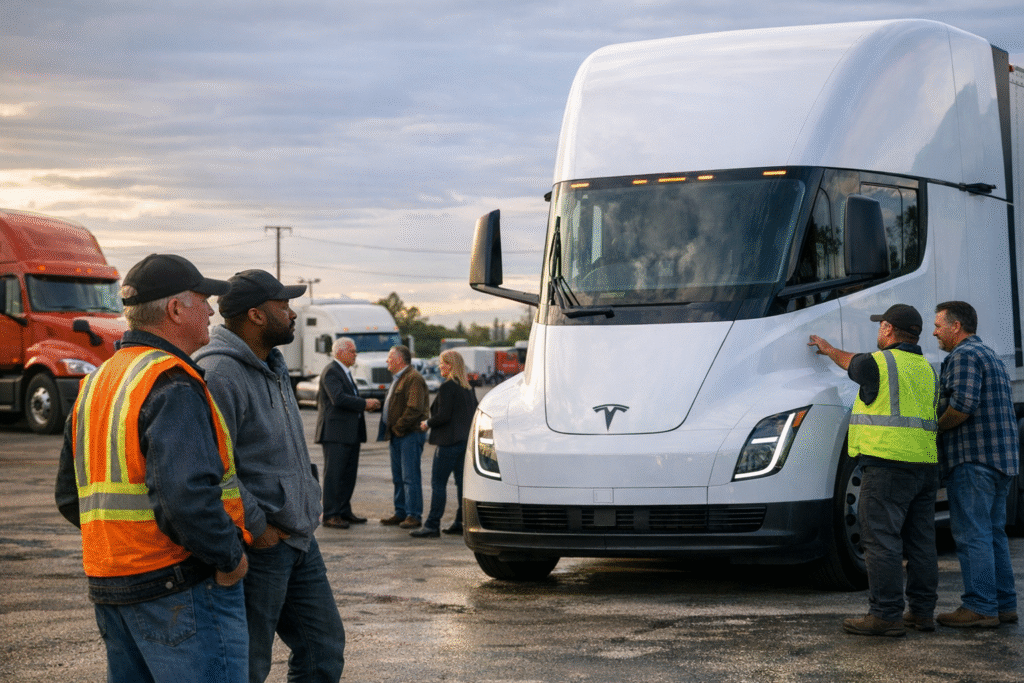
A niche but growing group of early adopters is embracing Tesla’s long-delayed Semi electric truck, drawn by the promise of lower operating costs and a cleaner image, even as broader industry skepticism persists about the vehicle’s scalability and infrastructure demands.
In “Truckers, Tesla Fans—and the Semi,” published by The Wall Street Journal, the company’s heavy-duty electric truck is depicted as both a technological experiment and a cultural symbol, attracting a mix of fleet operators, independent drivers, and Tesla enthusiasts eager to test its potential. The article highlights how these users are navigating the realities of range limitations, charging logistics, and high upfront costs while weighing them against potential savings on fuel and maintenance.
Tesla first unveiled the Semi in 2017, positioning it as a disruptive alternative to diesel-powered freight vehicles. Years of delays followed, with only a limited number of units delivered to select customers, including large corporations such as PepsiCo. Those companies have deployed the trucks on relatively short, predictable routes—conditions that better align with current battery performance and charging availability.
Drivers who have had the opportunity to operate the Semi report a markedly different experience compared with traditional trucks. The near-silent motor, rapid acceleration, and simplified controls are frequently cited as advantages. The central seating position and expansive visibility also contribute to a redesign of the driver’s workspace, one that aligns more with Tesla’s broader approach to vehicle ergonomics.
Yet the enthusiasm is tempered by structural challenges. Charging infrastructure remains one of the most significant barriers to widespread adoption. Unlike passenger vehicles, which can rely on an expanding network of fast chargers, heavy-duty trucks require high-capacity, specialized stations that are still scarce. The time required to recharge, combined with the operational demands of freight schedules, adds further complexity.
Cost is another sticking point. While Tesla has promoted long-term savings through reduced fuel and maintenance expenses, the upfront price of electric trucks can be prohibitive. Fleet operators must carefully calculate whether those long-term benefits justify the initial investment, particularly in a market where margins are often thin and equipment decisions carry significant financial risk.
The Wall Street Journal article also underscores the cultural dimension of the Semi’s early adoption. Some drivers are motivated not purely by economics but by a sense of participation in a technological shift. Tesla’s brand identity, which blends innovation with a degree of fan-driven loyalty, plays a role in shaping perception and willingness to experiment.
At the same time, traditional trucking stakeholders remain cautious. Concerns about battery degradation, payload trade-offs, and the durability of electric systems under heavy, continuous use persist. Industry analysts note that until production scales up and real-world data accumulates over longer periods, many companies will remain on the sidelines.
The Semi’s future will likely depend on a combination of factors beyond the vehicle itself, including regulatory incentives, advancements in battery technology, and the buildout of charging networks capable of supporting long-haul operations. For now, Tesla’s electric truck occupies a transitional space in the logistics sector—part proof of concept, part status symbol, and part test case for the electrification of freight.
As described in The Wall Street Journal’s reporting, the current moment reflects both optimism and uncertainty. Early adopters are helping define what the technology can achieve, but the broader industry continues to weigh whether those early results can translate into a scalable, reliable alternative to diesel-powered trucking.