Tiny Folding Helicopter Enables Iran Rescue
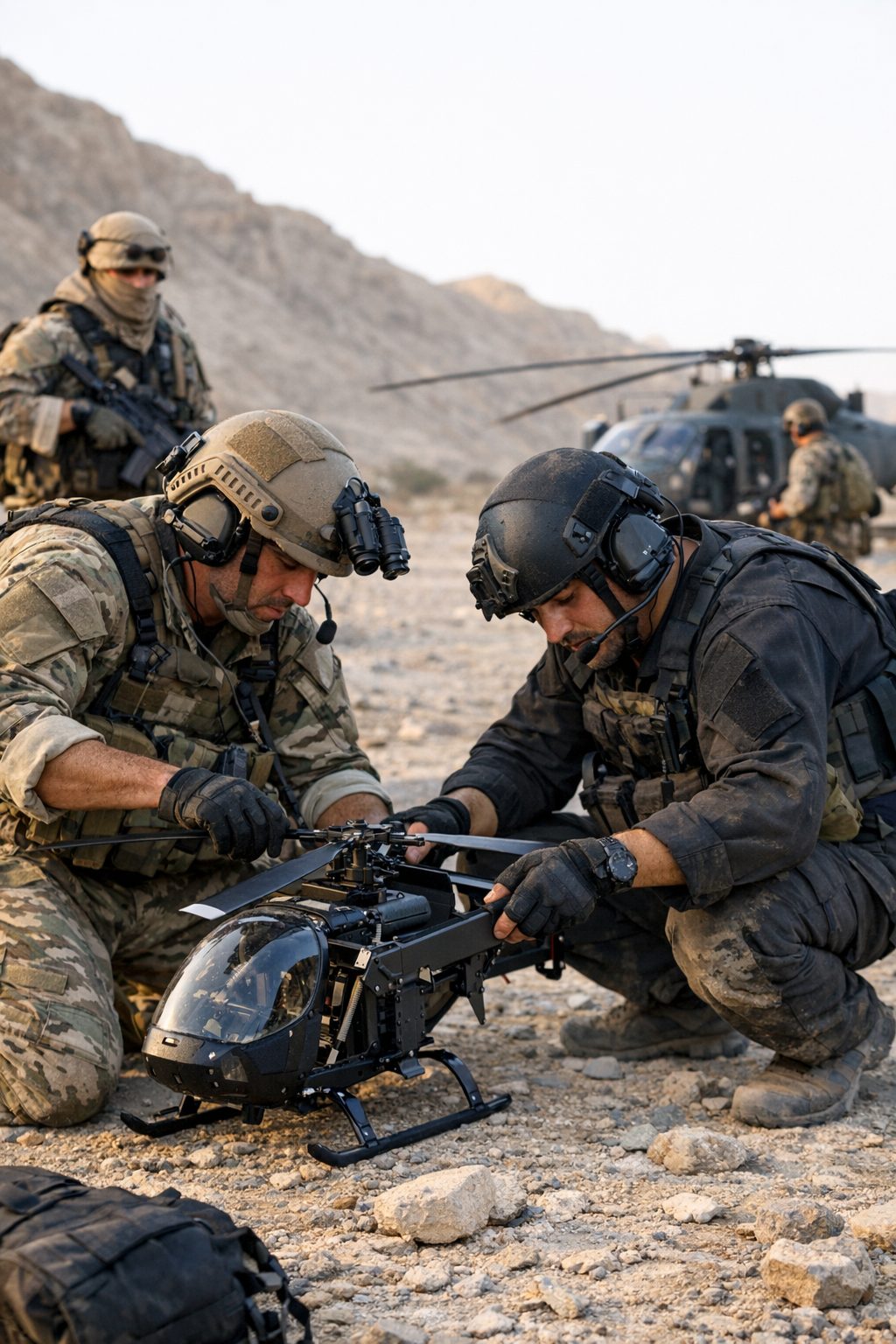
A compact, foldable helicopter long regarded as a niche innovation is now being reassessed as a critical tool in high-risk military rescue operations, following its reported role in extracting a U.S. aviator from Iran. The Wall Street Journal article titled “The Tiny Folding Helicopter Key to Rescuing the U.S. Aviator in Iran” details how this unconventional aircraft helped enable a mission where conventional options were limited or too dangerous.
Designed for portability and rapid deployment, the small helicopter can be transported in confined spaces and assembled quickly in the field. Its compact frame and reduced noise profile make it particularly suited for covert operations, especially in contested or heavily monitored environments. According to the Wall Street Journal, these attributes proved decisive in an operation requiring precision, speed, and minimal detection.
The aircraft’s engineering reflects a trade-off: limited payload and range in exchange for agility and operational flexibility. While it cannot replace standard military helicopters in most contexts, its utility emerges in scenarios where traditional air support is impractical or impossible. The reported rescue underscores how such specialized tools can fill critical gaps in military capability, particularly in politically sensitive regions like Iran, where overt operations carry significant geopolitical risks.
Defense analysts note that the use of this kind of aircraft points to a broader shift toward adaptable, mission-specific technologies. Rather than relying solely on large, multipurpose systems, modern military planning increasingly incorporates smaller platforms tailored for narrow but essential tasks. These systems can be deployed discreetly, require fewer logistical resources, and reduce the likelihood of escalation.
The Wall Street Journal’s account also highlights the strategic complexity of conducting operations inside adversarial territory. Even a successful extraction carries implications for international relations, signaling both capability and intent. At the same time, it demonstrates the extent to which technological innovation is reshaping the boundaries of what is operationally feasible.
In this case, the folding helicopter’s role appears to have been less about technological novelty and more about practicality under constraint. Its successful use suggests that future rescue missions—and potentially other clandestine operations—may increasingly rely on similarly compact, specialized aircraft designed for the most demanding conditions.