Pentagon Leaders Outline Strategy of Readiness
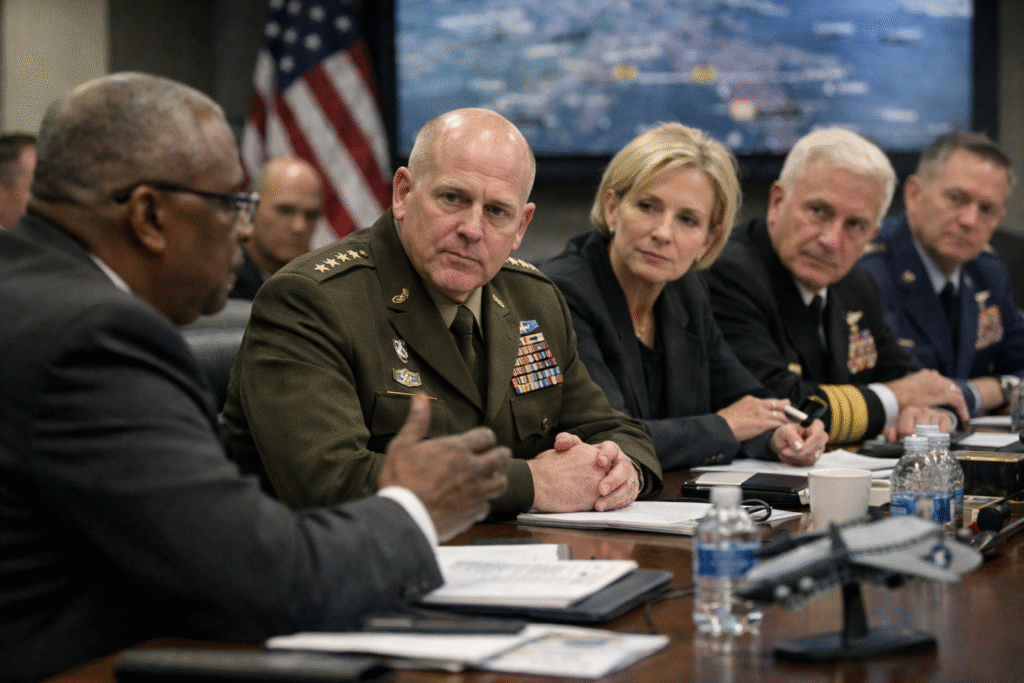
Remarks by U.S. Secretary of War Pete Hegseth and Chairman of the Joint Chiefs of Staff Gen. Dan, published by the official defense website war.gov under the title “Secretary of War Pete Hegseth and Chairman of the Joint Chiefs of Staff Gen. Dan,” offer a pointed snapshot of the administration’s current military posture, priorities, and strategic outlook.
Speaking before reporters, Hegseth emphasized a shift toward what he described as “decisive readiness,” underscoring the administration’s focus on strengthening force capabilities amid an increasingly volatile global environment. He framed the current moment as one requiring both rapid modernization and sustained deterrence, particularly in regions where U.S. interests face persistent challenges. His remarks suggested a continued prioritization of great-power competition, with particular attention to maintaining operational advantages in contested domains such as the Indo-Pacific.
Gen. Dan, appearing alongside the secretary, reinforced that message with a more operational emphasis. He pointed to ongoing efforts to integrate advanced technologies into military planning while ensuring that personnel remain prepared for high-intensity conflict. The chairman highlighted joint force coordination and interoperability with allies as central to maintaining strategic credibility, noting that multinational exercises and partnerships remain a cornerstone of U.S. defense planning.
Both officials addressed questions about resource allocation, signaling that budget decisions would continue to reflect a balance between immediate readiness needs and long-term investments. Hegseth indicated that modernization programs would proceed despite fiscal pressures, while Gen. Dan stressed that training and force preparedness could not be compromised.
The briefing also touched on the broader geopolitical context, with both leaders acknowledging a complex threat landscape that includes state adversaries and non-state actors. While neither offered specific operational details, their comments reflected a consistent message: the United States intends to maintain a forward-leaning defense posture backed by technological innovation and allied cooperation.
Overall, the exchange, as documented in the war.gov transcript, illustrates an administration intent on projecting strength while navigating competing demands on military resources. The emphasis on readiness, modernization, and alliance-building suggests a strategy aimed at deterring conflict while preparing for a range of contingencies in an uncertain global environment.