Marine Corps Reveals Medium Landing Ship Design
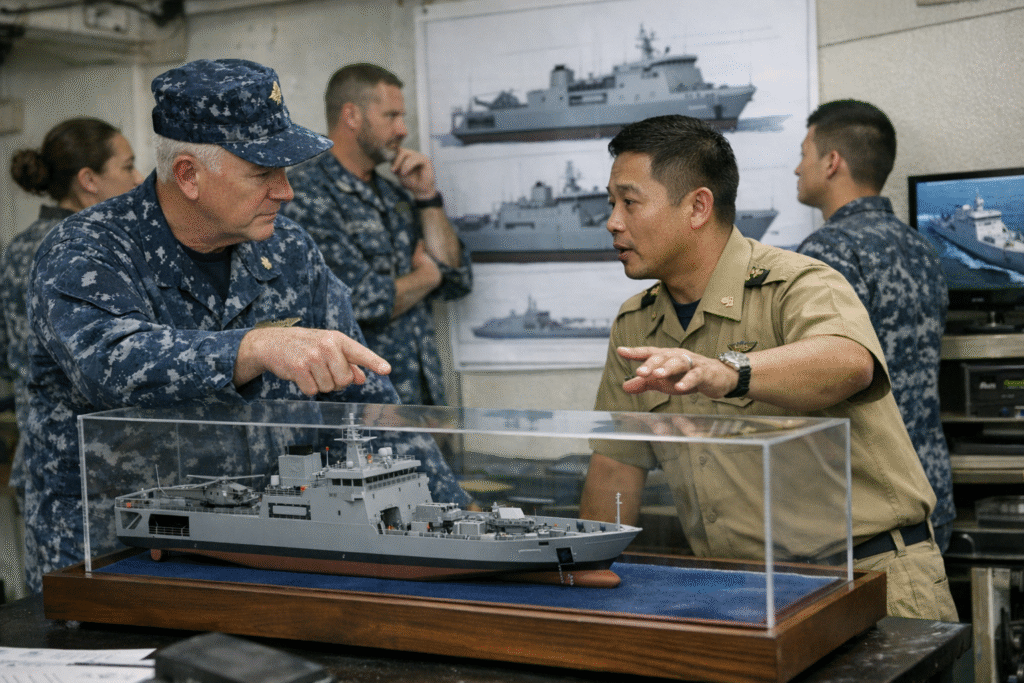
The U.S. Marine Corps has offered its most detailed public look yet at a key element of its future amphibious fleet, releasing a video that outlines the design and intended role of its planned Medium Landing Ship. The development, highlighted in the Military Times article titled “US Marine Corps releases video showcasing new medium landing ship design,” underscores the service’s ongoing effort to adapt its force structure to a more dispersed and maritime-focused operating concept.
The Medium Landing Ship, or LSM, is central to the Marine Corps’ Force Design 2030 initiative, which emphasizes smaller, more mobile units capable of operating across contested coastal regions. Unlike the Navy’s larger amphibious assault ships, the LSM is designed to be relatively simple, affordable, and numerous, enabling Marines to move personnel, equipment, and supplies between austere locations without relying on major ports.
According to details presented in the video, the vessel is expected to be capable of beaching itself to offload cargo and troops directly onto shore, a feature intended to support distributed operations across island chains and littoral environments. The ship’s projected capacity includes the ability to transport dozens of Marines along with vehicles and equipment, making it suitable for moving small units rapidly between expeditionary bases.
The design reflects a balance between survivability and cost. Marine Corps planners have emphasized that the LSM is not intended to operate as a high-end combatant but rather as a logistics and mobility platform that can function within a broader naval network. Its relatively modest size and draft are meant to enhance maneuverability in shallow waters while reducing its logistical footprint.
The service has consistently argued that a fleet of such vessels will be essential for maintaining operational flexibility in regions like the Indo-Pacific, where geography and potential adversary capabilities demand a more distributed approach. By enabling Marines to reposition frequently and unpredictably, the LSM is expected to complicate enemy targeting and enhance resilience.
However, the program has faced scrutiny over cost projections, acquisition timelines, and the challenge of aligning Navy shipbuilding priorities with Marine Corps requirements. Lawmakers and defense analysts have raised questions about whether sufficient funding and industrial capacity exist to deliver the number of ships envisioned within the desired timeframe.
The Marine Corps’ decision to release a visual representation of the ship’s design appears aimed in part at building understanding and support for the program. The video provides a clearer sense of how the vessels would operate in real-world scenarios, illustrating embarkation, transit, and shore operations in contested environments.
As the Pentagon continues to refine its approach to naval force structure, the Medium Landing Ship remains a focal point in the broader debate over how best to prepare for future maritime conflicts. The Marine Corps’ latest outreach effort signals both confidence in the concept and recognition that its success will depend on sustained institutional and political backing.