Europe’s Military Power Will Be Decided by Who Controls the Data
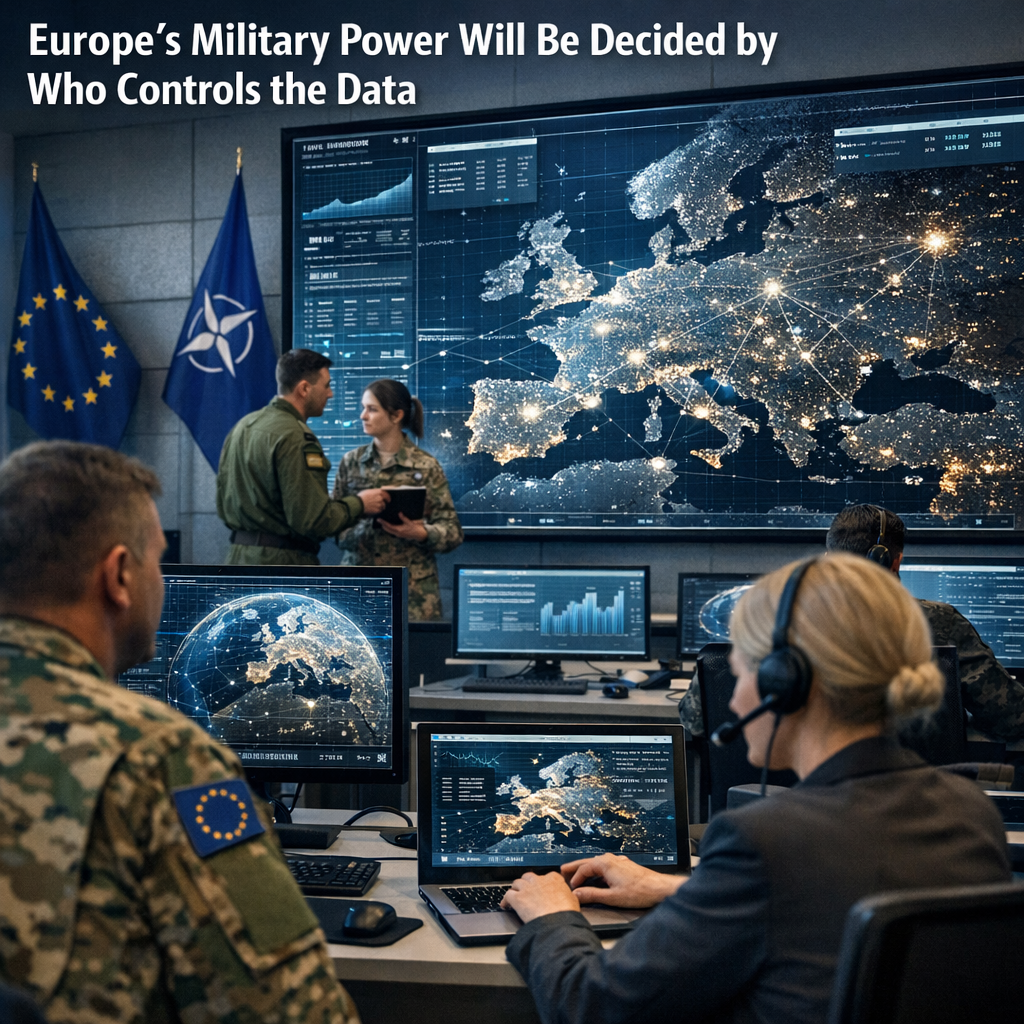
Europe’s ability to act as a credible military power will hinge less on the quantity of its forces than on its control over the data that informs them, according to an argument laid out in a recent Breaking Defense article titled “Europe’s military advantage depends on sovereign command of the ground truth.”
The analysis reflects a growing concern among defense planners that Europe’s reliance on external providers—particularly the United States—for intelligence, surveillance, reconnaissance, and data processing infrastructure could undermine its strategic autonomy at a moment of heightened geopolitical instability. As the war in Ukraine continues to demonstrate the centrality of real-time information to battlefield effectiveness, as seen in reporting from the Center for Strategic and International Studies, questions about who owns, processes, and distributes that information have taken on new urgency.
At the core of the issue is what defense officials increasingly refer to as the “ground truth”: the fused, verified, and continuously updated data picture that enables commanders to make decisions. This includes satellite imagery, signals intelligence, drone feeds, and battlefield analytics, all integrated through digital architectures. The Breaking Defense article argues that without sovereign control over these systems, European militaries risk being dependent not only on foreign hardware but on external decision-making pipelines.
Such dependence, the article suggests, could constrain Europe’s operational flexibility in scenarios where U.S. priorities diverge from European interests. Even when political alignment is strong, reliance on non-European platforms can introduce vulnerabilities related to access, latency, and data governance, issues also highlighted in broader discussions of EU data sovereignty policy. In high-intensity conflict, delays or restrictions in data sharing could translate directly into operational disadvantage.
The debate comes as European governments increase defense spending and invest in next-generation capabilities, including space-based sensors, artificial intelligence, and networked command systems. However, the Breaking Defense piece cautions that procurement alone will not address the underlying issue if systems remain tied to non-sovereign data ecosystems. True autonomy, it argues, requires not just European-made hardware but European-controlled data architectures, standards, and cloud infrastructure.
This challenge is compounded by the fragmented nature of Europe’s defense landscape. National armed forces often operate with incompatible systems and varying levels of technological maturity, making integration difficult. Efforts such as the European Union’s defense cooperation initiatives and NATO’s digital transformation programs are beginning to address interoperability, but progress remains uneven.
The article also highlights the role of commercial technology providers, many of them based in the United States, in shaping modern military data environments. While these companies offer advanced capabilities, their involvement raises additional questions about jurisdiction, data sovereignty, and long-term strategic dependence, themes explored in analyses by the Carnegie Endowment for International Peace. European policymakers are increasingly weighing how to balance the benefits of commercial innovation with the need for independent control.
Ultimately, the argument presented in Breaking Defense frames data sovereignty not as an abstract principle but as a practical requirement for military effectiveness. In an era where wars are fought as much through information dominance as through firepower, control over the “ground truth” may determine not only how Europe fights, but whether it can act decisively on its own.
The trajectory of Europe’s defense policy suggests growing recognition of this reality. Whether that recognition translates into coordinated investment and structural reform will likely shape the continent’s military posture for decades to come.