Space Force Prepares Orbital Tag Showdown to Test Agile Combat Tactics in Space
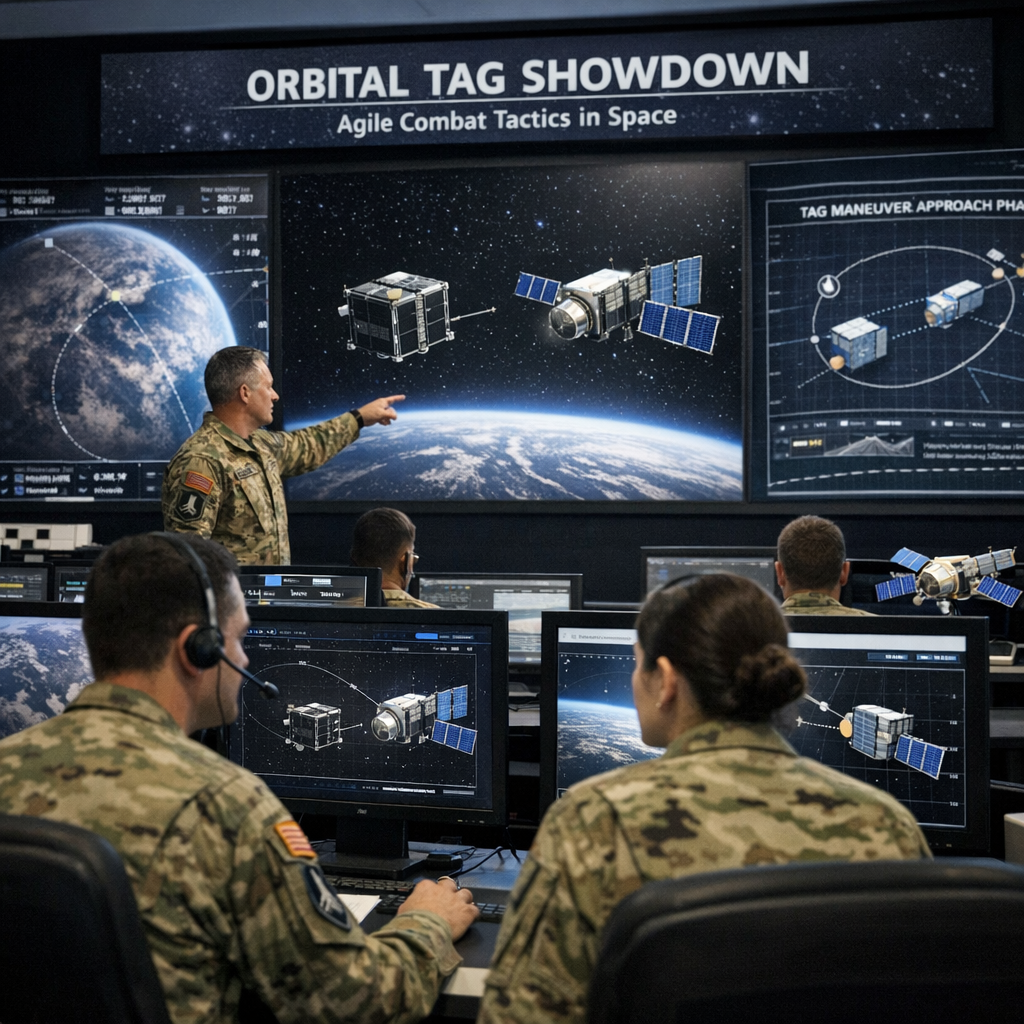
A forthcoming U.S. Space Force experiment will pit two maneuverable spacecraft against one another in orbit, offering a rare real-time demonstration of tactical space operations that military planners say could reshape how conflicts extend beyond Earth. The initiative, known as Victus Haze, centers on a “space tag” scenario involving two vehicles—Jackal and Puma—designed to maneuver dynamically in response to each other.
According to reporting by Breaking Defense in the article “Space ‘tag’: Jackal, Puma spacecraft to chase each other in Victus Haze demo,” the exercise is intended to simulate responsive space tactics under operational timelines far shorter than traditional satellite missions. The program reflects a broader shift within the U.S. Space Force toward agile, tactically relevant space capabilities that can adapt to rapidly evolving threats.
The Jackal spacecraft, developed by True Anomaly, will act as the pursuing vehicle, while Puma, built by Rocket Lab, will serve as the evader. The two are expected to conduct a series of maneuvers that test guidance, autonomy, and command-and-control under conditions that mirror contested orbital environments. Officials view such demonstrations as essential for understanding how spacecraft might operate in proximity to potentially hostile systems in the future.
Unlike conventional satellite missions, which often take years to plan and execute, Victus Haze emphasizes speed. The Space Force has increasingly prioritized tactically responsive space initiatives that compress timelines from concept to launch, enabling rapid deployment of capabilities when needed. This approach builds on earlier efforts such as the Victus Nox mission, which sought to demonstrate rapid launch readiness.
The “tag” concept serves as a proxy for more complex on-orbit interactions, including inspection, deterrence, or defensive maneuvers. While the Pentagon has not framed the exercise as a direct response to specific adversaries, military officials have repeatedly warned that competitors are developing technologies capable of maneuvering close to U.S. satellites, potentially threatening critical infrastructure.
By staging a controlled, transparent demonstration, the Space Force also appears to be signaling both capability and intent. Analysts say this kind of visibility can serve as a form of strategic communication, showing that the United States is preparing for a future in which space is a more dynamic and contested domain.
At the same time, the program raises questions about norms of behavior in orbit. As maneuverability increases, so does the risk of miscalculation, particularly if other nations interpret such activities as aggressive. U.S. officials have emphasized the importance of responsible conduct, but the line between defensive readiness and provocation remains a subject of debate.
From a technological standpoint, Victus Haze is expected to push the boundaries of autonomous operations. Both spacecraft will rely heavily on onboard systems to make near-real-time decisions, reducing dependence on ground control. This autonomy is seen as critical in scenarios where communication delays or disruptions could limit human intervention.
The outcome of the mission could influence future procurement and doctrine. If successful, it may accelerate investment in maneuverable satellites and responsive launch capabilities, reinforcing a shift away from large, static systems toward more flexible architectures.
As the Space Force continues to refine its approach to orbital operations, Victus Haze represents a tangible step toward translating strategy into practice. The demonstration underscores a growing recognition that space is no longer a purely passive environment, but one in which agility, speed, and situational awareness are becoming central to national security.