Emerging Low-Cost Threats Challenge the Security of US Ballistic Missile Submarines
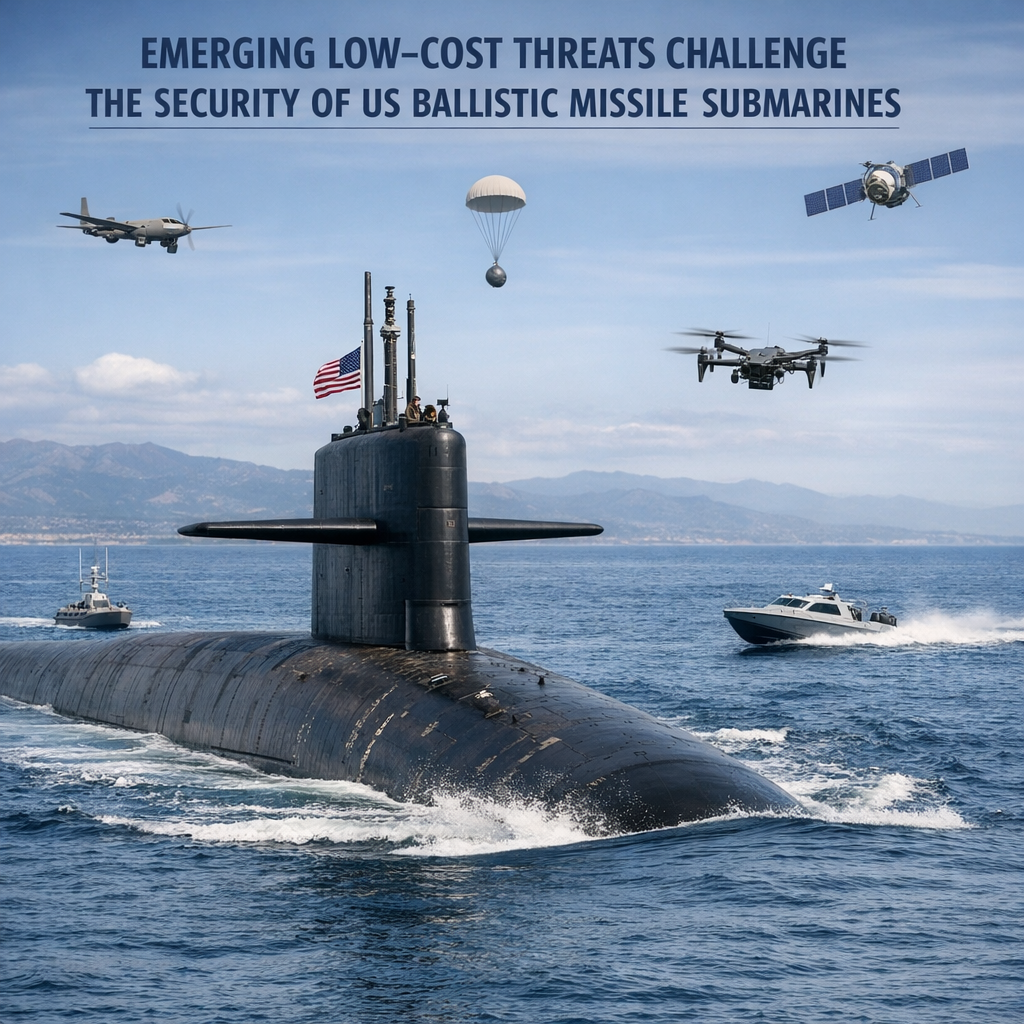
A recent report highlighting emerging vulnerabilities in U.S. naval assets has raised concerns among defense officials about the survivability of ballistic missile submarines in an evolving threat environment. The issue was examined in the Defense News article “US Navy fears ballistic missile subs can be hit by drones, anti-tank rockets,” which outlines how relatively low-cost, widely available technologies could challenge some of the military’s most critical strategic platforms.
Ballistic missile submarines, often described as the most survivable leg of the United States’ nuclear triad, are designed to remain undetected beneath the ocean’s surface for extended periods. Their stealth and mobility have long been considered key to maintaining credible nuclear deterrence. However, according to the Defense News report, Navy officials are increasingly concerned about the narrow windows of vulnerability that arise when these submarines surface or operate near ports, where they may be exposed to unconventional attack methods.
The article points to the growing accessibility and sophistication of commercial and military-grade drones, as well as shoulder-fired anti-tank weapons, as factors reshaping threat calculations. These systems, once limited in capability or confined to state actors, are now more widespread and adaptable. In the hands of non-state groups or adversaries employing asymmetric tactics, they could potentially be used to target submarines during critical moments such as transit, resupply, or maintenance operations.
Defense analysts cited in the Defense News piece suggest that while submarines are unlikely to be struck while submerged, the risk profile changes significantly when they are on the surface or operating in constrained environments. Drones could provide reconnaissance, track movement, or even deliver explosive payloads, while anti-tank rockets—such as those discussed in analyses of modern anti-armor weapons—might pose a threat to exposed sections of a submarine hull above the waterline.
The concern reflects a broader shift in military planning, where high-value platforms must now contend with relatively inexpensive systems that can be deployed quickly and unpredictably. The proliferation of unmanned systems, highlighted in reports from organizations like the International Institute for Strategic Studies, has introduced new layers of complexity to force protection. What was once a domain dominated by advanced state militaries has become increasingly accessible, lowering the barrier for potential attacks.
In response, the U.S. Navy is reportedly examining ways to bolster security around its submarine fleet, particularly in littoral zones and port facilities. This could include enhanced surveillance, counter-drone defenses, and revised operational procedures aimed at minimizing exposure during vulnerable periods. Physical hardening measures and expanded perimeter defenses may also be considered as part of a layered protection strategy.
The issue underscores a recurring challenge in modern defense: balancing the enduring value of strategic platforms with the need to adapt to rapidly evolving, often asymmetric threats. While ballistic missile submarines remain a cornerstone of U.S. deterrence policy, ensuring their security in an age of proliferating drone and missile technologies is becoming an increasingly complex task.
As the Defense News article makes clear, the concern is not that these submarines have suddenly become obsolete, but that adversaries are finding new ways to exploit moments of vulnerability. Addressing those risks will likely require a combination of technological innovation, tactical adaptation, and renewed attention to the security of assets once considered nearly invulnerable.