Pentagon Centralizes Drone Authority in Major Shakeup of Military Power Structure
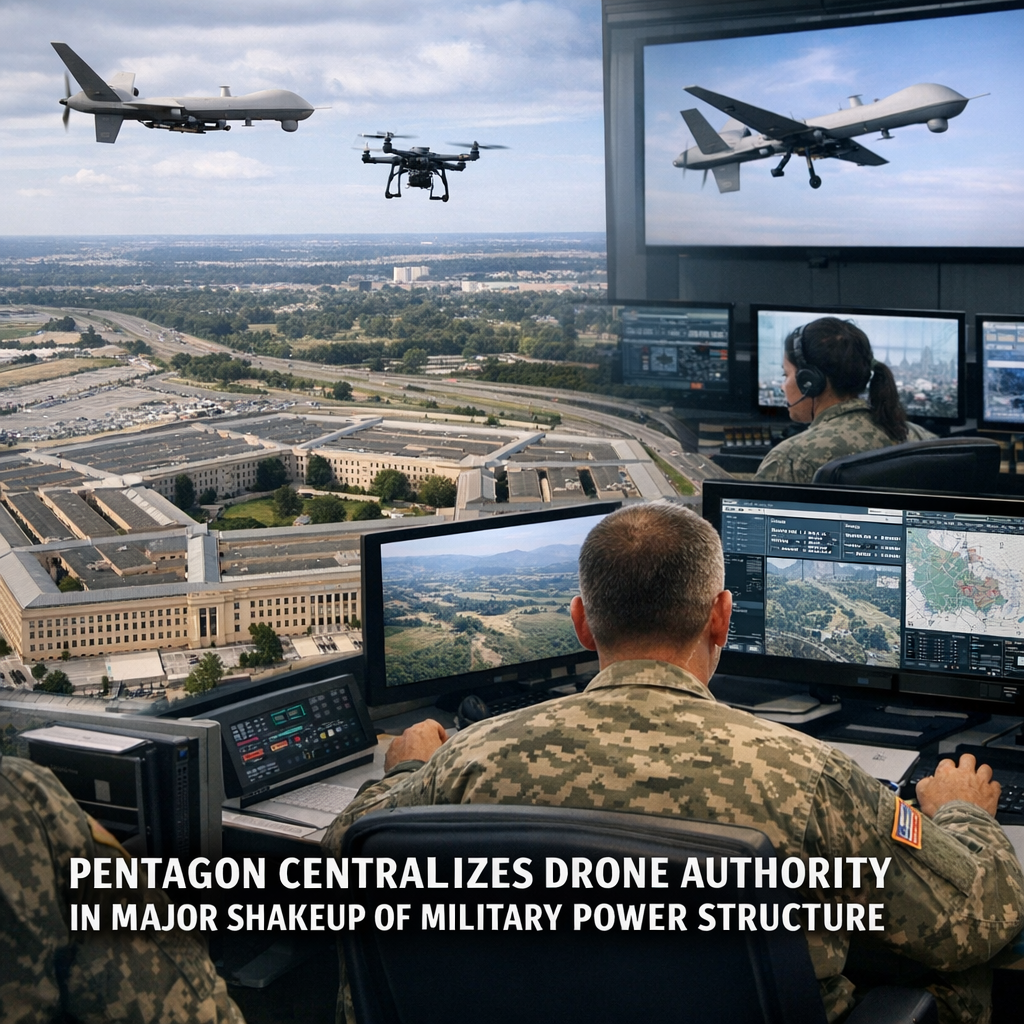
A senior Pentagon initiative to consolidate unmanned systems oversight is reshaping internal power dynamics, signaling a shift in how the U.S. military develops and deploys drone technology.
According to the Defense News report, “Hegseth creates powerful new drone office, pulling authority from the military services,” the move establishes a centralized office with broad authority over drone policy, procurement, and integration. The decision reflects growing urgency within the Department of Defense to streamline capabilities that have become essential across modern warfare but are often fragmented among the military branches.
The newly formed office will assume responsibilities that were previously dispersed across the Army, Navy, Air Force, and Marine Corps. By pulling those authorities into a single hub, Pentagon leaders aim to accelerate decision-making and reduce redundancy in acquisition programs. Officials believe that centralization will also improve the interoperability of drone systems, a longstanding challenge highlighted in reviews by the Government Accountability Office as each service has developed its own platforms and operational concepts.
Defense News reports that the initiative is being driven at a senior level, underscoring the strategic importance of unmanned systems in future conflicts. Drones have played a defining role in recent battles, particularly in Ukraine, where rapid innovation cycles and mass deployment—documented by outlets like Reuters—have demonstrated both their effectiveness and the risks of falling behind in technological adaptation.
The restructuring effort is expected to give the new office significant influence over budget priorities. By consolidating procurement authority, the Pentagon can more directly steer investment toward systems that align with broader joint-force objectives. This may come at the expense of service-specific programs that previously operated with greater autonomy.
While proponents argue that the change will foster efficiency and innovation, the shift is not without tension. Military services have traditionally guarded their acquisition authorities closely, viewing them as critical to maintaining operational independence and tailoring capabilities to specific missions. The reallocation of those responsibilities could prompt friction as implementation unfolds.
Supporters of the move contend that such resistance reflects institutional inertia rather than strategic necessity. They emphasize that emerging threats, including the proliferation of inexpensive autonomous systems and adversaries’ increasing reliance on drones, require a more unified approach. Analysis from organizations like CSIS has underscored the need for integrated drone strategies to counter rapidly evolving threats. Central oversight, they argue, is essential to keeping pace with new technologies and ensuring that U.S. forces maintain a competitive edge.
The creation of the office also raises questions about how innovation will be managed across the defense ecosystem. Industry partners, which have been instrumental in advancing drone capabilities, may face a more coordinated but potentially more centralized set of requirements. Some analysts see this as an opportunity to reduce duplication and align development efforts more closely with Pentagon priorities, while others caution that excessive centralization could slow experimentation.
As the Defense News article highlights, the broader context for the change is a Pentagon increasingly focused on preparing for high-end conflict against technologically sophisticated adversaries. In that environment, unmanned systems are not merely support tools but central elements of battlefield strategy, as reflected in the Pentagon’s official statements on unmanned systems.
Whether the new office succeeds will likely depend on its ability to balance standardization with flexibility. The challenge will be maintaining the speed of innovation that has characterized drone development while imposing the kind of discipline and coordination that large-scale military operations require.
The Pentagon’s decision marks a significant institutional shift, one that reflects both the promise and complexity of integrating unmanned systems into the future of warfare.