Lightweight Warfare Tools Redefine Small Unit Operations at SOF Week
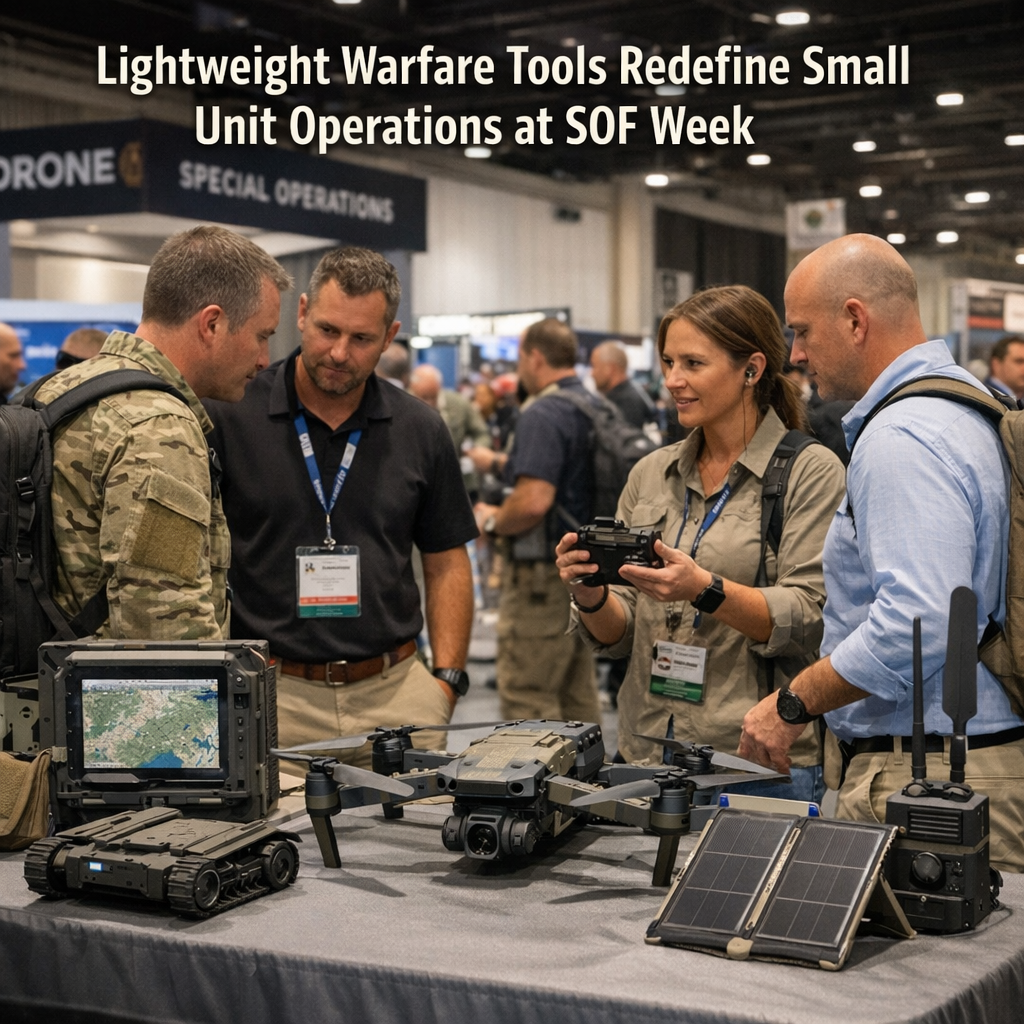
At this year’s Special Operations Forces (SOF) Week, emerging battlefield technologies underscored a growing shift toward lightweight, adaptable tools designed for small-unit operations. Among the innovations highlighted were foam-based drones and a throwable 360-degree tactical camera, developments that signal how militaries are prioritizing portability and rapid situational awareness in complex environments.
According to the Defense News video report “Foam drones and a throwable 360-degree tactical camera: SOF Week tech”, these systems exemplify a broader trend toward equipment that reduces logistical burden while enhancing operational flexibility. This aligns with wider developments in unmanned systems and modern warfare. Unlike traditional unmanned aerial systems that can be heavier, more rigid, and costly to replace, the foam drones showcased at the event are designed to be durable yet expendable. Their lightweight construction allows operators to deploy them quickly in confined or austere environments, where ease of transport and rapid launch can determine mission success.
The choice of foam as a primary material also reflects a practical calculation. Foam-bodied drones are more resilient to impact and can be repaired or replaced with minimal effort, lowering the cost-per-mission. This mirrors trends in scalable small UAS development. This makes them particularly attractive for special operations forces, which often operate far from supply lines and require equipment that can withstand unpredictable conditions without significant maintenance overhead.
Equally noteworthy is the development of a throwable 360-degree tactical camera, similar in concept to systems like throwable reconnaissance cameras, intended to provide immediate visibility inside enclosed or high-risk spaces before personnel enter. The device can be tossed into a room, where it captures a full panoramic view, transmitting real-time imagery back to operators. This capability addresses a longstanding challenge in urban and close-quarters operations: the need to rapidly assess unknown threats without exposing troops to direct danger, a key concern in urban warfare environments.
The integration of such systems reflects a continuing evolution in how special operations units approach reconnaissance and surveillance. Rather than relying solely on larger platforms or centralized intelligence assets, there is a clear movement toward distributing sensing capabilities down to the smallest tactical elements. This decentralization aligns with broader concepts in multi-domain operations, allowing teams to gather and act on information more quickly, reducing dependence on external support and enhancing autonomy in the field.
The technologies also point to an increasing emphasis on minimizing risk to personnel. By enabling forces to observe and assess environments remotely, whether through a drone overhead or a camera inside a structure, these tools can significantly reduce the likelihood of ambush or surprise contact. At the same time, their simplicity and portability ensure they can be used in a wide range of scenarios, from urban combat to reconnaissance in rugged terrain.
While still evolving, these systems illustrate how innovation in materials and design is reshaping modern military capabilities. As highlighted by Defense News, the focus is not solely on high-end, complex platforms but also on practical, scalable solutions that can be deployed quickly and widely. In an era where operational agility is increasingly critical, such technologies are likely to play an expanding role in shaping the tactics and effectiveness of elite forces.