Thales Enhances Guided Rocket with LiDAR to Counter Fast-Moving Drone Threats
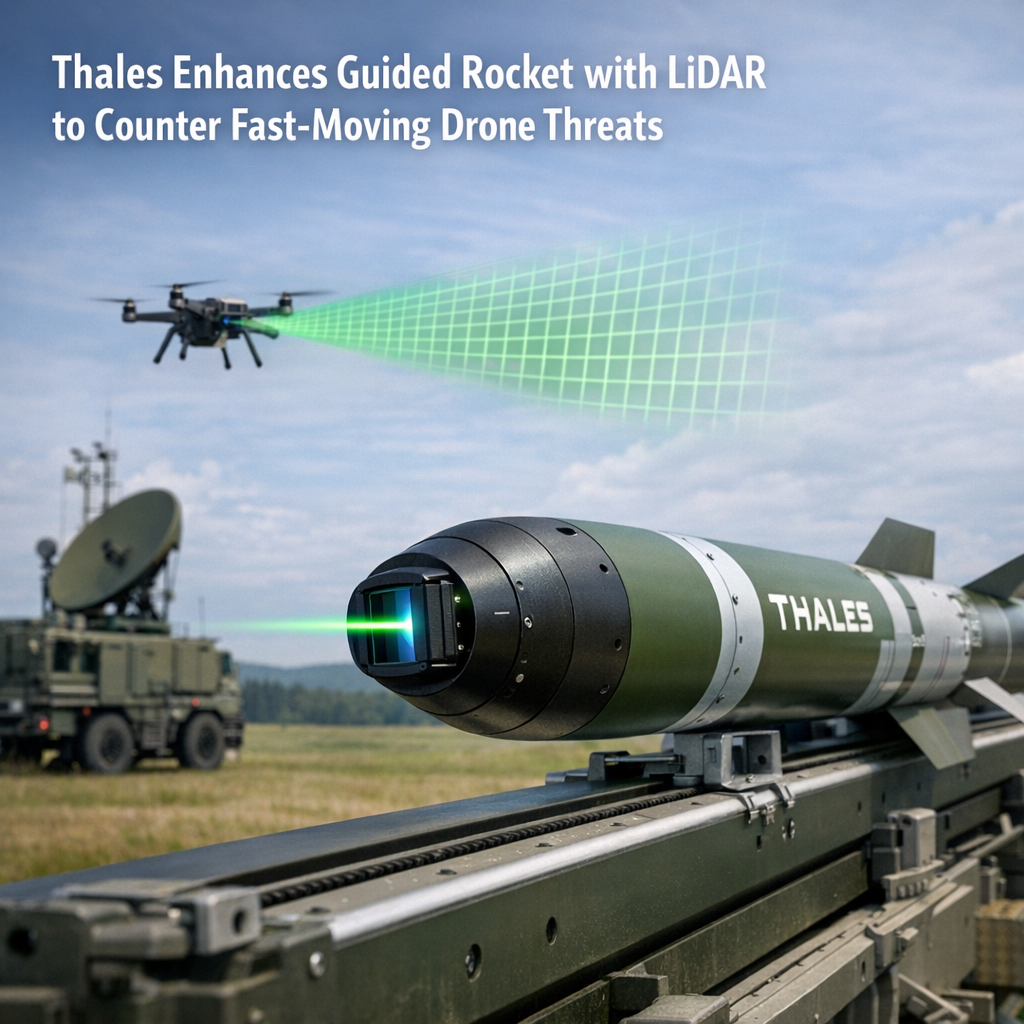
Thales has unveiled an upgraded version of its laser-guided rocket designed to improve effectiveness against small, fast-moving aerial threats, incorporating a new LiDAR sensor to enhance targeting precision, according to a report by Breaking Defense.
The article, “Thales upgrades its laser-guided rocket with new LiDAR sensor to target drones,” published by Breaking Defense, details how the French defense company is adapting its weapon systems to counter the growing challenge posed by unmanned aerial systems on modern battlefields. The addition of LiDAR technology marks a notable evolution in the guidance architecture of the rocket, enabling improved detection and tracking of low-signature targets that have proven difficult for traditional guidance solutions.
LiDAR, which uses laser pulses to measure distances and generate detailed spatial data, is explained in detail by NASA and is expected to give the rocket a sharper ability to distinguish drones from background clutter. This capability is particularly valuable in contested environments where small drones can evade radar or blend into complex terrain. By integrating LiDAR with existing laser guidance, Thales aims to create a multi-sensor approach that increases reliability against evasive or low-visibility targets.
The development reflects a broader shift within defense industries as militaries worldwide seek layered, cost-effective counter-drone solutions, a trend highlighted by NATO’s analysis on countering drone threats. Small drones have become a defining feature of recent conflicts, used for reconnaissance, targeting, and even direct attacks. Traditional air defense systems, often described by organizations like RAND Corporation, can struggle to respond efficiently to the speed, scale, and relatively low cost of drone swarms.
Thales’ upgraded rocket appears positioned to fill a niche between expensive missile interceptors and less precise gun-based systems. By enhancing an existing guided rocket rather than developing an entirely new platform, the company is also signaling a focus on scalability and affordability—key factors in sustaining prolonged operations against large numbers of aerial targets.
According to Breaking Defense, the integration of LiDAR is part of a broader effort to modernize legacy munitions with advanced sensors and processing capabilities, a concept aligned with modular upgrade strategies discussed by Thales Group. This trend mirrors wider industry moves toward modular upgrades, where improvements in sensing and software can extend the operational relevance of existing weapons.
The announcement comes as European defense firms face increasing pressure to respond to evolving threat environments shaped by rapid technological change. Investments in counter-drone capabilities have accelerated across NATO countries, with particular emphasis on systems capable of operating in degraded or contested electromagnetic environments where GPS or traditional targeting methods may be unreliable, an issue explored by CSIS.
While specific performance data for the upgraded rocket has not been publicly disclosed, the addition of LiDAR suggests a focus on close-range engagement where high-resolution sensing can offer decisive advantages. Analysts note that combining multiple guidance modalities could also improve resilience against countermeasures, a growing concern as adversaries adopt electronic warfare tactics to disrupt precision weapons.
Thales has not detailed when the upgraded system will be deployed, but the development underscores how incremental technological enhancements are reshaping the effectiveness of established weapon platforms. As drone proliferation continues, such upgrades are likely to become a central feature of defense procurement strategies across allied forces.