US and China Carriers Maneuver in Philippine Sea
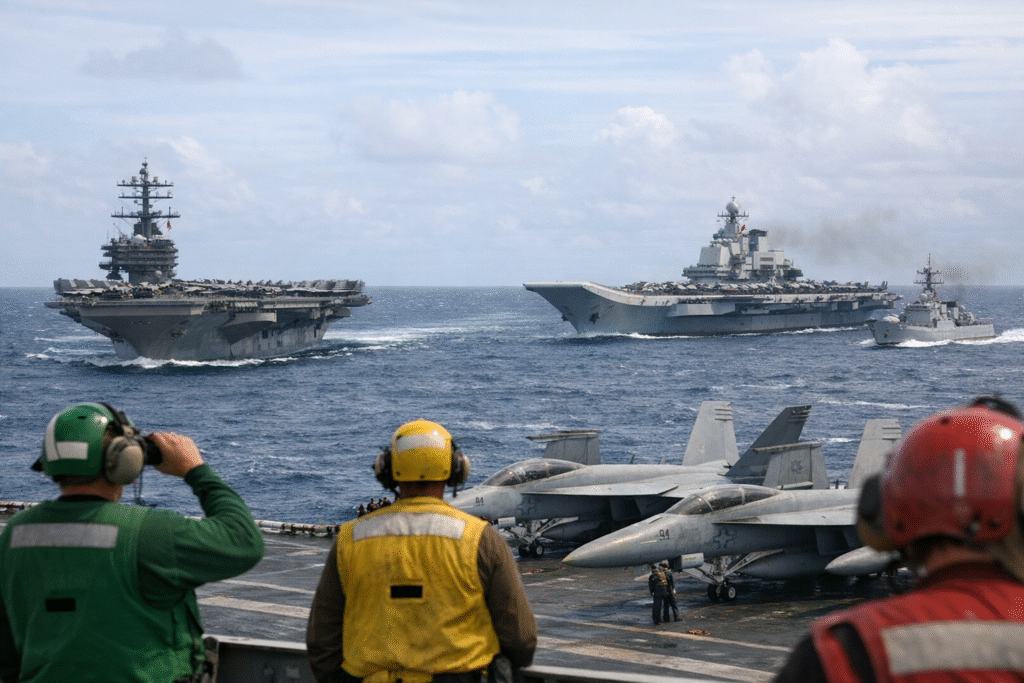
U.S. and Chinese naval movements in the Western Pacific have drawn renewed scrutiny as both countries position key assets in and around the Philippine Sea, underscoring persistent strategic competition in the region.
According to a report titled “Chinese Carrier Liaoning Near Philippines, USS George Washington Leaves Yokosuka Ahead of Spring Patrol,” published by the U.S. Naval Institute News, China’s aircraft carrier Liaoning has been operating in waters east of the Philippines, while the U.S. Navy’s forward-deployed carrier USS George Washington recently departed its homeport in Yokosuka, Japan, signaling the start of a new patrol cycle.
The Liaoning’s presence near the Philippines marks another instance of China projecting carrier power beyond its immediate coastal waters. While the vessel is not China’s most advanced carrier, its deployments are closely watched as indicators of Beijing’s growing naval proficiency and its ability to sustain operations at greater distances. The Philippine Sea, a strategic corridor connecting the South China Sea to the broader Pacific, has increasingly become a focal point for these activities.
U.S. Navy officials have not framed the George Washington’s departure as a direct response to the Liaoning’s movements, but the timing highlights the continuous nature of U.S. carrier operations in the Indo-Pacific. Based in Yokosuka, the George Washington serves as the centerpiece of America’s forward-deployed naval presence, providing rapid-response capability and reinforcing security commitments to regional allies.
The concurrent activity reflects a broader pattern rather than a singular episode. Both navies routinely operate in the region, but their overlapping deployments add to an already complex security environment marked by competing territorial claims, military modernization, and expanding alliances.
China has steadily increased the frequency and scope of its naval deployments over the past decade, including longer-range carrier operations and more intricate exercises involving escort vessels and support ships. Analysts view these deployments as part of a broader effort to normalize Chinese naval presence far from its shores and to refine operational readiness for potential contingencies.
For the United States, maintaining a visible and persistent carrier presence in the Western Pacific remains central to its strategy of deterrence and reassurance. The George Washington’s patrol is expected to include joint exercises with allies and partners, reinforcing interoperability and demonstrating continued U.S. commitment to freedom of navigation in international waters.
Regional countries are watching closely. The Philippines, in particular, has deepened defense cooperation with the United States in recent years amid ongoing tensions with Beijing in the South China Sea. The proximity of a Chinese carrier to Philippine waters, even if in international space, is likely to reinforce concerns about China’s expanding military reach.
While such movements are not unusual in isolation, their simultaneity reflects the increasingly routine nature of great-power naval activity in the Indo-Pacific. The result is a maritime environment defined less by sporadic encounters and more by sustained, parallel operations—an evolution that is reshaping both the strategic landscape and the assumptions that govern it.