Army Expands AV LASSO Loitering Munition Race
The U.S. Army has expanded its competition to develop next-generation loitering munitions, awarding an additional prototyping contract under its Autonomous Vehicle-Launched Suspended Sensor (AV LASSO) program, according to reporting by Breaking Defense in its article “Army awards AV LASSO award, joining Textron, UVision in prototyping competition.”
The newly selected entrant joins Textron Systems and UVision USA, both of which were previously tapped to develop competing designs for the Army’s emerging capability. The AV LASSO effort seeks to field a system capable of launching loitering munitions from ground vehicles, offering units a way to identify and strike targets at extended ranges without relying on traditional indirect fire or close air support.
By adding another participant to the prototyping phase, the Army is signaling a continued commitment to competitive development as it refines operational requirements for this class of weapon. The service has increasingly emphasized modular, scalable systems that can be integrated onto a variety of platforms, particularly as it looks to enhance lethality and responsiveness in dispersed, high-intensity combat environments.
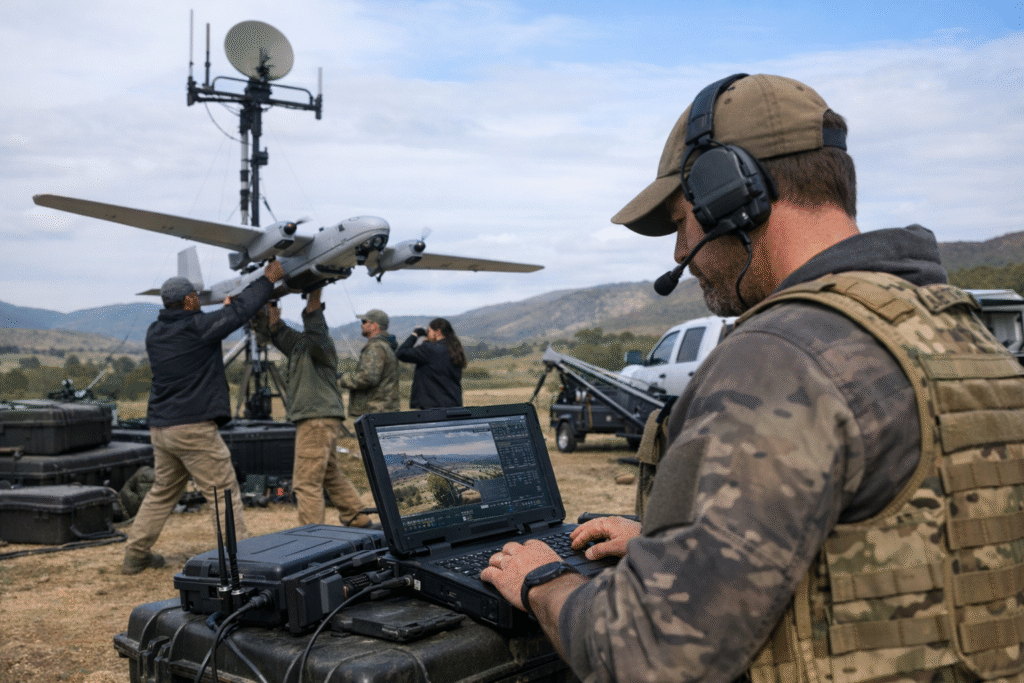
The AV LASSO concept centers on providing maneuver units with organic precision-strike capability. Loitering munitions — often described as a hybrid between missiles and drones — can be launched, surveil an area for a period of time, and then strike a target once identified. The Army’s variant is expected to be vehicle-launched and capable of rapid deployment, enabling faster engagement cycles and reducing dependence on higher-echelon assets.
Textron and UVision bring established experience to the competition. Textron has worked on multiple unmanned and precision-guided systems, while UVision is known for its Hero family of loitering munitions, some of which are already in service with U.S. and allied forces. The addition of a third competitor broadens the design space and may accelerate innovation as the Army evaluates different technical approaches.
According to the Breaking Defense report, the prototyping phase will allow the Army to assess performance, integration challenges, and operational suitability before making a down-selection decision. Key considerations are likely to include range, endurance, payload flexibility, launch mechanisms, and ease of integration with existing vehicle platforms and command-and-control networks.
The effort comes as the Pentagon places growing emphasis on unmanned systems and precision fires, shaped in part by lessons observed in recent conflicts where loitering munitions have played a prominent role. The Army has been working to expand its portfolio of such capabilities across echelons, from soldier-portable systems to larger, vehicle-launched platforms.
While timelines for a final selection have not been detailed publicly, the prototyping competition marks a significant step toward operationalizing AV LASSO. The Army’s decision to expand the field suggests an intent to hedge technical risk and ensure it captures the most effective solution as it seeks to equip units with more agile and autonomous strike options.