Artemis II Signals U.S. Strength in Space Race
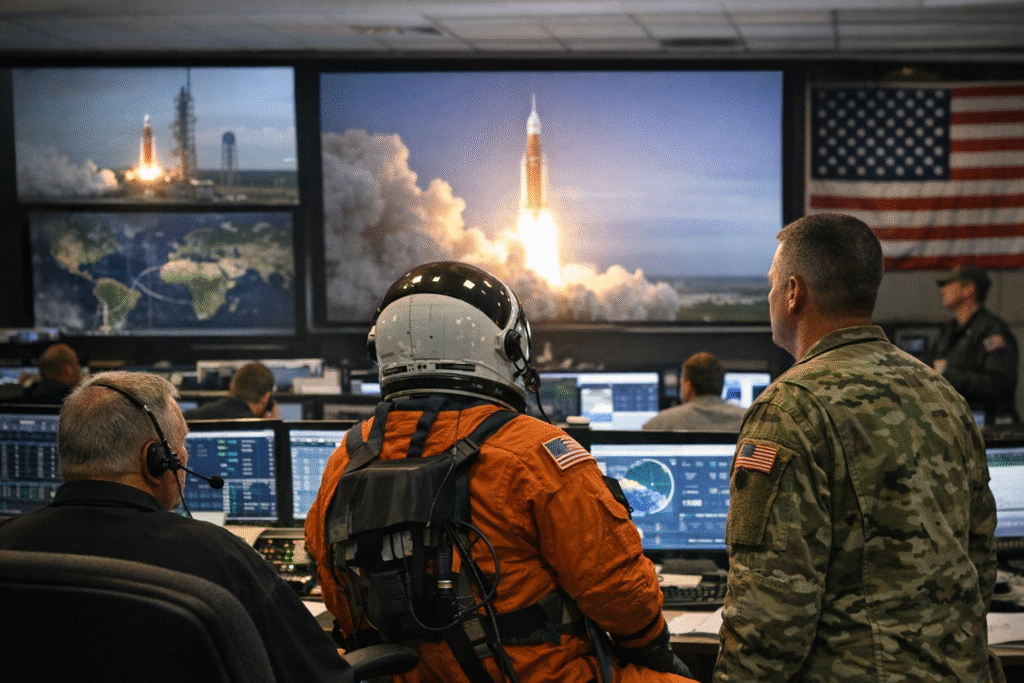
The Wall Street Journal’s opinion video segment “Artemis II Is ‘Very Good News’,” published on the Journal’s website, frames NASA’s next lunar mission as a pivotal moment not only for U.S. space exploration but also for broader geopolitical and technological competition. The assessment reflects a growing view among policymakers and analysts that Artemis II represents more than a symbolic return to the Moon; it is a strategic marker of national capability.
Artemis II, scheduled to carry astronauts on a crewed flight around the Moon, is expected to be the first such mission since the Apollo era. The Journal’s editorial discussion emphasizes that the mission demonstrates renewed operational momentum after years of delays, cost overruns, and shifting political priorities that have complicated NASA’s human spaceflight programs. The ability to execute a complex deep-space mission, even one that stops short of a lunar landing, signals that the United States remains capable of leading in crewed exploration beyond low Earth orbit.
Commentators in the segment also tie the mission’s significance to intensifying global competition, particularly with China’s advancing lunar program. Beijing has outlined its own ambitions for a crewed Moon landing within the next decade, alongside plans for a joint lunar research station with international partners. In that context, Artemis II is presented as a demonstration of not just engineering progress, but also of alliance-building. NASA’s Artemis program includes substantial contributions from international partners and private industry, reinforcing a model of cooperation that contrasts with more centralized approaches elsewhere.
The segment underscores the role of commercial partnerships in enabling the Artemis program. Companies such as SpaceX and others are integral to the development of lunar landers and supporting technologies. This public-private framework, while not without risk, has already proven capable of accelerating innovation and reducing costs in certain areas of spaceflight. The Journal’s editorial perspective suggests that Artemis II will further validate this approach if successful.
At the same time, the discussion acknowledges persistent challenges. NASA continues to operate under tight budget constraints relative to the scale of its ambitions, and skepticism remains about whether timelines for subsequent missions, including a crewed lunar landing under Artemis III, can be met. Technical hurdles, including life support systems for deep-space missions and the reliability of new spacecraft components, remain under close scrutiny.
Nevertheless, the tone of the Wall Street Journal’s analysis is cautiously optimistic. Artemis II is characterized as a tangible step forward at a time when long-term projects often struggle to maintain public and political support. By putting astronauts on a trajectory around the Moon, the mission could serve to re-energize interest in space exploration and provide a clear demonstration of progress after years of incremental development.
More broadly, the mission is seen as part of a larger narrative about American leadership in science and technology. Success would not only lay the groundwork for sustained human presence on and around the Moon but also strengthen the United States’ position in shaping the regulatory and cooperative frameworks that may govern future activity in space.
In that sense, Artemis II carries symbolic and strategic weight well beyond its immediate objectives. As highlighted in the Wall Street Journal’s “Artemis II Is ‘Very Good News’,” the mission stands at the intersection of exploration, national policy, and international competition, making its outcome consequential for the next phase of human spaceflight.