Ukraine Expands Defense Ties to UAE and Qatar
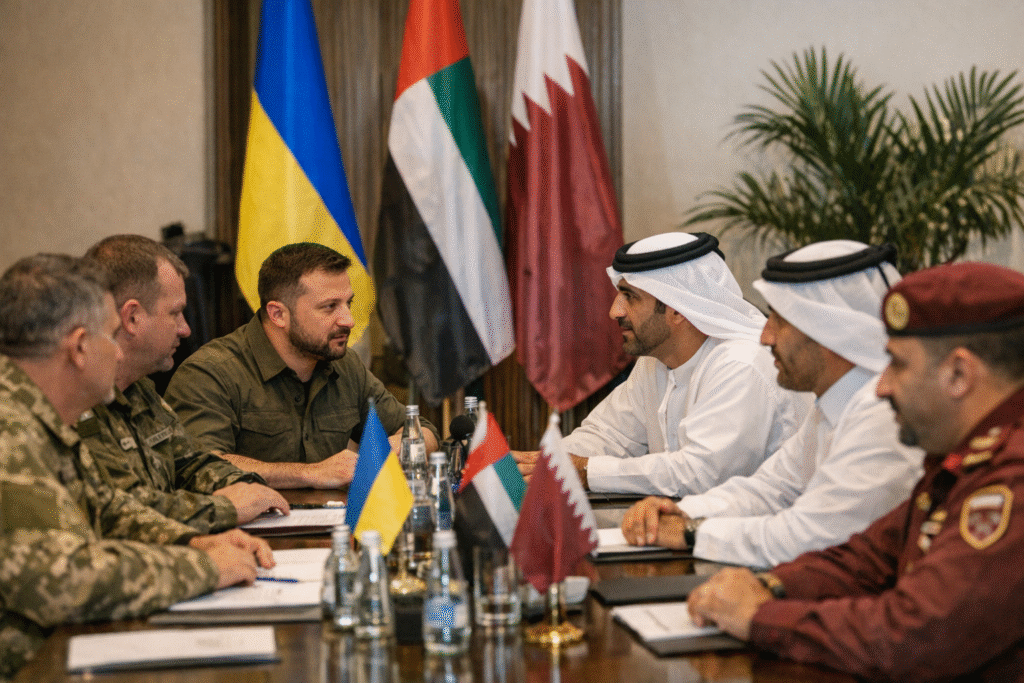
Ukraine is expanding its network of defense partnerships beyond its traditional Western backers, with President Volodymyr Zelenskyy reaching new cooperation agreements with the United Arab Emirates and Qatar. The development, reported in the Defense News article titled Ukraine’s Zelenskyy agrees to defense cooperation with UAE, Qatar, reflects Kyiv’s effort to diversify military and industrial support as the war with Russia continues into a protracted phase.
According to Defense News, the agreements center on strengthening defense-industrial collaboration, with a particular emphasis on joint production, technology exchange, and long-term investment in Ukraine’s domestic defense sector. While specific project details remain limited, the partnerships are expected to encompass areas such as weapons manufacturing, maintenance, and potentially emerging technologies tied to modern warfare.
The outreach to Gulf states marks a notable evolution in Ukraine’s diplomatic and defense strategy. Since Russia’s full-scale invasion in 2022, Kyiv has relied heavily on military aid from the United States and European allies. However, Ukrainian officials have increasingly sought to broaden support geographically, both to reduce dependency on any single bloc and to secure more sustainable industrial backing.
The involvement of the UAE and Qatar carries both financial and strategic significance. Both countries possess substantial sovereign wealth resources and have invested heavily in advanced technologies, including defense and aerospace sectors. Their participation could provide Ukraine with access to capital and technical capabilities that complement Western-supplied weapons systems, particularly as Kyiv looks to build up its own production capacity.
For the Gulf states, cooperation with Ukraine aligns with a broader pattern of expanding their geopolitical engagement. Both the UAE and Qatar have sought to position themselves as flexible partners capable of engaging with a wide range of actors, from Western governments to emerging and conflict-affected states. Defense collaboration with Ukraine may also offer opportunities to gain operational insights from a high-intensity conflict that has reshaped modern combat doctrines, particularly in areas such as drone warfare, electronic warfare, and battlefield integration.
At the same time, the agreements may carry diplomatic sensitivities. Gulf countries have historically maintained balanced relations with major global powers, including Russia. Deepening defense ties with Ukraine could require careful calibration to avoid disrupting those relationships, especially as energy markets and regional security concerns remain intertwined with Moscow’s global role.
For Ukraine, the partnerships underscore an urgent priority: sustaining and expanding defense production amid ongoing uncertainty about the pace and scale of Western assistance. Ukrainian officials have repeatedly emphasized the need to localize production of critical systems, from ammunition to drones, to ensure resilience against supply disruptions.
The Defense News report suggests that these agreements are unlikely to deliver immediate battlefield effects but could have significant long-term implications. By embedding cooperation with well-resourced international partners, Ukraine is attempting to transition from a recipient of aid into a more self-sufficient defense producer with global linkages.
As the war grinds on, such efforts highlight a broader shift in Kyiv’s strategy—one that blends immediate military necessity with longer-term industrial and diplomatic positioning. The success of these agreements will depend not only on political will but also on the practical challenges of executing complex joint projects in a country still under active attack.