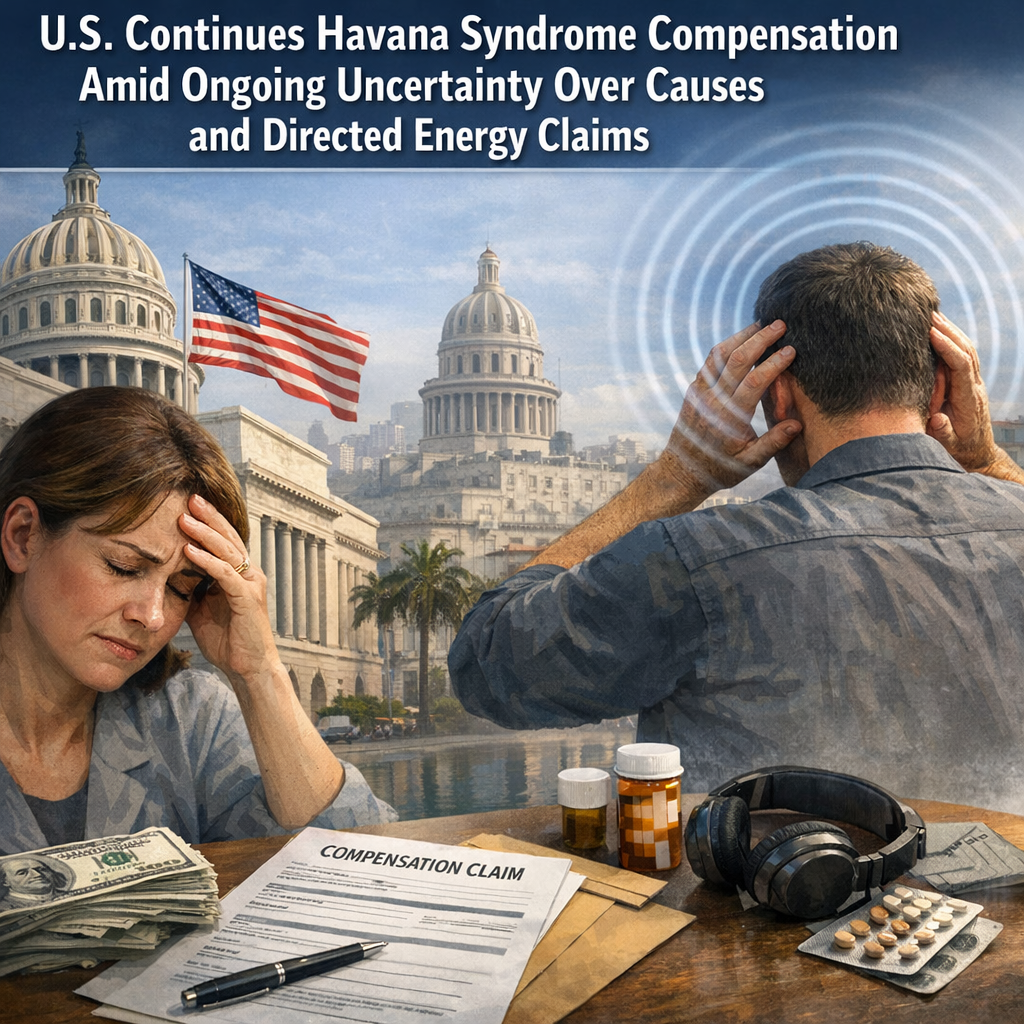
U.S. Continues Havana Syndrome Compensation Amid Ongoing Uncertainty Over Causes and Directed Energy Claims
A recent report by DefenseScoop, titled “Havana Syndrome payments directed energy bio effects,” highlights the renewed scrutiny surrounding compensation for U.S. personnel reporting symptoms linked to so-called Havana Syndrome, while underscoring ongoing debate within the scientific and intelligence communities about its underlying causes. The original report can be found here: DefenseScoop article.
According to the DefenseScoop article, U.S. government agencies continue to process payments to affected individuals under legislation such as the HAVANA Act, designed to support personnel who experienced anomalous health incidents during overseas assignments. These payments are intended to cover medical treatment and related hardships for diplomats, intelligence officers, and military personnel who reported neurological and sensory symptoms, including dizziness, headaches, and cognitive difficulties, which are broadly discussed in neurological health resources from the National Institute of Neurological Disorders and Stroke.
The article emphasizes that while compensation frameworks have been formalized, disagreements persist over whether the symptoms can be attributed to directed energy exposure or other explanations. Some officials and researchers continue to explore the possibility that novel energy-based technologies could produce the reported effects, while others remain skeptical, pointing to a lack of conclusive, reproducible evidence—echoing findings discussed in the National Academies of Sciences report on anomalous health incidents.
DefenseScoop reports that internal government studies have yielded mixed findings. Certain analyses suggest that a subset of cases could align with patterns consistent with external energy sources, while broader intelligence assessments—such as those summarized by the Office of the Director of National Intelligence—have often concluded that a foreign adversary is unlikely to be responsible for a widespread campaign. These divergent conclusions have complicated both policy responses and scientific consensus.
The article also notes that individuals receiving compensation have, in some cases, expressed frustration with the pace of medical evaluation and the ambiguity surrounding diagnoses. Advocacy groups argue that regardless of the ultimate cause, the government has an obligation to ensure timely care and financial support for those affected during official duties abroad, consistent with broader public health response principles outlined by the Centers for Disease Control and Prevention.
At the same time, ongoing research efforts are attempting to better characterize the biological effects described in reported cases. DefenseScoop highlights that scientists continue to investigate whether environmental factors, psychological stressors, or undetected medical conditions may account for at least some of the symptoms attributed to Havana Syndrome. The absence of a definitive biomarker or diagnostic test remains a central challenge, as noted in ongoing research tracked by institutions like the National Institutes of Health.
Policy experts cited in the article suggest that the compensation programs reflect a pragmatic approach: addressing the needs of affected personnel without requiring a final determination about causation. However, they caution that unresolved scientific questions leave broader national security implications unsettled, particularly regarding the possibility—however disputed—of emerging directed energy threats.
As DefenseScoop reports, the issue remains both medically and politically sensitive, sitting at the intersection of national security, employee welfare, and scientific uncertainty. While payments continue and research progresses, the lack of consensus ensures that Havana Syndrome will remain a subject of debate within government and academic circles for the foreseeable future.