Pentagon Leaders Outline Strategy Amid New Threats
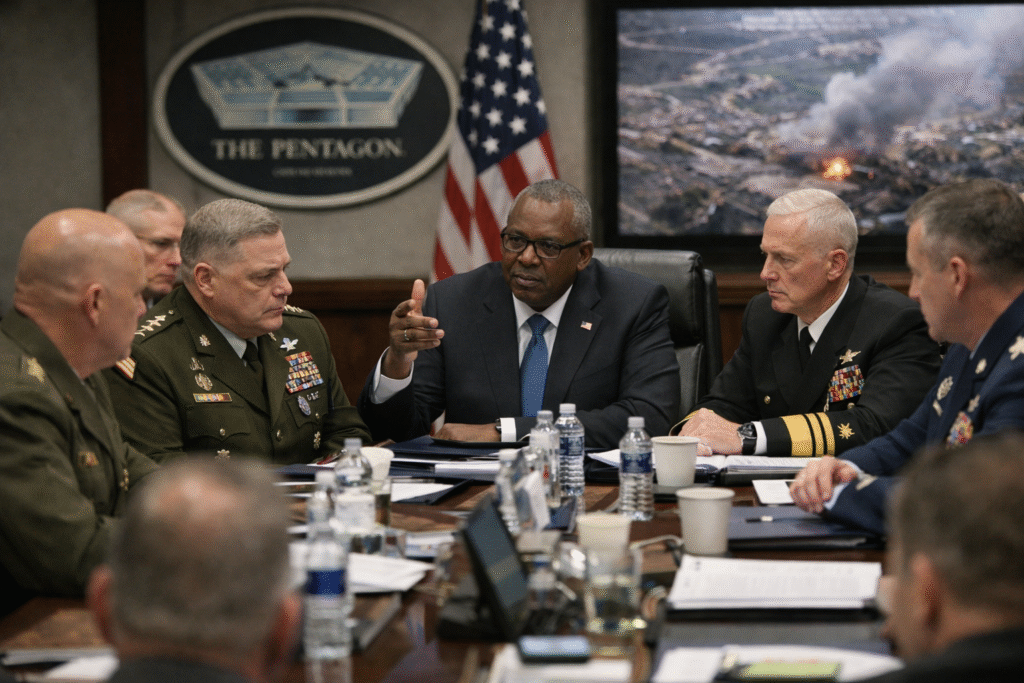
Senior U.S. defense leaders outlined strategic priorities, operational challenges, and evolving global threats during a recent Pentagon briefing, emphasizing the need for sustained military readiness amid rising geopolitical tensions.
According to the Department of Defense transcript titled “Secretary of War Pete Hegseth and Chairman of the Joint Chiefs Air Force Gen. David…” published on war.gov, Secretary of War Pete Hegseth and the Chairman of the Joint Chiefs of Staff addressed the press on issues ranging from force posture and modernization to ongoing military engagements. Their remarks underscored the administration’s focus on maintaining deterrence while adapting to increasingly complex security environments.
Hegseth highlighted the importance of strengthening alliances and ensuring that U.S. forces remain capable of responding rapidly to crises across multiple theaters. He stressed that adversaries are investing heavily in advanced technologies, including cyber capabilities and next-generation weapons systems, requiring the United States to accelerate modernization efforts. At the same time, he emphasized fiscal discipline, suggesting the Pentagon must balance readiness with efficient resource management.
The Chairman of the Joint Chiefs expanded on operational considerations, noting that the military continues to monitor a range of global hotspots. He pointed to the importance of joint force integration, describing how coordination among the Army, Navy, Air Force, Marine Corps, and Space Force is critical to maintaining strategic advantage. He also emphasized the growing role of data, artificial intelligence, and space-based assets in shaping future conflicts.
Both leaders addressed concerns about troop readiness and morale. They acknowledged the strain placed on service members by prolonged deployments and evolving mission requirements, while reiterating commitments to improving quality of life, training, and support systems for military personnel and their families.
The briefing also touched on the evolving nature of deterrence. Hegseth argued that deterrence is no longer solely defined by conventional military strength, but increasingly by the ability to project resilience across economic, technological, and informational domains. The Chairman echoed this view, stressing that modern deterrence requires integration across government agencies and cooperation with international partners.
While the officials avoided detailing specific operational plans, they made clear that the Pentagon is preparing for a range of contingencies. Their remarks suggested an approach that blends traditional military power with emerging capabilities, reflecting a broader shift in defense strategy.
The war.gov transcript captures a moment in which U.S. defense leadership is seeking to reassure allies, deter adversaries, and adapt to a rapidly changing global security landscape, while navigating political scrutiny and budgetary pressures at home.