As Iraq and Afghanistan Veterans Retire, the U.S. Military Faces a Critical Test of Institutional Memory
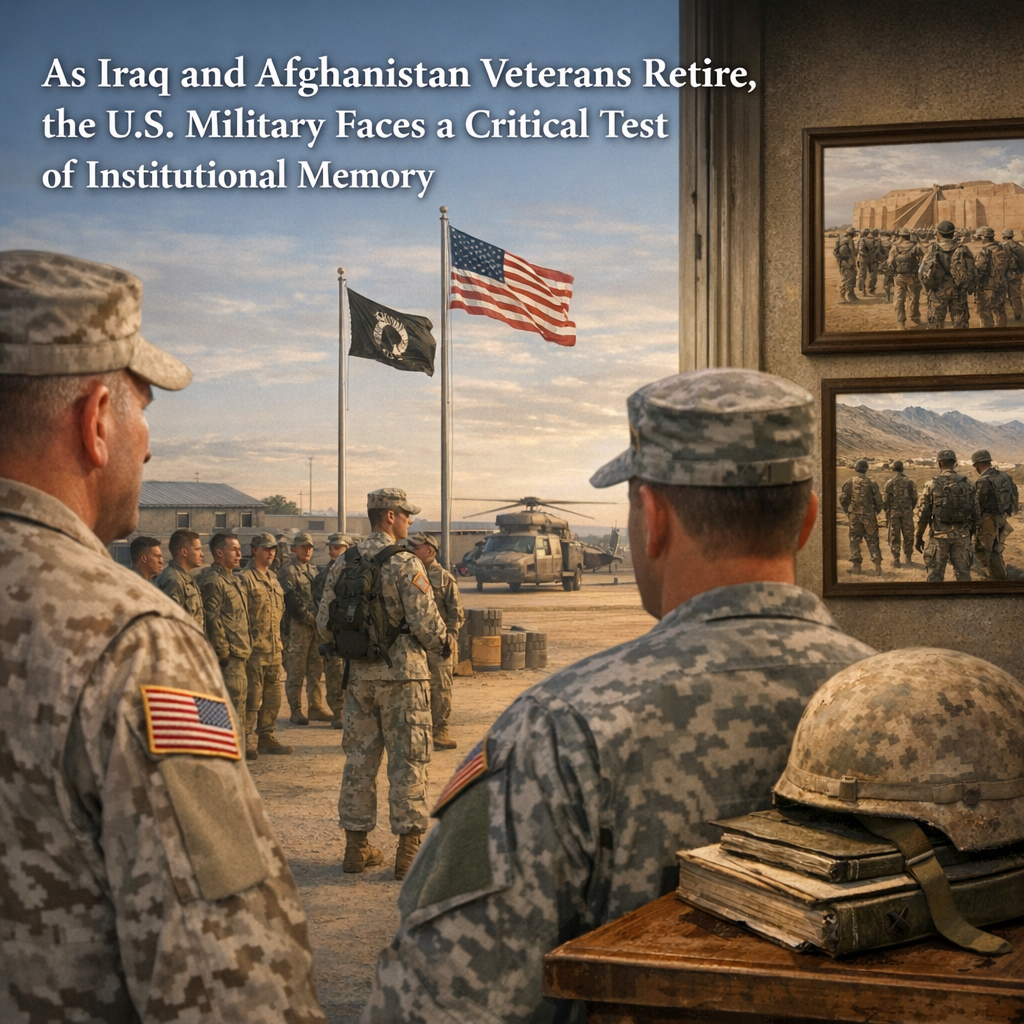
As the cohort of U.S. service members who fought in Iraq and Afghanistan begins to retire in significant numbers, the military faces a pivotal generational transition that could shape its institutional memory for decades. A recent report published by Military Times, titled “Iraq and Afghanistan veterans are retiring. How will new leaders inherit their lessons learned?”, (full article) highlights growing concern among defense officials and analysts that hard-earned knowledge from two decades of war may not transfer seamlessly to the next generation of leaders.
The wars in Iraq and Afghanistan, which spanned more than 20 years, produced a generation of officers and noncommissioned officers seasoned in counterinsurgency, joint operations, and complex coalition warfare. These individuals largely came of age during a period defined by irregular conflict, rapid adaptation, and decentralized decision-making. Now, as many of them exit active duty, the military confronts a shift toward leaders who may have less direct experience in sustained combat operations.
This transition comes at a moment when the strategic environment is also evolving. U.S. defense priorities have increasingly pivoted toward preparing for potential conflicts with near-peer adversaries such as China and Russia, emphasizing conventional warfare, advanced technologies, and large-scale coordination, as outlined in the 2022 National Defense Strategy. While the operational demands differ significantly from those of counterinsurgency campaigns, experts—such as those at the Center for Strategic and International Studies—warn that abandoning—or failing to preserve—the lessons of recent wars could leave the force vulnerable to repeating past mistakes.
One of the central concerns raised in the Military Times article is the challenge of institutionalizing knowledge that was often learned informally or through hard experience. Many battlefield adaptations during the Iraq and Afghanistan wars were driven by necessity rather than doctrine, resulting in innovations that were not always systematically recorded or integrated into formal training and education systems. Research from organizations like the RAND Corporation has similarly highlighted gaps between operational experience and institutional learning. As a result, much of that knowledge resides in the memories of individuals now approaching retirement.
Military leaders have attempted to mitigate this risk through after-action reports, professional military education programs, and digital knowledge repositories. Institutions such as the National Defense University play a key role in capturing and disseminating lessons learned. However, these mechanisms can fall short of capturing the nuances of leadership under pressure, cultural understanding in foreign environments, and the practical realities of prolonged deployments. The concern is not simply about preserving tactics, but about retaining judgment shaped by prolonged exposure to complex, ambiguous situations.
There is also an institutional tension between looking forward and looking back. As the military invests in emerging technologies such as artificial intelligence, cyber capabilities, and autonomous systems—areas emphasized by the Defense Advanced Research Projects Agency (DARPA)—there is a risk that the experiences of counterinsurgency warfare may be viewed as less relevant. Yet many analysts argue that the core lessons—adaptability, decentralized command, and the importance of human terrain—retain enduring value regardless of the operational context.
The generational shift is particularly evident in leadership pipelines. Mid-career officers who were junior leaders during the height of operations in Iraq and Afghanistan are now moving into senior roles, but the cohort behind them may have had limited or no deployment experience in those theaters. This creates a narrowing window in which direct mentorship and experiential knowledge transfer can occur.
Some within the defense community advocate for more deliberate efforts to capture and transmit these lessons. Suggestions include expanding oral history programs, embedding recent veterans in training commands, and incorporating case studies from Iraq and Afghanistan more deeply into curricula at service academies and war colleges. Others emphasize the need for cultural continuity within units, where institutional memory can be preserved through traditions, mentorship, and professional dialogue.
The stakes extend beyond historical preservation. The ability to learn from past conflicts has long been considered a cornerstone of military effectiveness. Failures to do so have, in previous eras, resulted in costly relearning under fire. As the United States prepares for an uncertain security environment, the question is not whether future wars will resemble those in Iraq and Afghanistan, but whether the military can carry forward the intellectual and leadership capital those conflicts produced.
The Military Times article underscores that this moment represents both a challenge and an opportunity. The departure of a generation of combat-experienced leaders could create gaps in institutional knowledge, but it also offers a chance to deliberately integrate those lessons into a force designed for future threats. Whether that opportunity is seized will depend on how effectively the military bridges the divide between lived experience and institutional learning.