U.S. Marines Advance Air Defense Modernization with Successful Medium-Range System Test
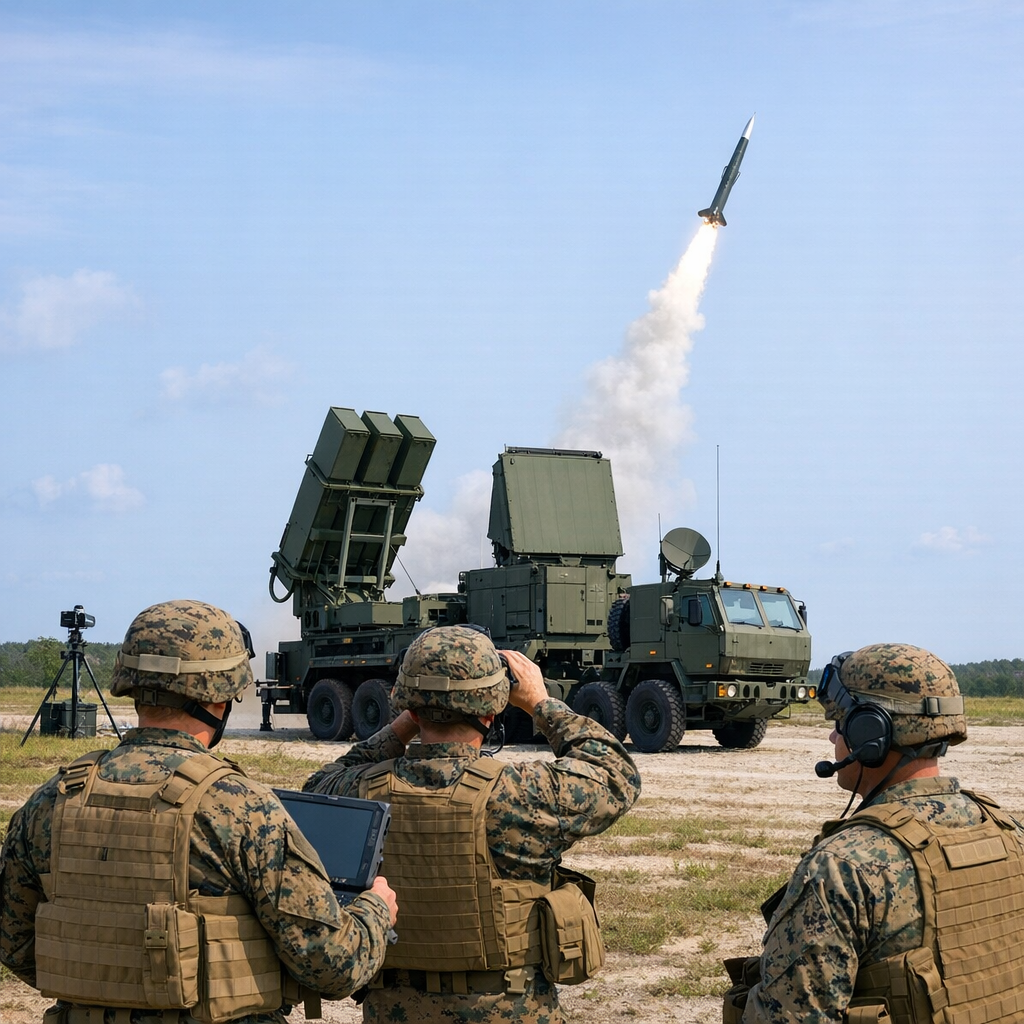
The U.S. Marine Corps has taken a notable step toward strengthening its ground-based air defense capabilities with the successful live-fire test of a new medium-range system, according to reporting by Defense News in its article “US Marines successfully test-fire new medium-range air defense system.”
The test, conducted as part of ongoing efforts to modernize the service’s air defense architecture, reflects a broader shift in U.S. military planning toward countering more advanced aerial threats, including drones, cruise missiles, and fixed-wing aircraft. Marine Corps officials have emphasized that evolving battlefield conditions—particularly the proliferation of relatively low-cost, highly capable aerial platforms—have exposed gaps in legacy systems designed for earlier eras of warfare, a trend widely analyzed in studies such as CSIS reporting on drone warfare.
The newly tested capability is intended to fill the space between short-range air defense systems and higher-tier missile defenses, offering Marines greater flexibility in contested environments where threats may emerge quickly and from multiple directions. According to Defense News, the system’s successful intercept during testing demonstrates not only technical viability but also progress toward operational integration within Marine units.
This development aligns with the Marine Corps’ Force Design 2030 initiative, which seeks to reorient the service toward distributed operations across the Indo-Pacific and other strategically significant regions, a concept that complements broader strategic guidance such as the U.S. Department of Defense Indo-Pacific Strategy. In such environments, smaller, more mobile units are expected to operate with a high degree of independence, increasing the need for organic air defense that can be rapidly deployed and sustained.
Officials have indicated that the system is designed with mobility and modularity in mind, allowing it to be transported and employed in austere conditions. That emphasis reflects lessons drawn from recent conflicts, where static and easily targeted air defense assets have proven vulnerable to precision strikes and electronic warfare.
While the Defense News report notes that further testing and validation are required before the system reaches full operational capability, the successful live-fire event marks a key milestone in the acquisition process. It also signals growing momentum behind U.S. efforts to rebuild layered air defenses after years of relative de-emphasis during counterinsurgency operations in Iraq and Afghanistan, echoing broader discussions of integrated air and missile defense concepts.
Analysts have observed that renewed investment in air defense across the U.S. military stems in part from observing peer and near-peer adversaries, particularly in Europe and the Indo-Pacific, where integrated air defense systems play a central role in deterrence and warfighting, as outlined in NATO discussions on integrated air and missile defense. For the Marine Corps, which has historically relied on other services for broader air defense coverage, the push to field its own medium-range capability represents both a doctrinal and operational shift.
The Defense News article underscores that this program is not occurring in isolation but is part of a wider modernization effort that includes improved sensors, networking, and command-and-control systems. Together, these elements are intended to create a more resilient and responsive defensive network capable of operating in environments where communications may be degraded or contested.
As development continues, questions remain about cost, scalability, and interoperability with joint and allied forces. However, the recent test suggests that the Marine Corps has moved beyond conceptual planning and into the phase of tangible capability development.
In the context of rising global tensions and rapid technological change in aerial warfare, the successful demonstration of a medium-range air defense system represents a significant, if early, step toward adapting to a more complex and contested battlespace.