i24NEWS Report Indicates Gradual Recovery of Hamas Military Structure Governance and Finances in Gaza
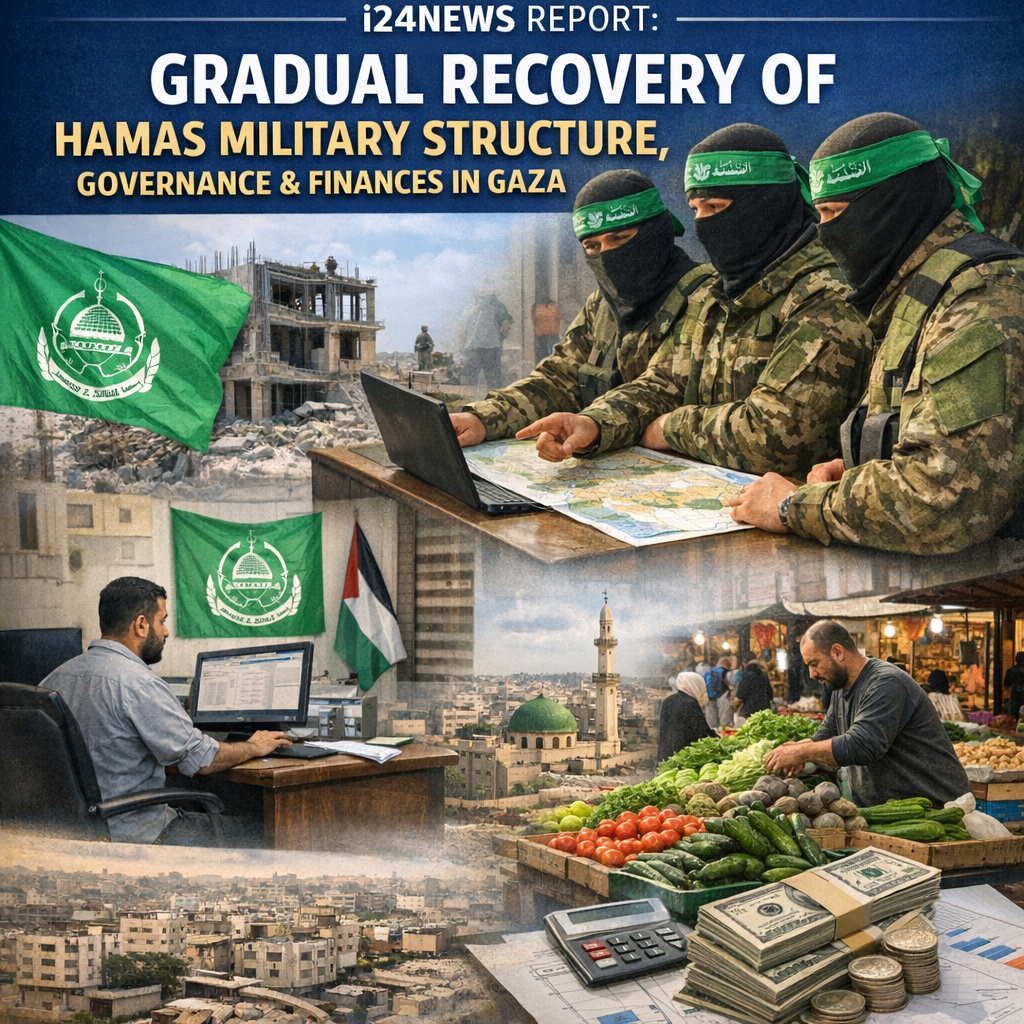
A recent report by i24NEWS, titled “Palestinian sources confirm to i24NEWS the continued military, authoritative, and financial recovery of Hamas,” points to a gradual but persistent reconstitution of the group’s capabilities in the Gaza Strip, despite months of sustained Israeli military pressure. Drawing on Palestinian sources, the report describes a movement working to restore not only its armed infrastructure but also aspects of governance and revenue collection that were significantly disrupted during the war.
According to the i24NEWS account, Hamas has focused on rebuilding its chain of command and reasserting authority in areas where its control had weakened. This includes efforts to reestablish internal security mechanisms and administrative functions, which are critical to maintaining influence over the civilian population. While the group’s leadership remains fragmented and under pressure, the report suggests that localized commanders and operatives are playing an increasingly important role in sustaining organizational continuity.
The article also highlights indications of renewed financial activity. Hamas is reportedly seeking to restore revenue streams through a mix of internal taxation, external funding channels, and informal economic networks. These efforts, Palestinian sources told i24NEWS, are uneven and constrained but sufficient to support limited operational and administrative recovery. The financial dimension is particularly significant, as access to funds underpins both military rebuilding and the provision of basic services that can reinforce the group’s legitimacy among Gaza’s residents, a dynamic often examined by International Crisis Group analyses.
On the military front, the i24NEWS report points to incremental regrouping rather than a rapid return to pre-war strength. Hamas is said to be prioritizing the reconstitution of smaller, more flexible units, along with the repair of damaged infrastructure and the replenishment of weapons stockpiles where possible. The report indicates that while large-scale capabilities remain degraded, the group retains the ability to conduct localized attacks and maintain a degree of tactical presence—an approach consistent with patterns described by the RAND Corporation on insurgency and recovery.
The broader picture that emerges is one of a weakened but adaptive organization. Israeli operations have inflicted substantial damage, yet the persistence of Hamas structures underscores the challenges inherent in dismantling an entrenched non-state actor with deep social and territorial roots. The findings cited by i24NEWS align with longstanding assessments by regional analysts, including reporting from BBC News on Gaza conflict dynamics, that such groups can absorb significant losses and gradually regenerate, particularly in environments where governance vacuums and economic hardship persist.
At the same time, the report’s reliance on Palestinian sources underscores the difficulty of independently verifying conditions on the ground in Gaza. Access remains limited, and information is often filtered through actors with their own interests. Nonetheless, the contours described by i24NEWS correspond with a pattern observed in previous conflicts: cycles of degradation followed by partial recovery, a phenomenon also referenced in Council on Foreign Relations background on Hamas.
The implications are likely to weigh on ongoing strategic calculations. For Israel, signs of Hamas recovery may reinforce arguments for sustained security measures and continued operations aimed at preventing regrouping. For international stakeholders, the report highlights the complexity of post-conflict stabilization in Gaza, where the absence of a clear alternative governing authority can create space for the reemergence of familiar actors.
As the conflict’s trajectory evolves, the extent and durability of Hamas’s recovery will remain a central question. The i24NEWS report suggests that while the group has not returned to its former capabilities, it is far from eliminated, and its adaptive capacity continues to shape realities on the ground.