Germany Accelerates Naval Laser Weapons Program with Rheinmetall and MBDA Partnership
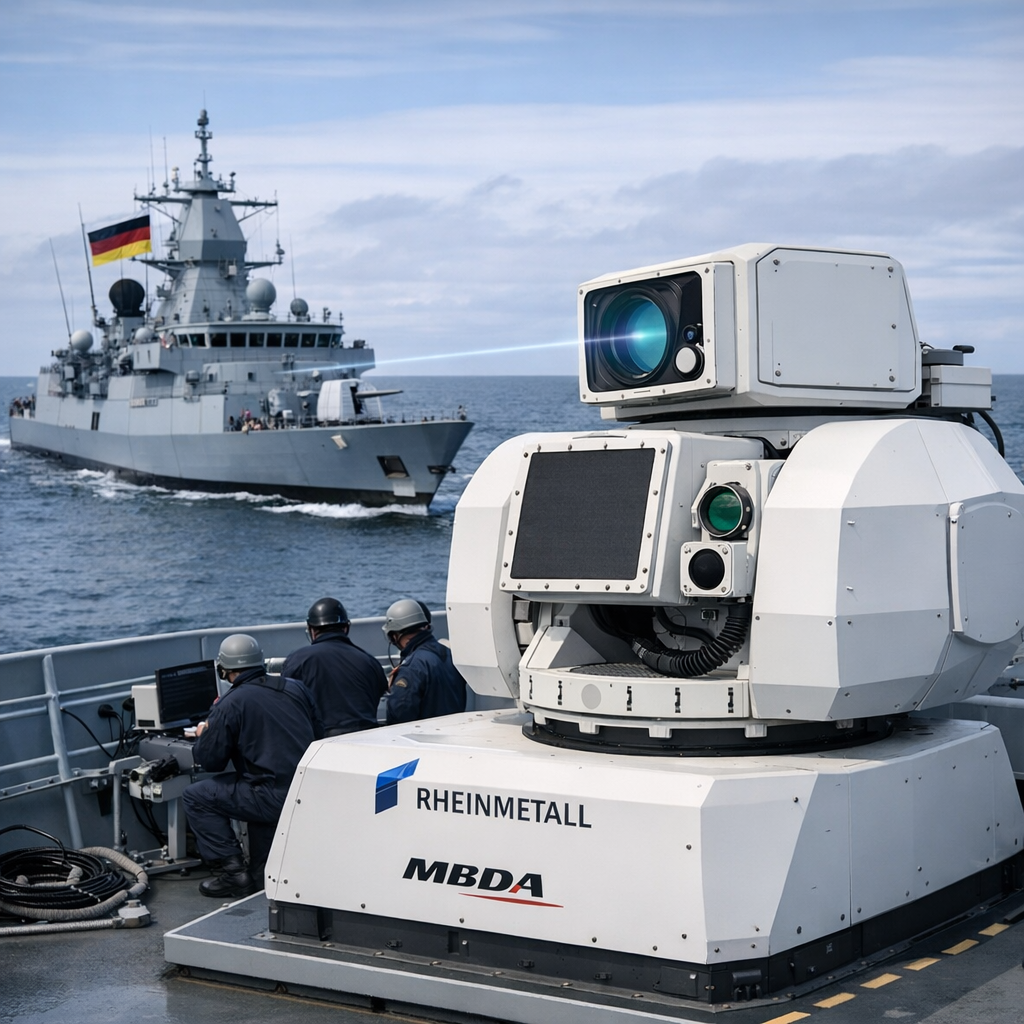
Germany’s push to operationalize ship-based directed-energy weapons has taken a significant step forward, as major defense contractors Rheinmetall and MBDA Deutschland confirmed plans to jointly develop a naval laser system for the German Navy. The move, first reported in Defense News under the headline “Rheinmetall, MBDA to develop laser weapon for German Navy,” underscores Berlin’s growing emphasis on countering emerging aerial threats with advanced, scalable technologies.
The partnership builds on earlier experimental work conducted by the German Navy, which has already tested a demonstrator laser weapon system aboard the frigate Sachsen. Those trials, carried out in recent years, focused on tracking and neutralizing drones and small, fast-moving targets under realistic maritime conditions. According to project stakeholders, the new phase aims to transition from experimentation to an operational capability integrated into frontline vessels.
Rheinmetall and MBDA bring complementary expertise to the effort. Rheinmetall has been at the forefront of high-energy laser development in Europe, particularly in modular laser sources and beam control technologies. MBDA, a major European missile manufacturer, contributes deep experience in weapon system integration, command-and-control architecture, and naval combat systems. The collaboration is designed to merge these capabilities into a coherent system suitable for sustained deployment at sea.
The laser weapon concept reflects a broader shift in naval warfare toward layered air defense that can address increasingly complex threat environments. Conventional missile systems remain essential but are expensive and limited in magazine depth. In contrast, laser weapons offer the prospect of a “deep magazine,” constrained primarily by available power, allowing ships to engage large numbers of low-cost threats such as unmanned aerial vehicles without rapidly depleting munitions.
German defense planners have signaled that countering drones and potentially cruise missiles is a priority as adversaries invest heavily in such capabilities. Directed-energy systems are particularly attractive for dealing with swarm scenarios, where traditional interceptors may be economically or operationally inefficient. However, significant technical hurdles remain, including maintaining beam quality over distance, ensuring performance in adverse weather, and integrating sufficient power generation aboard naval platforms.
While detailed specifications of the planned system have not been publicly disclosed, industry officials indicate that scalability and modularity will be central features. This would allow the system to be adapted for different classes of ships and potentially upgraded as laser technology advances. It also aligns with broader European defense efforts to enhance interoperability and reduce reliance on non-European suppliers.
The initiative comes amid increased German defense spending and a wider reassessment of military readiness following Russia’s invasion of Ukraine. Investments in next-generation technologies, including air and missile defense, have become a central pillar of Berlin’s strategy to modernize its armed forces and contribute more robustly to NATO.
If successful, the Rheinmetall-MBDA project could position Germany among a small group of nations moving toward operational deployment of naval laser weapons, alongside the United States and the United Kingdom. For the German Navy, the system represents not only a technological advance but also a shift in how maritime threats may be managed in an era defined by rapid innovation and evolving risks.