Reconstructing the Central Israel Shooting Attack How Mobile Assailants Carried Out a Coordinated Rampage
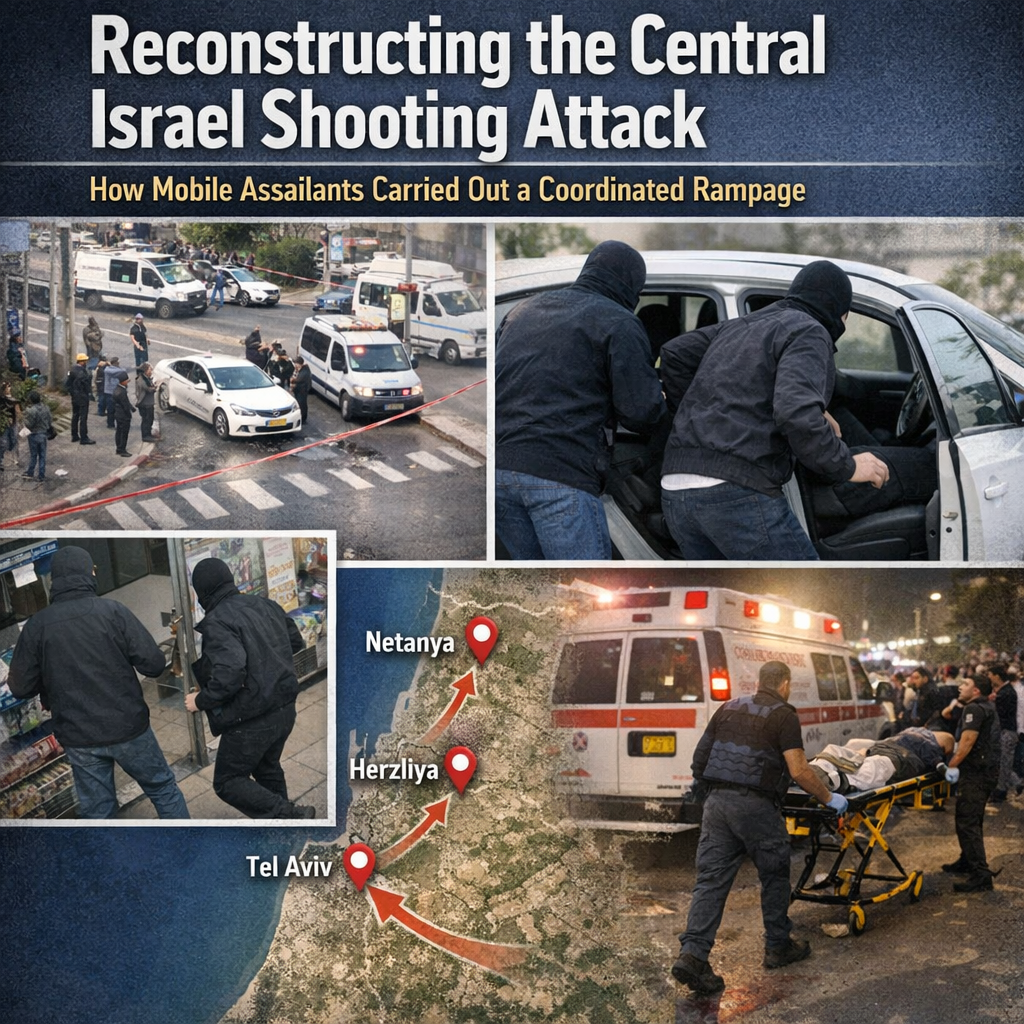
An investigation into a deadly shooting in central Israel has begun to piece together the movements of the assailants and the sequence of events that led to multiple casualties, shedding light on what authorities describe as a coordinated and highly mobile attack.
According to reporting by i24NEWS, in its article “A deadly rampage: The route terrorists took during the central Israel shooting spree,” the attackers carried out a series of shootings across several locations, moving between sites in a manner that complicated the security response and amplified the scale of the violence. Security officials believe the assailants deliberately selected a route that allowed them to maximize exposure to civilian areas before being confronted.
Israeli police and emergency services, including units of the Israel Police, responded to reports of gunfire that began in a densely populated area and quickly spread as the attackers traveled. Witness accounts cited in the i24NEWS report describe moments of sudden panic, with civilians fleeing streets, vehicles, and public spaces as shots rang out. First responders worked to evacuate the wounded while security forces launched a manhunt, attempting to track the attackers’ path in real time.
Authorities said the perpetrators used a vehicle to move between locations, enabling them to strike multiple sites within a short span. This mobility posed a significant challenge for law enforcement, as initial reports were fragmented and emerged from different areas simultaneously, creating confusion about the scale and nature of the incident, a pattern noted in analyses of similar attacks by organizations like Europol.
Security forces eventually intercepted the attackers, bringing the rampage to an end. Officials have not released full operational details but indicated that the response involved coordination between local police units, counterterrorism forces, and intelligence services, similar to frameworks described by the U.S. Department of Homeland Security. The attack is being treated as an act of terrorism, and investigators are examining whether the perpetrators acted independently or with broader support.
The incident has reignited concerns over internal security and the threat posed by small, mobile cells capable of conducting rapid, multi-site attacks. Analysts note that such tactics are designed to overwhelm emergency response systems and generate widespread fear, even when carried out by a limited number of individuals, a phenomenon covered in reporting by outlets such as BBC News and Reuters Middle East.
In the aftermath, Israeli authorities have increased security presence in major urban centers and initiated a review of response protocols. Officials emphasized the importance of rapid information sharing and coordination across agencies to contain similar threats in the future.
The i24NEWS report underscores how the attackers’ route and timing played a critical role in the attack’s deadliness, highlighting vulnerabilities that security services now face renewed pressure to address.