Trump Proposes US Escorts in Strait of Hormuz
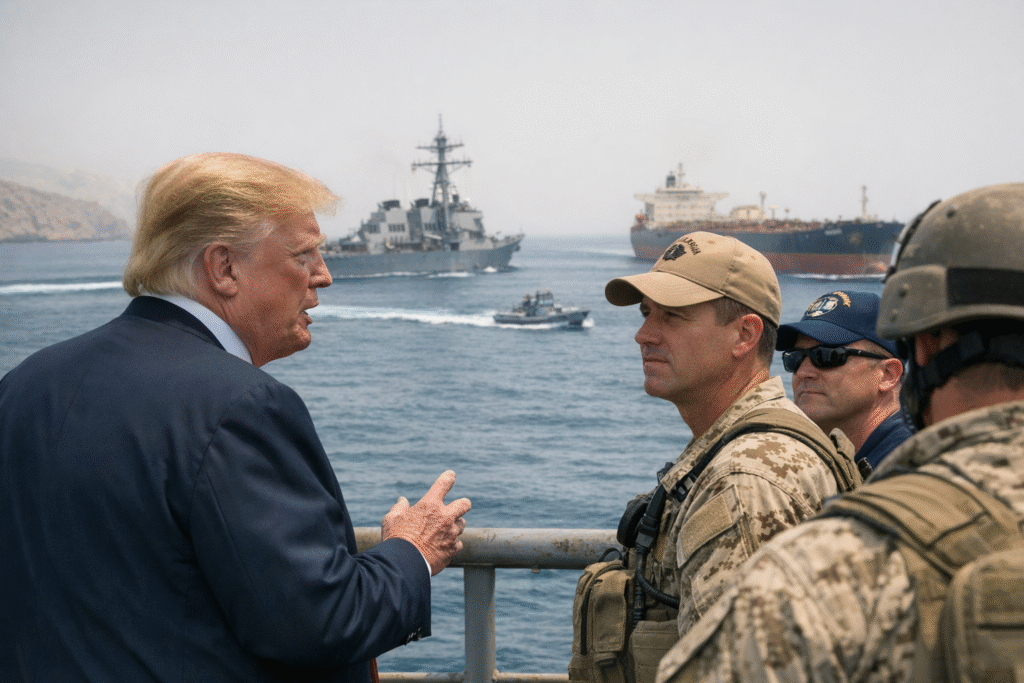
Former President Donald Trump said the United States would take a more active role in safeguarding maritime traffic through the Strait of Hormuz, according to a report by The Wall Street Journal titled “Trump Says U.S. Will Guide Stranded Ships Through Strait of Hormuz.” His remarks come amid heightened tensions in one of the world’s most strategically vital waterways, where commercial vessels have faced mounting risks linked to regional instability.
Speaking as concerns grow over the safety of international shipping, Trump indicated that the U.S. could provide direct escort or guidance to ships navigating the narrow passage, which connects the Persian Gulf to global trade routes. Roughly a fifth of the world’s oil supply transits through the Strait of Hormuz, making any disruption there a matter of global economic consequence.
The Wall Street Journal reported that the proposal reflects a more assertive posture toward maritime security in the region. Trump’s comments suggest a willingness to expand U.S. involvement beyond traditional deterrence measures, potentially placing American naval forces in closer proximity to contested or vulnerable vessels. While details of the plan remain limited, the concept of “guiding” stranded or at-risk ships implies coordinated naval operations designed to prevent seizures, harassment, or blockades.
The idea raises both strategic and political questions. Supporters argue that a stronger U.S. presence could deter hostile actions and reassure allies dependent on stable energy flows. Critics, however, warn that increased military engagement in the Strait risks escalation with Iran, which has previously threatened to disrupt shipping in response to economic sanctions or geopolitical pressure.
Recent incidents in the region, including vessel seizures and reported interference with commercial shipping, have underscored the fragility of maritime security in the Gulf. Insurance premiums for ships operating in the area have fluctuated alongside security concerns, and some companies have rerouted or delayed shipments to avoid potential threats.
Trump’s remarks reflect a broader debate about the role of the United States in protecting global trade corridors at a time of shifting geopolitical priorities. While successive administrations have maintained a naval presence in the Gulf, the extent to which Washington should directly intervene to shepherd commercial vessels remains contested.
As The Wall Street Journal notes, any move to actively guide ships through the Strait of Hormuz would signal a significant escalation in operational involvement. Whether such a policy is implemented, and how it would be received by regional actors, remains uncertain amid an already volatile security environment.