Green Berets Test Ship Killing Drone in Luzon Strait
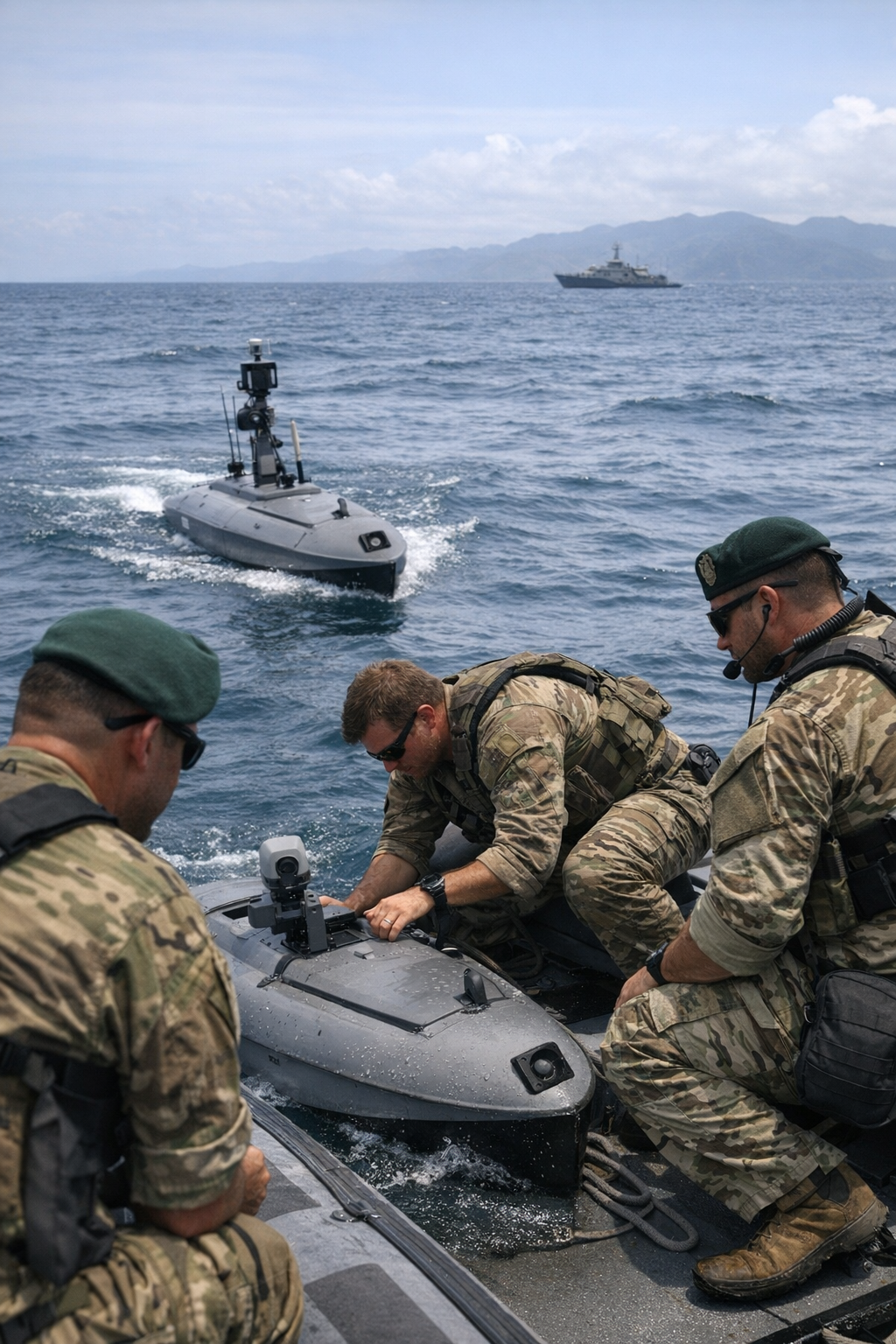
U.S. Army Special Forces recently demonstrated a new maritime strike capability during an exercise in the Luzon Strait, signaling a continued shift in how the United States prepares for potential conflict in the Indo-Pacific. The development was detailed in a USNI News report titled “Green Berets Deploy Ship-Killing Drone in Luzon Strait Maritime Strike Exercise,” which described how Army units are adapting to operate in traditionally naval domains.
According to the report, Green Berets from the 1st Special Forces Group conducted a live-fire exercise involving a loitering munition designed to target and destroy ships. The system, described as a “ship-killing drone,” was launched from a ground-based position, underscoring the Army’s growing emphasis on contributing to maritime operations without relying on traditional naval platforms.
The exercise took place in the strategically significant Luzon Strait, a key waterway between Taiwan and the Philippines that connects the South China Sea to the broader Pacific Ocean. The location is widely seen as a potential flashpoint in any future regional conflict, particularly involving China and U.S. allies. By demonstrating the ability to hold maritime targets at risk from dispersed land-based positions, U.S. forces are signaling an intent to complicate adversary operations in contested environments.
U.S. Army officials cited in the USNI News report emphasized that the capability reflects broader changes in military doctrine, including the concept of multi-domain operations. This approach seeks to integrate land, sea, air, cyber, and space capabilities to achieve strategic effects. In this context, Special Forces units are being equipped and trained to operate with greater autonomy and flexibility, including the ability to conduct precision strikes against naval targets.
The use of loitering munitions in this role is particularly notable. Unlike traditional missiles, these systems can remain airborne for extended periods while searching for targets, offering a combination of surveillance and strike functions. Their relatively small footprint and mobility make them well suited to the dispersed, expeditionary style of operations envisioned in the Indo-Pacific.
The exercise also highlighted the increasing overlap between the missions of different branches of the U.S. military. While anti-ship warfare has historically been the domain of the Navy and Air Force, the Army’s growing involvement reflects a recognition that future conflicts may require contributions from all services across multiple domains.
Analysts have pointed to such developments as part of a broader effort to deter aggression by raising the potential costs for adversaries. By demonstrating the ability to deploy lethal capabilities from unpredictable locations, U.S. forces aim to create uncertainty and limit the freedom of movement of opposing naval forces.
At the same time, the deployment of these capabilities raises questions about escalation and the evolving nature of warfare in the region. As more systems capable of targeting ships are distributed among allied and partner forces, the maritime battlespace could become more complex and harder to control in a crisis.
The USNI News report suggests that the Army is likely to continue refining this capability, with future exercises expected to expand its scope and integration with other elements of joint and allied forces. As the United States adapts to the strategic realities of the Indo-Pacific, the role of Special Forces in maritime operations appears set to grow, blurring traditional boundaries and reshaping how power is projected at sea.