Air Force Accelerates Shift to Combat Drones
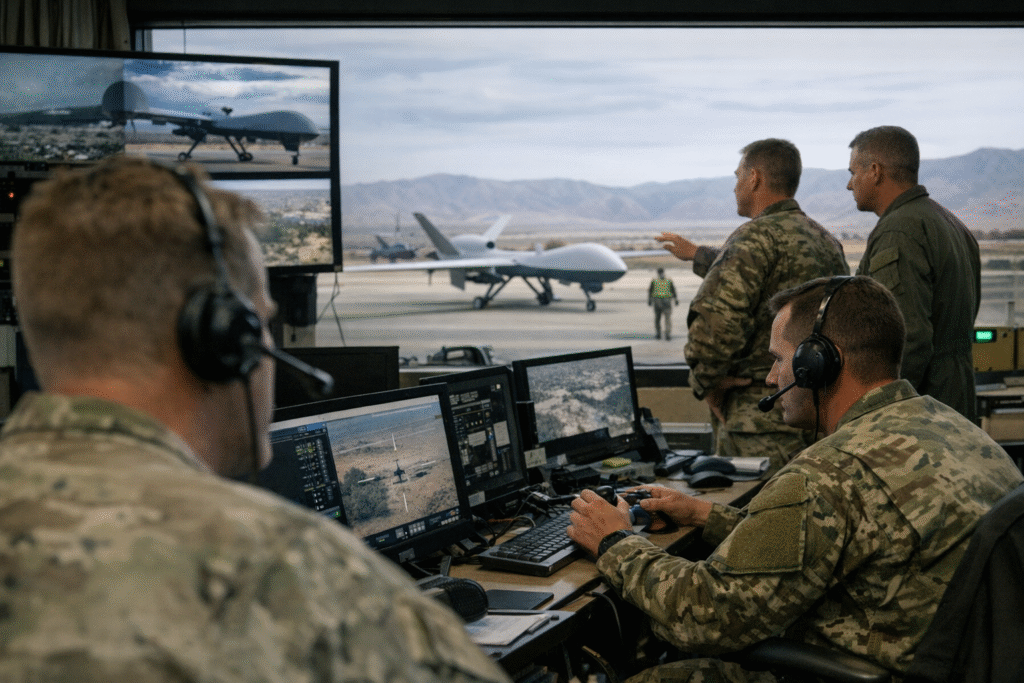
The U.S. Air Force is moving to accelerate its push into autonomous and semi-autonomous aviation, seeking nearly $1 billion in funding to begin initial procurement of Collaborative Combat Aircraft, or CCA, according to a recent report by Defense News titled “From prototypes to production: US Air Force seeks nearly $1B for initial CCA procurement.”
The requested funding marks a transition point for one of the service’s most closely watched modernization efforts. After several years focused on experimentation and prototyping, the Air Force is now attempting to shift the CCA program into early production, an indication that senior leaders view the technology as sufficiently mature to begin fielding.
Collaborative Combat Aircraft are designed to operate alongside crewed fighter jets, such as the F-35 and the forthcoming Next Generation Air Dominance platform. These uncrewed systems are expected to perform a range of missions, including surveillance, electronic warfare, and strike operations, while reducing risk to human pilots and extending the reach of manned aircraft. The concept hinges on teaming autonomous aircraft with traditional fighters, allowing the Air Force to distribute capabilities across a more flexible and potentially less costly force.
According to the Defense News report, the nearly $1 billion request would support the procurement of an initial batch of these aircraft as part of the Air Force’s fiscal year budget planning. While still limited in scale, this first tranche is intended to bridge the gap between prototype development and broader operational deployment. Officials have indicated that early production units will also help refine operational concepts and integration strategies, particularly as the service continues to explore how best to pair CCAs with existing and future platforms.
The move comes as Pentagon leaders emphasize the need to adapt to evolving threats, particularly in the Indo-Pacific region, where contested airspace and advanced adversary capabilities pose increasing challenges. Autonomous systems like CCAs are seen as a way to complicate adversary targeting, increase sortie generation, and lower the cost curve associated with high-end air combat.
However, the transition from prototypes to procurement is not without uncertainty. Questions remain about cost control, technological reliability, and the degree of autonomy these aircraft will ultimately possess. Lawmakers are also likely to scrutinize the program closely, given the broader pressures on the defense budget and competing modernization priorities across the services.
Despite these challenges, the Air Force’s funding request signals growing confidence in the CCA concept and reflects a broader shift toward integrating uncrewed systems into frontline operations. If approved, the investment would mark a significant step toward reshaping the composition of U.S. airpower, blending human decision-making with machine-enabled capabilities in ways that could redefine future combat الجوية operations.