Inside Apple’s Hidden Archive and Unseen History
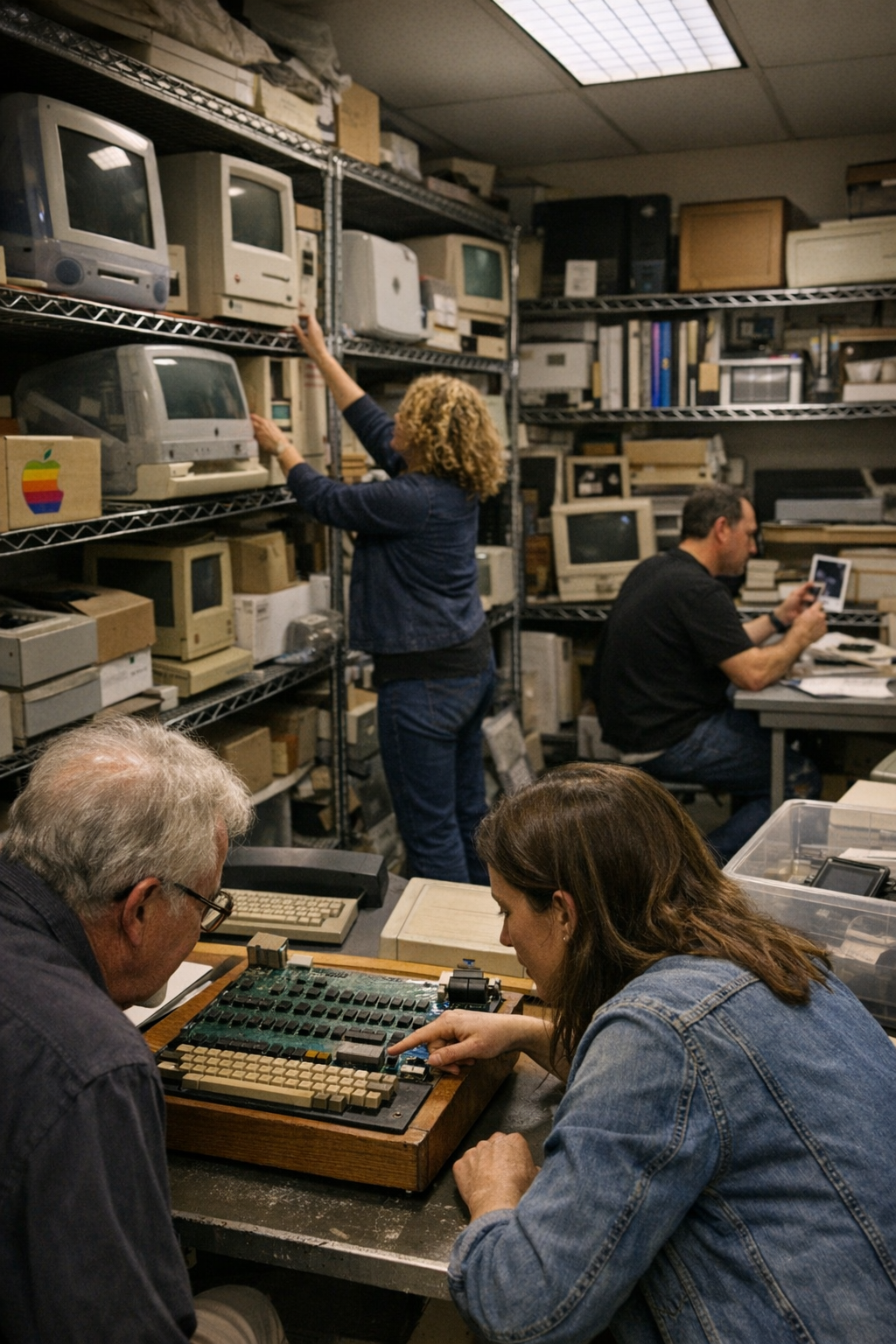
In a video feature titled “Apple Has Archives That Even Tim Cook Didn’t Know About. We Went Inside,” published by The Wall Street Journal, reporters were granted rare access to a little-known trove of Apple’s institutional memory—an archive that underscores both the company’s obsessive secrecy and its evolving relationship with its own history.
The report reveals that, despite Apple’s global stature and carefully curated public image, parts of its past have remained fragmented, stored across disparate collections and in some cases largely unknown even to senior leadership. The Journal found that internal materials, prototypes, marketing artifacts and documentation—some dating back decades—have been preserved in ways that reflect Apple’s historically forward-looking culture, where the next product cycle often eclipses deliberate retrospection.
Apple has long been defined by a philosophy that prioritizes innovation over nostalgia. That approach helped drive its transformation from a near-bankrupt computer maker in the 1990s into one of the world’s most valuable companies. Yet the Journal’s reporting suggests that this ethos came with trade-offs. Institutional memory, while not entirely neglected, was neither centralized nor consistently leveraged as a strategic asset.
What makes the archive particularly notable is the suggestion that even Chief Executive Tim Cook was unaware of the extent of certain preserved materials. This detail highlights the decentralized nature of Apple’s historical preservation efforts and points to a broader tension between operational efficiency and historical stewardship. In a company where secrecy is deeply embedded, information has often been compartmentalized, limiting visibility beyond immediate teams and product lines.
The archive itself offers a window into Apple’s iterative design philosophy. Early prototypes and discarded concepts illustrate a process defined as much by elimination as by breakthrough. The artifacts show how ideas evolved—or were abandoned—on the path to products that would later define categories. For industry observers, this reinforces the notion that Apple’s success has depended not just on visionary thinking but on disciplined curation of what not to pursue.
The Journal’s access also reflects a subtle shift. Apple, while still famously guarded, has in recent years shown a greater willingness to engage with its own legacy, particularly as it seeks to reinforce brand identity across generations of consumers. As the company matures, its history becomes a strategic asset in its own right, informing design language, marketing narratives and corporate culture.
At the same time, the existence of relatively unknown archives raises questions about how large technology firms manage their past in an era when corporate identity is increasingly tied to storytelling. Companies such as Apple must balance the need for secrecy and competitive advantage with growing public interest in origins, processes and heritage.
The Wall Street Journal’s report ultimately presents Apple’s archive not as a static collection, but as a reflection of a company still negotiating its relationship with its own history. For a business built on anticipating the future, the rediscovery of its past may shape how it defines itself in the years ahead.