Army Laser Program Stumbles on Battlefield Reality
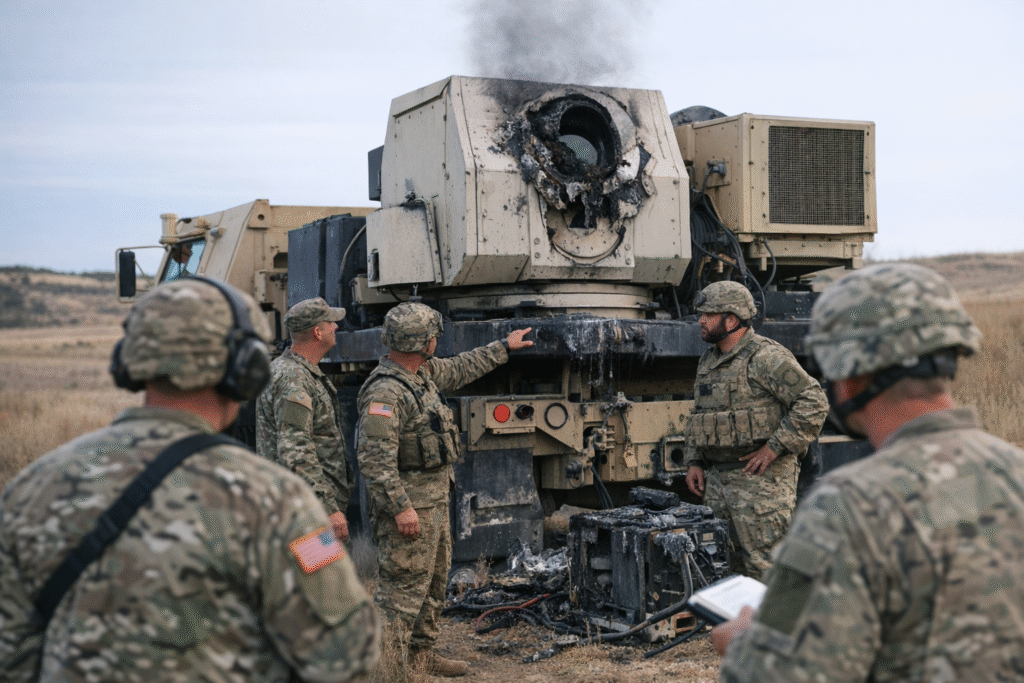
The U.S. Army’s decision to move away from one of its most ambitious directed-energy programs underscores the persistent gap between technological promise and battlefield practicality.
According to a recent Defense News report titled “The US Army is already ditching its most powerful laser weapon yet,” the service is stepping back from its high-energy laser initiative after encountering mounting technical and operational challenges. The program, which had been expected to deliver unprecedented defensive capabilities against drones, rockets, and other aerial threats, now illustrates the difficulty of translating cutting-edge research into reliable, deployable systems.
The Army had positioned high-energy lasers as a cornerstone of future air and missile defense, particularly in countering increasingly sophisticated unmanned aerial systems. Compared with traditional munitions, laser weapons offer appealing advantages: near-instant engagement, deep magazines limited primarily by power supply, and a significantly lower cost per shot. However, these theoretical benefits have proven difficult to sustain under real-world conditions.
One of the central obstacles has been power generation and thermal management. Scaling a laser to higher energy levels requires not only greater electrical output but also robust cooling systems to prevent overheating. These requirements add weight and complexity, complicating integration onto mobile platforms such as tactical vehicles. As a result, systems that perform well in controlled demonstrations often struggle to maintain effectiveness in field environments marked by heat, dust, and vibration.
Atmospheric interference has also limited performance. Factors such as humidity, smoke, and particulate matter can degrade beam quality and reduce effective range. While engineers have made progress in adaptive optics and beam नियंत्रण, these solutions have not yet fully mitigated environmental constraints.
The Army’s reassessment reflects broader questions about how quickly directed-energy weapons can transition from experimental prototypes to dependable combat assets. While lower-powered systems have shown promise in counter-drone roles, scaling up to defeat more resilient threats—such as cruise missiles or artillery shells—remains an ongoing challenge.
Importantly, the decision does not represent a wholesale abandonment of laser technology. Instead, it signals a recalibration of expectations and priorities. The Army and other services continue to invest in directed-energy research, but with a growing emphasis on incremental improvements and niche applications rather than rapid breakthroughs.
The shift also highlights the importance of balancing innovation with operational realism. As defense planners confront evolving threats, they must weigh the allure of transformative technologies against the practical demands of reliability, maintainability, and cost-effectiveness.
In that sense, the experience described in Defense News serves as a cautionary example. Even as militaries pursue next-generation capabilities, the path from laboratory success to battlefield utility remains uncertain, shaped as much by engineering constraints as by strategic ambition.