Russia’s Window at Tartus Has Closed for Good, and Its Mediterranean Ambitions With It
Russia’s long-held Tartus base in Syria never became the deep-water power hub Moscow envisioned, and now that opportunity is gone.

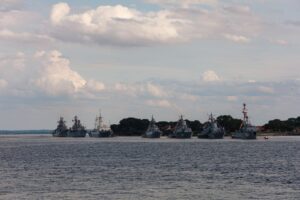
Russia’s naval foothold at Tartus, Syria — the only base Moscow operated on the Mediterranean — has slipped permanently out of reach, foreclosing what was once positioned as a cornerstone of Russian naval power projection in the region. According to Forbes analysis by defense writer Paul Iddon, Russia never transformed Tartus into the capable, permanent installation it publicly announced, and the political conditions that once made that aspiration plausible no longer exist. The fall of Bashar al-Assad’s government ended Moscow’s basing rights, and Syria’s new leadership has shown no interest in restoring them.
The loss carries strategic weight well beyond the facility itself. Russia’s Black Sea Fleet has faced sustained pressure throughout the war in Ukraine, making unimpeded Mediterranean access — which a fully developed Tartus could have supported — more operationally consequential than at any point since the Cold War. The timing could hardly be worse for Moscow. For context on how rival naval powers have continued investing in forward presence, satellite imagery documented China’s fifth aircraft carrier advancing at Jiangnan Shipyard, a reminder of how seriously Beijing is pursuing blue-water reach while Russia’s own options contract.
A Base That Was Always More Symbol Than Capability
Tartus was established as a Soviet logistical point in 1971 and survived the USSR’s collapse largely through inertia. When Russia intervened militarily in Syria in 2015, the facility attracted renewed attention as a potential hub that Moscow could upgrade into a genuine deep-water port capable of servicing larger warships and submarines. A 2017 agreement extended Russia’s basing rights for 49 years and outlined ambitions for significant infrastructure investment. Neither the investment nor the infrastructure materialized at the scale Moscow announced.
Throughout the Syria intervention, Tartus functioned primarily as a logistical waypoint — a place to replenish and conduct minor repairs — rather than a permanent, fortified naval station. The port’s depth and existing facilities were insufficient for routine berthing of capital ships without the expansion that never came. Russia’s defense budget constraints, compounded by sanctions pressure and then the full-scale costs of the Ukraine war from 2022 onward, consistently crowded out the long-term investment Tartus required to become genuinely useful.
Assad’s Fall Ended the Basing Equation
The collapse of Assad’s government in December 2024 removed the political architecture underpinning Russia’s presence entirely. Syria’s new authorities inherited no obligation to honor agreements signed by the previous government with a foreign power whose intervention had, in part, prolonged a devastating civil war. Journalist Ibrahim Hamidi’s reporting on Syria captured the sharpness of the post-Assad diplomatic rupture, reflecting how completely Russia’s leverage inside Syria evaporated once its client was no longer in power.
With no allied government in Damascus and no realistic diplomatic path back to a basing agreement, Russia has no near-term mechanism for reconstituting its Mediterranean access. Alternative arrangements — Libya has been floated in Russian strategic discussions for years — remain distant and fragile. None offers Tartus’s combination of location, prior infrastructure, and historical precedent. The window for turning that precedent into genuine capability is now closed.

Operational Consequences in a Contested Maritime Environment
The practical implications extend into current operations. Russia’s ability to sustain surface and submarine deployments in the Mediterranean has depended on access to friendly ports for maintenance and provisioning. Without Tartus, those deployments become logistically harder to sustain for extended periods, especially given ongoing attrition in the Black Sea Fleet. Russian naval activity in the Mediterranean has not stopped, but its sustainability without a reliable land-based logistics node is materially reduced.
The episode stands as a case study in the gap between announced strategic ambitions and executed investment. Russia held a rare geopolitical asset — a recognized basing right in the Mediterranean, backed by a long-term agreement — and lacked either the resources or the sustained institutional will to develop it before political conditions shifted. As great-power competition over maritime access intensifies, the cost of that failure will compound. Whether Moscow draws operational lessons from it, given the more immediate pressures of the Ukraine war, is a separate and open question. For now, the base at Tartus belongs to what Russia almost had, not what it built.