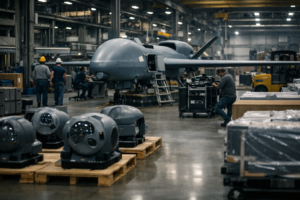
Leaked Documents Expose Russia’s Push to Dramatically Scale Up Shahed-Style Drone Manufacturing by 2026
Leaked Russian documents reveal an ambitious plan to massively expand kamikaze drone production capacity ahead of 2026.
Russia has been quietly developing plans to substantially expand its domestic production of kamikaze drones, according to leaked documents reported by Business Insider. The documents, which surfaced publicly in mid-2025, outline an industrial effort to scale up output of loitering munitions modeled on Iran’s Shahed design — the one-way attack drones that have become a central instrument of Russia’s air campaign against Ukrainian cities and infrastructure. Ukraine’s response to that threat, including its own drone-interception programs, has been tracked closely; GDD has previously covered Kyiv’s Shahed interceptor program designed to hunt the very systems Russia now plans to build in greater numbers.
The plans envision a significant increase in manufacturing throughput at Russian drone facilities ahead of a 2026 target horizon, though the specific production figures cited in the leaked materials have not been independently verified by Western governments or open-source analysts, and Russian officials have not publicly confirmed the authenticity of the documents.

What the Leaked Documents Reveal
The documents were first highlighted in a detailed post published by the SE Peace Missions monitoring account on X, which shared what it described as internal Russian planning materials related to drone factory expansion timelines and capacity benchmarks.
Russia began deploying Shahed-136 drones — rebranded domestically as Geran-2 — in Ukraine in the autumn of 2022, and the weapons have since been used in mass waves targeting power generation infrastructure, particularly during winter months. The leaked plans appear aimed at sustaining and intensifying that campaign by ensuring a domestic production base that is less vulnerable to the kind of sanctions and export controls that have complicated Iranian arms transfers.
Industrial and Strategic Implications
The scale of the envisioned expansion, if realized, would mark a meaningful shift in Russia’s defense-industrial posture. Loitering munitions have proven cost-effective tools for degrading high-value infrastructure targets at comparatively low unit cost, and a larger domestic stockpile would give Russian planners more flexibility to sustain attrition-based air campaigns without depleting reserves of more expensive ballistic or cruise missiles. European governments have been watching precisely this kind of capability growth with alarm; the darkening Russian threat assessment driving European rearmament has been documented in GDD’s coverage of European defense spending acceleration.
Analysts caution that leaked planning documents do not guarantee execution. Russia’s defense industry has faced documented difficulties meeting production targets in other munitions categories due to sanctions, component shortages, and workforce constraints. Whether the drone expansion blueprint translates into actual factory output at the pace the documents describe remains an open question — one Western intelligence agencies are likely watching carefully as the war in Ukraine grinds into its fourth year.
The disclosure nonetheless adds weight to longstanding concerns among NATO members that Russia is systematically hardening its war-production infrastructure for a prolonged conflict, and that loitering munitions will remain a persistent feature of the threat environment regardless of how the front lines evolve.