Russia’s Jet-Powered Shahed Drones Now Dominate Some Attack Waves, Kyiv Says
Ukraine says jet-powered Shahed variants now account for up to two-thirds of some Russian drone salvos, complicating air defenses.
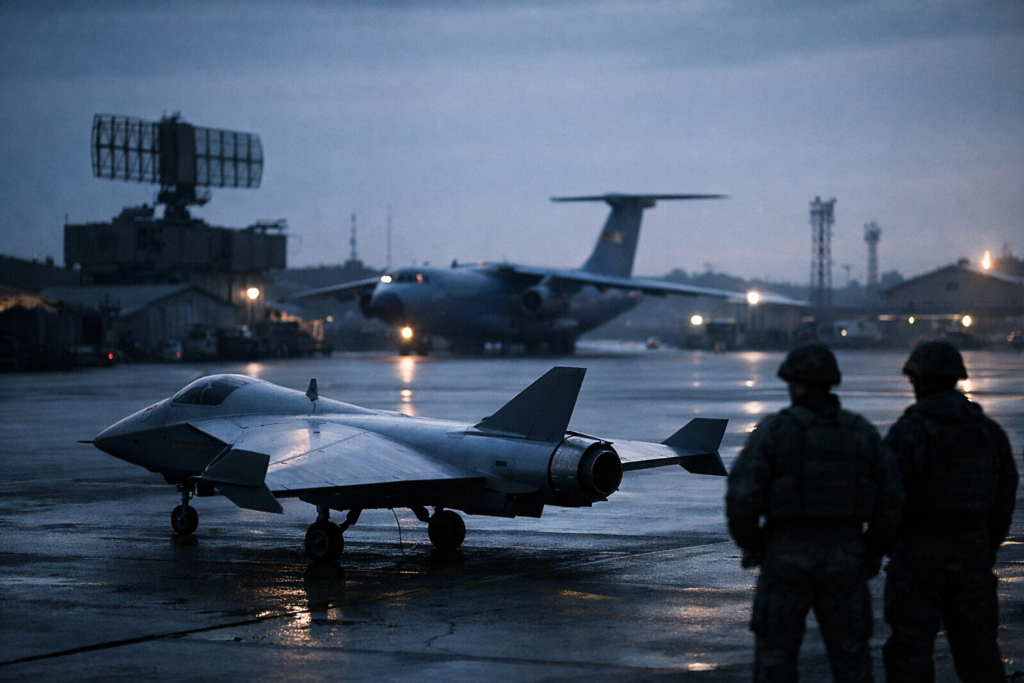
Jet-powered variants of the Russian-employed Shahed drone now constitute as much as two-thirds of the unmanned aerial vehicles used in some Russian attack waves against Ukraine, a Ukrainian official has said, according to Business Insider reporting. The disclosure marks a significant evolution in the composition of Russian drone salvos and raises the operational burden on Ukrainian air-defense crews, who face faster and harder-to-intercept threats compared with the propeller-driven Shahed-136 variants that defined earlier phases of the conflict. The drone strikes Kherson and other population centers have already drawn international condemnation; the shift to jet propulsion adds a new layer of urgency to Ukraine’s air-defense calculus.
The original Business Insider article, published in August 2026, does not specify which Ukrainian official made the statement or the precise salvo sizes involved, but the figure — up to two-thirds — suggests the jet-powered Shahed has moved from a supplementary asset to a primary strike tool in at least some Russian operations.
A Strategic Pivot Toward Speed and Survivability
The shift is consistent with a broader Russian operational trend assessed by Ukrainian military analysts. According to a separate Business Insider report, Ukraine’s navy has concluded that Russia is now “betting primarily” on jet-powered Shahed drones and pivoting away from older piston-engine models. The navy’s assessment frames the transition not as incremental but as a deliberate doctrinal choice — one aimed at saturating Ukrainian defenses with platforms that are faster, fly at different acoustic and radar signatures, and require different intercept geometries than legacy variants.
The operational implication is substantial. Propeller-driven Shaheds fly at relatively low speeds, giving ground-based air-defense systems and short-range interceptors more engagement time. Jet-propelled variants compress that window considerably. Ukrainian air-defense operators must now account for a mixed-threat environment within the same salvo, requiring faster sensor-to-shooter cycles and potentially expending higher-value interceptor rounds on targets that previously could have been engaged by cheaper means.
Ukraine Developing Dedicated Intercept Capability
The tactical pressure has already prompted a domestic response. A Ukrainian arms manufacturer has announced a new high-speed interceptor drone, designated the Jetkiller P1, specifically designed to pursue and defeat jet-powered Shaheds, according to a prior Business Insider report on Ukrainian interceptor development. The manufacturer’s claim has not been independently verified, and Ukrainian officials have not confirmed the system’s operational status or fielding timeline. Still, the emergence of a dedicated counter-platform signals that Ukrainian industry and defense planners view the jet-powered Shahed threat as durable, not transient.
The Jetkiller P1 represents one strand of a wider Ukrainian effort to adapt asymmetrically to Russian drone escalation. Whether cost-effective interceptor drones, electronic warfare, or upgrades to existing ground-based systems will prove sufficient against an adversary that appears to be scaling jet-Shahed production remains an open question — and one that Ukrainian officials have not publicly answered in detail. What the latest figures make clear is that the composition of the threat overhead Ukrainian cities has changed materially, and the defense architecture built to counter slower, cheaper drones is under pressure to keep pace.