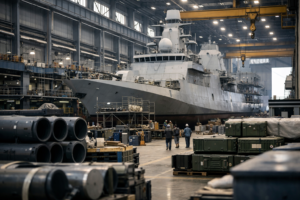
Italy Advances Its Next-Generation Submarine Program as Fincantieri Begins Work on Second U212NFS Boat
Fincantieri has laid the keel of Italy’s second U212NFS submarine, marking a key milestone in the Marina Militare’s modernization drive.
Italian shipbuilder Fincantieri has laid the keel of the second boat in the U212NFS submarine class for the Marina Militare, marking a formal construction milestone for one of Europe’s most closely watched undersea modernization programs. The ceremony, reported by Naval News in its article “Fincantieri Lays Keel of Second U212NFS Submarine,” signals that Italy’s next-generation submarine fleet is advancing on schedule even as NATO allies continue to scrutinize undersea competition in both the Mediterranean and the broader Euro-Atlantic theater. With European navies under mounting pressure to recapitalize aging submarine fleets, the Italian program represents one of the continent’s more concrete near-term deliveries in the domain — a point that connects directly to broader questions about naval force posture across multiple theaters.
The U212NFS — where NFS stands for Near Future Submarine — is an evolution of the proven German-Italian U212A design, developed to meet the Marina Militare’s requirements for the coming decades. The class incorporates air-independent propulsion technology, a feature central to its ability to operate quietly for extended periods without surfacing or snorkeling. Fincantieri is building the boats at its Muggiano facility in La Spezia, which has served as Italy’s primary submarine construction site for decades.
Program Structure and Industrial Significance
Italy’s contract for the U212NFS class covers two boats in an initial tranche, with options for additional hulls. The keel-laying of the second vessel follows the earlier milestone achieved for the first boat and reflects the program’s progression through a construction pipeline that Fincantieri has described as a generational investment in Italian naval industrial capability. Keel-laying ceremonies carry formal significance in naval procurement — they mark the point at which a vessel’s primary structural assembly begins and trigger specific contractual and regulatory benchmarks under Italian and NATO procurement frameworks.
The industrial implications extend beyond the immediate contract. Fincantieri’s submarine work at Muggiano supports a specialized workforce and a supplier base that feeds advanced systems — including combat management electronics, sonar arrays, and propulsion components — across Italian and partner-nation defense industries. Sustaining that industrial base through active construction contracts is itself a strategic objective for Rome, particularly as European governments revisit defense spending priorities in response to the security environment on NATO’s eastern and southern flanks.
Operational Context and NATO Relevance
The U212NFS will eventually replace the Marina Militare’s aging Sauro-class and earlier Todaro-class hulls, giving Italy a more capable and acoustically refined undersea force for Mediterranean and out-of-area operations. The Mediterranean remains among NATO’s most operationally complex maritime environments, with overlapping interests from multiple alliance members, partner nations, and adversarial actors. A quieter, more capable Italian submarine fleet directly enhances the alliance’s collective undersea warfare posture in a theater that has received heightened attention since Russia’s full-scale invasion of Ukraine in 2022 altered the European security calculus.
The U212NFS design also carries export potential, and Italy has previously cooperated with Germany on the baseline U212A platform, which has been sold to several allied navies. Whether the NFS variant attracts similar international interest will depend in part on how efficiently Fincantieri delivers the first hulls and what operational performance data the Marina Militare can demonstrate. For now, the second keel-laying keeps the program on a trajectory that Italy’s defense establishment will cite as evidence that its naval shipbuilding capacity remains viable and competitive within the European defense-industrial landscape. U.S. and NATO planners watching capability gaps across alliance members will have reason to track the program’s delivery timeline closely in the years ahead.