Navy Tests Drone-Enabled Seahawk to Advance Hybrid Carrier Air Wing Operations
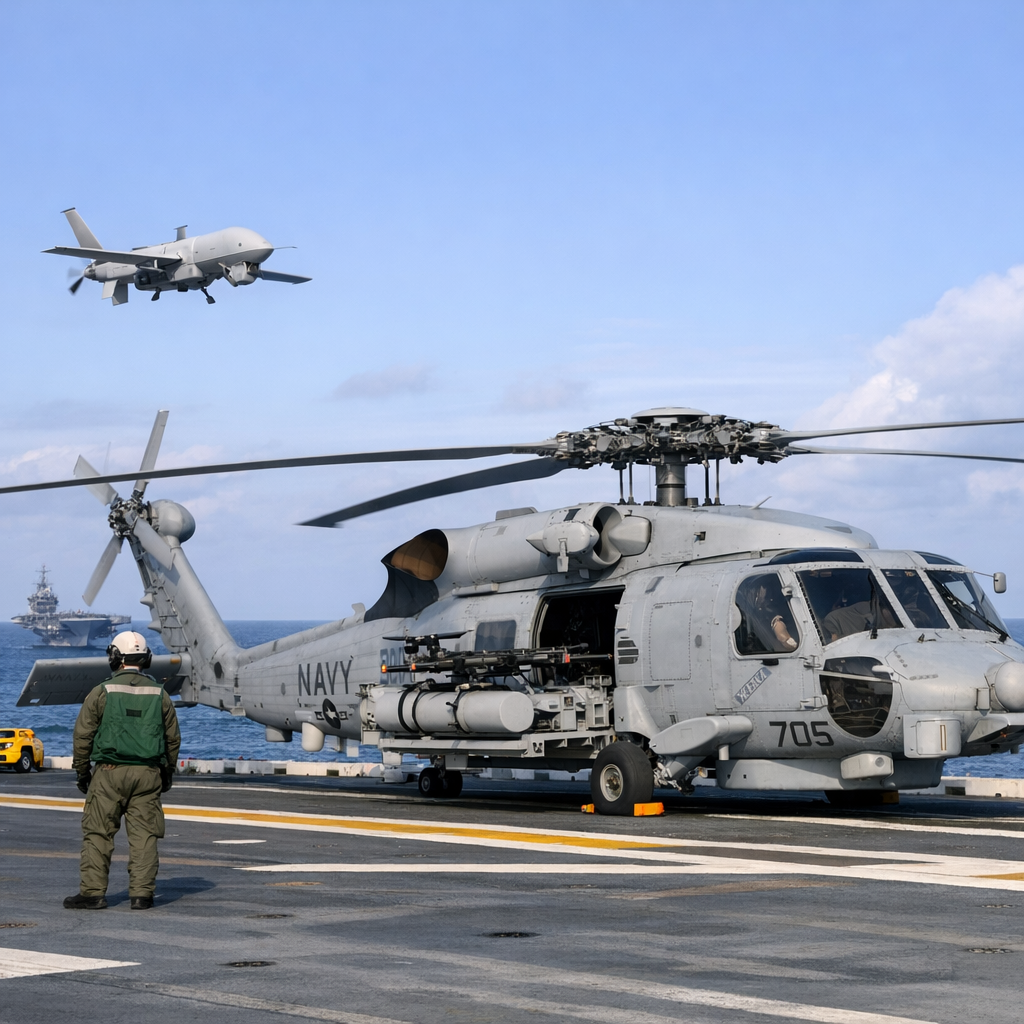
The U.S. Navy has taken another step toward integrating unmanned systems into carrier aviation, deploying a drone-equipped MH-60 Seahawk aboard the USS Theodore Roosevelt as part of ongoing experimentation with hybrid air wings. The move, first reported by Breaking Defense in its article “Navy carrier Theodore Roosevelt drone Seahawk deployment”, reflects the service’s broader effort to expand the operational role of autonomous and remotely piloted systems at sea.
According to the Breaking Defense report, the deployment involves a modified Seahawk helicopter capable of operating with advanced autonomy and remote-control features. While the aircraft remains based on the widely used MH-60 Seahawk platform, it has been adapted to test how unmanned capabilities could be incorporated into existing naval aviation frameworks without requiring entirely new airframes.
The Navy has been exploring the integration of unmanned systems into carrier strike groups for several years, but much of that focus has centered on fixed-wing aircraft such as the MQ-25 Stingray. The Seahawk deployment signals increasing interest in rotary-wing applications, which could expand the range of missions performed without placing pilots at risk. Potential roles include logistics resupply, surveillance, and reconnaissance in contested environments.
Operating such systems from an aircraft carrier presents both technical and doctrinal challenges. Flight deck operations are already tightly choreographed, and introducing unmanned or optionally manned aircraft raises questions about command and control, safety, and interoperability with crewed platforms. The Navy appears to be using the USS Theodore Roosevelt (CVN-71) deployment as a testbed to better understand how these issues can be addressed in real-world conditions.
The Breaking Defense article notes that the effort is part of a broader push to create a “hybrid air wing,” where manned and unmanned systems work together to extend reach, increase endurance, and reduce risk. This concept aligns with Pentagon priorities emphasizing distributed operations and resilience in potential high-end conflicts, particularly in the Indo-Pacific region.
While the technology remains in a developmental phase, Navy officials have indicated that incremental adaptation of existing aircraft may provide a faster and more cost-effective pathway to operational capability than designing entirely new unmanned systems. The Seahawk platform, already deeply integrated into carrier operations, offers a familiar foundation for testing these concepts.
The deployment aboard the Theodore Roosevelt will likely inform future decisions about procurement, doctrine, and the balance between manned and unmanned assets in carrier aviation. As the Navy continues to refine its approach, the success or limitations of the drone-enabled Seahawk could shape how quickly such capabilities move from experimental deployments to routine operations.