US tests Typhon missile system in Philippines drill
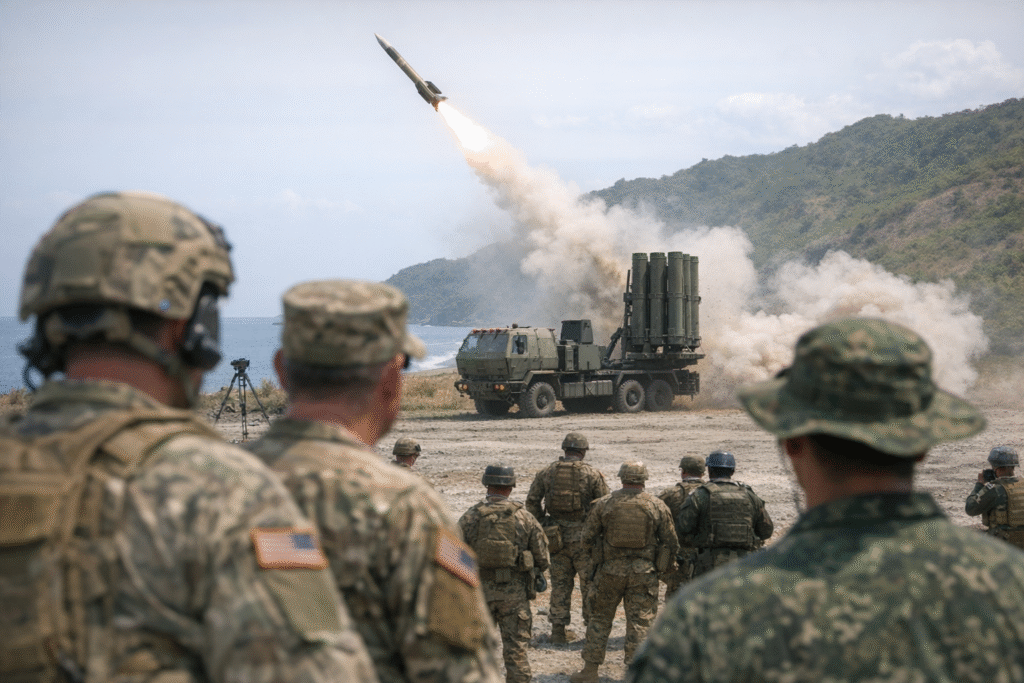
The United States Army has conducted a live-fire test of its Typhon missile system during joint military exercises in the Philippines, marking a notable step in Washington’s efforts to expand its long-range strike capabilities across the Indo-Pacific. The development was reported in the article “US Army fires Tomahawk missile from new Typhon launcher during Philippines drill,” published by Defense News.
According to the report, the exercise featured the launch of a Tomahawk cruise missile from the Typhon system, a mobile ground-based platform designed to deploy long-range precision strike weapons. The system, also known as the Mid-Range Capability (MRC), is part of the Army’s broader modernization push to field land-based missiles capable of targeting threats at extended distances, filling a capability gap that persisted for decades during the era of the now-defunct Intermediate-Range Nuclear Forces Treaty.
The test took place as part of joint drills between US and Philippine forces, underscoring deepening defense cooperation between the two allies amid rising tensions in the region. The Philippines has increasingly opened its military facilities to US forces under the Enhanced Defense Cooperation Agreement, allowing rotational deployments and prepositioning of equipment. The inclusion of the Typhon system in these exercises signals a growing emphasis on interoperability and deterrence in the face of evolving regional security challenges.
The Tomahawk missile, long associated with US naval operations, is capable of striking targets at distances exceeding 1,000 miles with high precision. Its integration into a ground-based launcher represents a significant doctrinal shift, giving US Army units the ability to deliver comparable long-range strike effects from land. This capability is particularly relevant in the Indo-Pacific, where vast distances and dispersed geography complicate traditional force projection.
Defense News reported that the Typhon system is designed to be transportable and rapidly deployable, allowing it to operate from austere locations. This mobility could enable US forces to reposition quickly across island chains and coastal areas, complicating adversaries’ targeting calculations. The Philippines, with its strategic location near key maritime routes and contested areas of the South China Sea, offers a particularly advantageous environment for such operations.
The deployment of advanced missile systems in Southeast Asia, however, is likely to draw scrutiny from China, which has consistently criticized the expansion of US military presence in the region. Beijing has warned that the introduction of intermediate-range missiles could escalate tensions and destabilize the security environment. For Washington and its allies, the move is framed as a necessary response to China’s own growing arsenal of long-range missiles and assertive military posture.
US Army officials have emphasized that the Typhon system enhances deterrence by providing flexible, survivable strike options. By dispersing launchers across multiple locations, the Army can reduce vulnerability to preemptive attacks while maintaining the ability to hold high-value targets at risk. The system also complements other elements of the US military’s evolving posture in the Indo-Pacific, including increased naval deployments and closer collaboration with regional partners.
The Philippines, for its part, has sought to balance its security relationship with the United States against economic ties with China. The decision to host exercises involving advanced missile systems highlights Manila’s growing concern over maritime disputes and its willingness to strengthen defense cooperation with Washington. Philippine officials have framed the drills as part of routine training aimed at enhancing national and collective security.
As reported by Defense News, the successful launch during the exercise demonstrates that the Typhon system is moving closer to operational maturity. Its deployment in allied territories suggests that the United States is actively working to integrate these capabilities into real-world scenarios, not merely testing them in isolation.
The exercise reflects a broader shift in US military strategy, emphasizing distributed operations, long-range precision fires, and partnerships with regional allies. As tensions in the Indo-Pacific continue to shape global security dynamics, the introduction of systems like Typhon is likely to play an increasingly central role in deterrence and defense planning.