Air Force Advances T-7A Toward Production
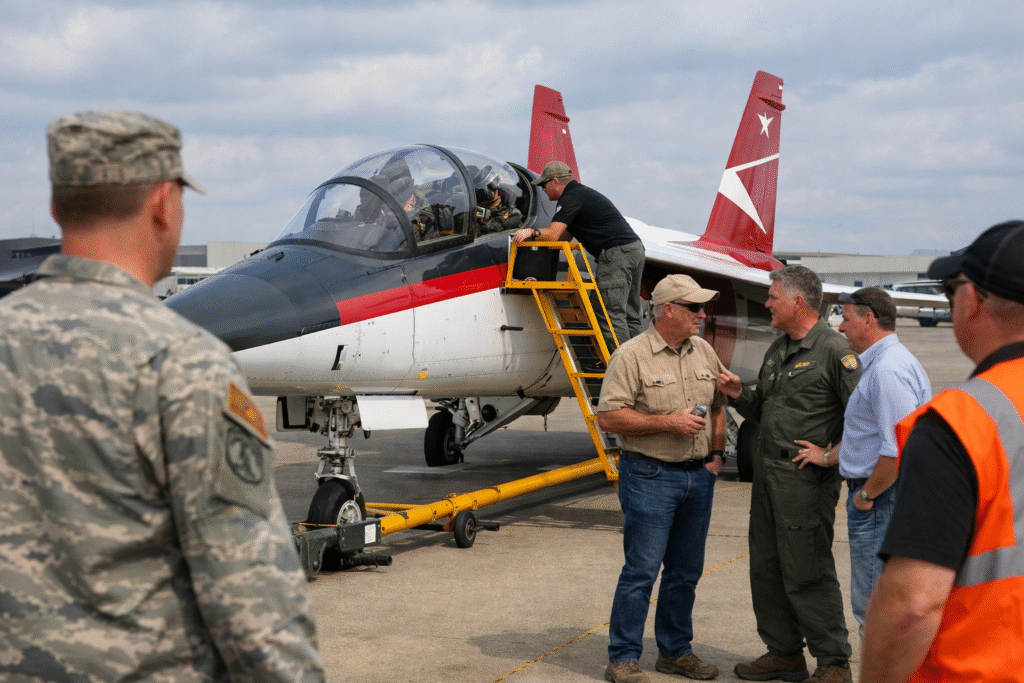
The U.S. Air Force has cleared the T-7A Red Hawk advanced trainer aircraft for low-rate initial production, marking a significant milestone in a program that has faced delays and technical challenges in recent years. The decision, reported in the Defense News article titled “Air Force clears T-7A Red Hawk for low-rate production,” signals growing confidence in the jet’s readiness to begin entering the service’s pilot training pipeline.
The approval follows a series of developmental setbacks that pushed the program behind its original schedule, including issues with the aircraft’s escape system and software integration. Despite these hurdles, Air Force officials now assess that sufficient progress has been made to move forward with limited production while continuing testing and refinement.
The T-7A, developed by Boeing and Saab, is intended to replace the aging T-38 Talon, a supersonic trainer that has been in service since the 1960s. The new aircraft is designed to prepare pilots for fifth-generation fighters such as the F-22 and F-35, incorporating modern avionics, open architecture software, and advanced simulation capabilities. The Air Force has emphasized that the T-7A’s digital engineering and development approach could serve as a model for future acquisition programs.
Moving into low-rate production allows the Air Force to begin building a small fleet of aircraft while continuing to identify and address any remaining deficiencies. This phase is a standard step in major defense acquisition programs and is intended to reduce risk before full-scale production is authorized.
While the decision represents forward momentum, the program’s challenges have underscored broader concerns about timelines and technical integration in modern aircraft development. Problems with the ejection seat system, particularly related to pilot safety across a range of body types, drew scrutiny and required redesign efforts. Officials have indicated that these concerns have been mitigated sufficiently to proceed, though work will continue.
The Air Force plans to use the early production aircraft for testing and initial training activities, gradually transitioning from developmental evaluation to operational use. Full-rate production approval will depend on the aircraft meeting performance and safety benchmarks in subsequent phases.
As noted by Defense News, the clearance for low-rate production reflects a careful balancing act between urgency and caution. The service faces increasing pressure to modernize its training fleet as it prepares pilots for more complex and technologically advanced combat aircraft, but must also ensure that the T-7A meets stringent safety and reliability standards before widespread deployment.
The program remains a central component of the Air Force’s broader modernization strategy, and its progress will be closely watched as an indicator of how effectively the Pentagon can deliver next-generation systems on revised timelines.