Opening the Strait of Hormuz Is No Simple Task
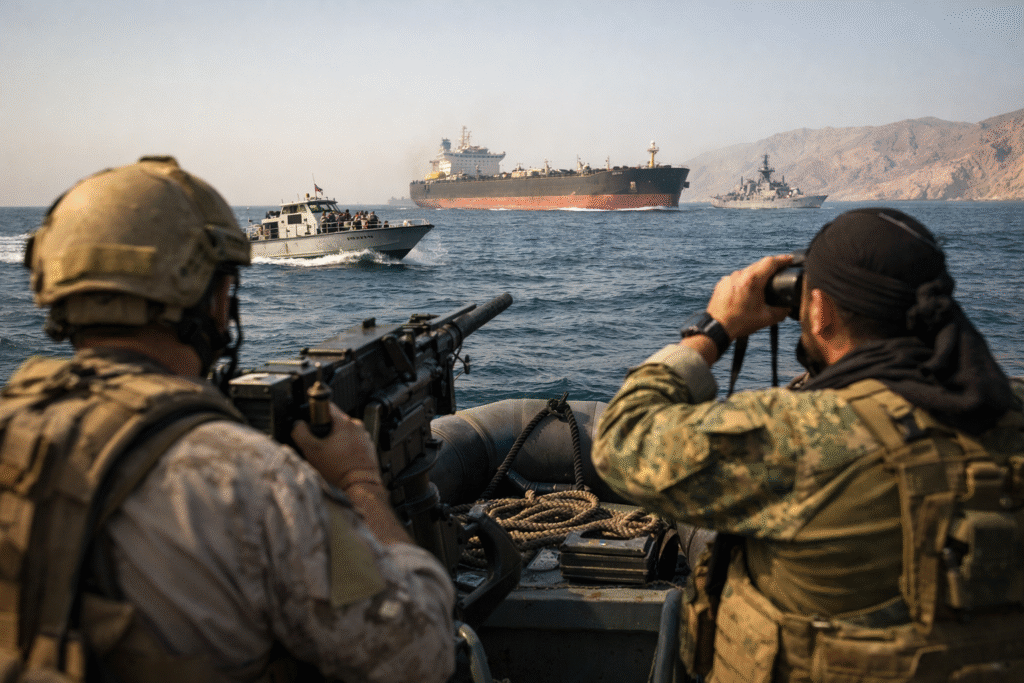
A proposal to reopen the Strait of Hormuz through what some observers have described as a “simple maneuver” is far more complex and dangerous than it appears, according to regional security analysts, who warn that even limited actions in the waterway could trigger wide-ranging military and economic consequences.
In an article titled “The simple maneuver of opening Hormuz Strait carries great risks, analysts say,” published by Defense News, experts assess that while the narrow maritime corridor is often portrayed as a chokepoint that can be quickly cleared or secured, the reality is far more volatile. The strait, bordered by Iran to the north and Oman and the United Arab Emirates to the south, handles a significant share of the world’s oil shipments, making it one of the most strategically sensitive waterways on the globe.
Analysts cited in the report emphasize that any attempt to forcibly guarantee passage through Hormuz—whether by escorting tankers, neutralizing threats, or responding to Iranian interference—would almost certainly be interpreted as escalation by Tehran. Iran has long positioned itself to leverage the strait as a pressure point, using a mix of naval assets, mines, missiles, and proxy capabilities to complicate adversaries’ operations.
The notion that reopening or securing the strait could be achieved through a limited or discrete maneuver overlooks the layered nature of Iran’s defensive posture, according to the assessments highlighted by Defense News. Even a narrowly defined operation could expand quickly, drawing in regional actors and disrupting global energy markets.
Military planners face additional complications stemming from geography. The Strait of Hormuz is just 21 miles wide at its narrowest point, leaving little margin for error in congested shipping lanes. Analysts note that this confined environment amplifies the risks of miscalculation, accidental encounters, or rapid escalation following even minor incidents.
The Defense News report also underscores the economic stakes. Any sustained disruption in Hormuz would likely produce immediate effects on global oil prices and shipping insurance rates, with ripple effects extending far beyond the Middle East. For this reason, even signaling a willingness to intervene militarily carries strategic weight.
Experts further caution that attempts to frame the issue as a technical or operational challenge—something that can be resolved through superior naval capability—fail to account for the political dimension. Iran’s calculus is shaped not only by military considerations but also by its broader strategic objectives, including deterrence and regional influence.
While Western and allied naval forces maintain a strong presence in the region, analysts stress that deterrence and de-escalation remain preferable to direct confrontation. As indicated in the Defense News coverage, the risks attached to any effort to “open” the strait by force extend well beyond the initial objective, potentially igniting a wider conflict that would be difficult to contain.
In that context, what may appear to be a straightforward operational task is, in reality, a deeply complex strategic dilemma—one where even limited actions carry the potential for global repercussions.