Iran US Race to Adapt Missile and Drone Warfare
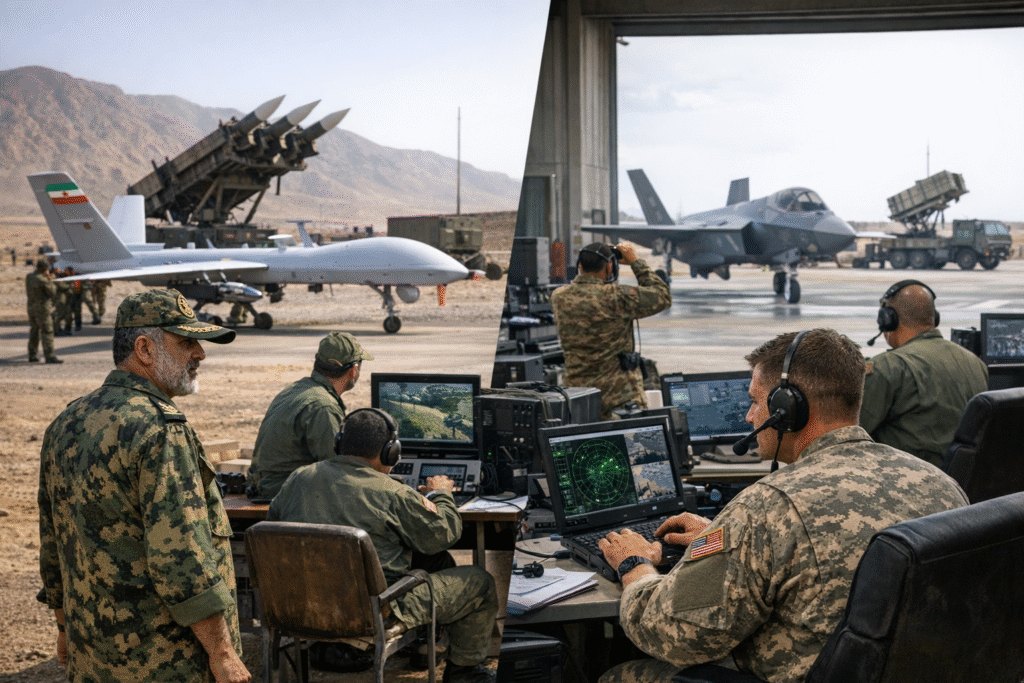
A recent report by The Wall Street Journal, titled “Iran, U.S. Advance Missile and Drone Defenses,” examines a rapidly evolving contest between Tehran and Washington as both sides refine capabilities in response to changing threats across the Middle East.
According to the Journal’s reporting, Iran has invested heavily in expanding and diversifying its arsenal of missiles and unmanned aerial vehicles, systems that have become central to its military strategy and regional influence. These capabilities, often distributed through allied militias and proxy groups, are designed not only to project power but also to complicate the defensive calculations of adversaries. The approach emphasizes saturation tactics, mobility, and relatively low-cost production, enabling Iran to challenge more technologically sophisticated opponents.
At the same time, the United States and its regional partners are working to strengthen layered defense systems capable of detecting, tracking, and neutralizing incoming threats. The Journal notes that this includes integrating radar networks, missile interceptors, and counter-drone technologies across allied countries. Officials view these efforts as essential to defending critical infrastructure, military bases, and shipping routes against increasingly frequent and sophisticated attacks.
The dynamic has created what analysts describe as a cycle of adaptation. As Iran refines its offensive tools—improving accuracy, range, and survivability—the U.S. and its partners respond by enhancing interception capabilities and coordination. In turn, those defensive improvements drive further innovation on the Iranian side, particularly in tactics designed to overwhelm or evade defenses.
Beyond the technical developments, the Journal highlights the broader strategic implications. The proliferation of missile and drone technology has lowered the threshold for engagement, enabling non-state actors to carry out strikes with significant impact. This trend raises concerns among policymakers about escalation risks and the possibility of miscalculation in an already volatile region.
Ultimately, the report underscores a shifting balance in modern warfare, where relatively inexpensive systems can challenge advanced militaries and where defense requires constant adaptation. The evolving contest between Iran’s strike capabilities and U.S.-led defensive measures is likely to remain a defining feature of regional security in the years ahead.