Ukraine Expands Counter Drone Role to Middle East
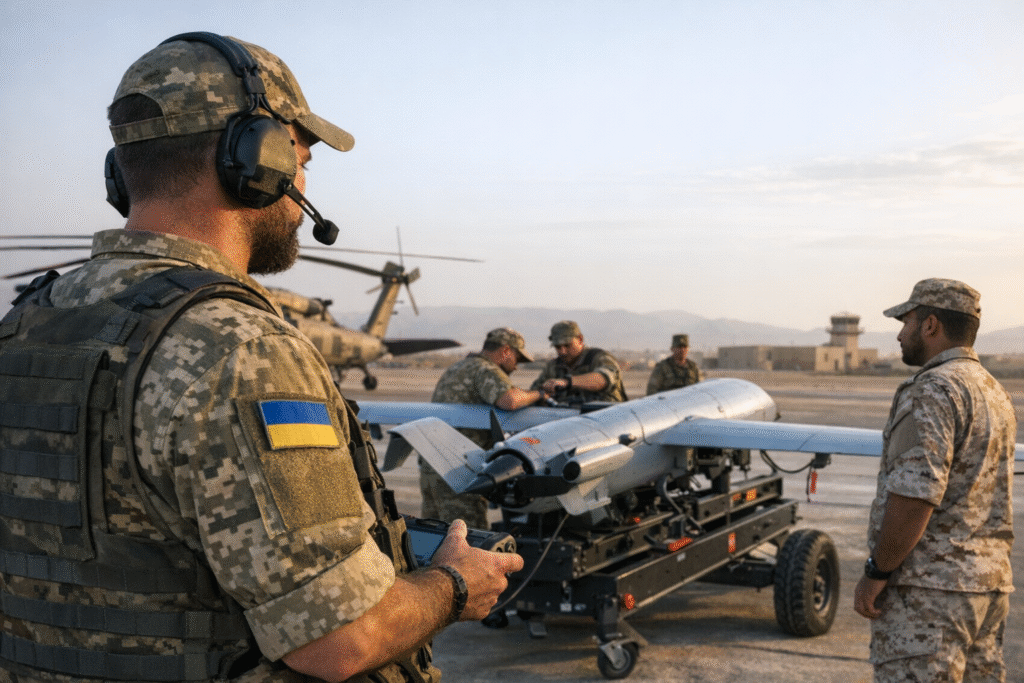
A recent report by Defense News, titled “Ukraine deploys units to 5 Middle East countries to intercept drones,” highlights a notable expansion of Kyiv’s military engagement beyond its immediate battlefield, signaling both operational adaptation and deepening international security ties.
According to the Defense News report, Ukraine has dispatched specialized units to five Middle Eastern countries with the primary mission of countering drone threats. These deployments focus on intercepting and neutralizing unmanned aerial systems, reflecting Ukraine’s growing expertise in drone warfare after years of sustained conflict with Russia. The move underscores how battlefield innovations developed under duress are now being exported to partner nations facing similar asymmetric threats.
The initiative appears to be mutually beneficial. For Ukraine, it offers an opportunity to strengthen diplomatic relationships, secure additional military cooperation, and demonstrate the effectiveness of its evolving defense capabilities. For host countries, many of which face persistent risks from non-state actors employing low-cost aerial systems, Ukrainian personnel bring practical, combat-tested experience in counter-drone tactics that Western militaries have only more recently prioritized.
The Defense News article indicates that these Ukrainian units are not deployed in traditional combat roles but are instead focused on training, advisory support, and operational assistance in detecting, tracking, and intercepting drones. This includes the use of electronic warfare tools, mobile air defense systems, and rapid-response coordination practices refined on the Eastern European battlefield.
Ukraine’s ability to extend its military footprint abroad, even while engaged in a high-intensity conflict at home, reflects a calculated effort to position itself as both a security provider and a valuable partner in emerging defense networks. It also suggests a degree of confidence in its force structure and capacity, despite ongoing demands on manpower and matériel.
At a broader level, the deployments point to the growing centrality of drone warfare in modern conflicts. The widespread availability of inexpensive unmanned systems has altered threat environments across regions, particularly in the Middle East, where militant groups and irregular forces have repeatedly used drones to target infrastructure and military assets. Ukraine’s experiences have made it one of the most adaptive actors in countering such threats, and its willingness to share that expertise is likely to deepen strategic alignments.
However, the expansion is not without risk. Extending military personnel into multiple foreign environments carries logistical, political, and security challenges. It also raises questions about how Ukraine balances external commitments with the ongoing demands of its own war effort.
As Defense News reports, the deployments reflect a shifting paradigm in which combat knowledge is rapidly transferred across borders. Ukraine’s role in this emerging landscape suggests that even nations under active threat can shape global security dynamics, particularly in areas where technological adaptation outpaces traditional military doctrine.