Amazon Pullback From USPS Reshapes Delivery Economics
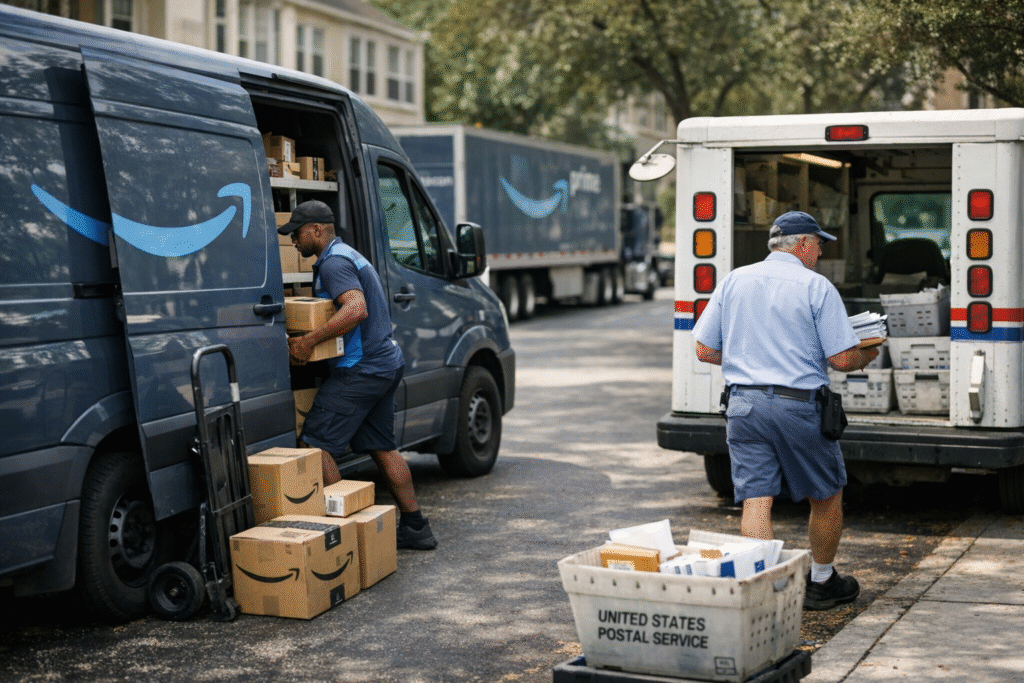
Amazon is sharply reducing its reliance on the U.S. Postal Service for last-mile deliveries, a shift that is reshaping the economics of one of the nation’s largest shipping partnerships and raising fresh questions about the financial outlook for the federal mail carrier.
According to a Wall Street Journal report titled “Amazon Is Pulling Back From USPS for Package Delivery,” the e-commerce giant has been redirecting a growing share of its parcel volume to its own logistics network and alternative carriers. The change has begun to erode a once-critical source of business for the Postal Service, which has long depended on Amazon’s massive shipping volume to help offset declines in traditional mail.
For years, Amazon and USPS maintained a mutually beneficial arrangement. The Postal Service handled a significant portion of Amazon’s so-called “last mile” deliveries, particularly in rural areas and on Sundays, when USPS offered a unique nationwide reach. In turn, Amazon provided steady, high-volume business that helped stabilize USPS finances.
That dynamic is now shifting as Amazon continues to build out one of the most sophisticated logistics operations in the world. The company has invested heavily in warehouses, sorting centers, delivery vans, and its own network of drivers and contractors. As that infrastructure matures, Amazon is increasingly able to handle deliveries internally or through private partners, reducing its dependence on USPS.
Industry analysts say the transition reflects Amazon’s long-term strategy to control more of its supply chain, improving delivery speed while lowering costs. But the ripple effects could be significant. The Postal Service, already under financial strain, faces the prospect of losing a dependable revenue stream tied to e-commerce growth — one of the few bright spots in its balance sheet over the past decade.
The Journal reported that package volumes handled by USPS for Amazon have declined noticeably in recent periods, even as overall e-commerce demand remains strong. While USPS still delivers a substantial number of Amazon parcels, particularly in less densely populated areas, its share of that business is shrinking.
Postal officials have acknowledged the evolving relationship, emphasizing efforts to diversify revenue and modernize operations. The agency has been pursuing cost-cutting measures, network restructuring, and pricing adjustments as part of a broader turnaround plan. However, replacing lost volume from a customer as large as Amazon will be challenging.
The shift also underscores broader changes in the logistics sector, where competition is intensifying among carriers such as UPS, FedEx, and a growing number of regional delivery firms. Amazon’s expansion into logistics has turned it from a customer into a formidable competitor, putting pressure on incumbents while redefining expectations around delivery speed and cost.
For consumers, the transition is largely invisible, as packages continue to arrive quickly and reliably. But behind the scenes, the reconfiguration of delivery networks signals a deeper transformation in how goods move across the United States.
As Amazon refines its logistics strategy, the long-standing partnership with the Postal Service appears set to become less central, marking the end of an era in which the federal mail system played a pivotal role in powering the rise of e-commerce.