Navy Shifts Focus from Carriers to Agile Operations
As the global security landscape continues to evolve, the U.S. Navy is signaling a strategic pivot away from its traditional reliance on aircraft carriers as frontline crisis response tools. This shift was recently outlined in a compelling article titled “Navy leader wants to move faster, leaner instead of turning to carriers in crisis,” published by Military Times, in which Chief of Naval Operations Adm. Lisa Franchetti emphasized the need for more agile and unpredictable force projection in the face of modern threats.
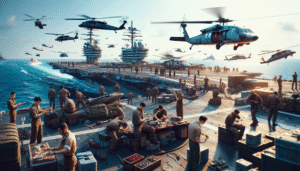
Adm. Franchetti’s remarks reflect a growing consensus within the Navy that tomorrow’s conflicts may demand a rethinking of both posture and platform. In a discussion with reporters, she advocated for a faster and more flexible approach to deploying naval power—one that leverages distributed maritime operations and a mix of smaller, mobile units rather than defaulting to carrier strike groups as the Navy’s primary instrument of deterrence or crisis response.
This view highlights an ongoing tension between legacy platforms that have become symbols of U.S. military dominance—such as nuclear-powered aircraft carriers—and the urgent need to adapt to contemporary security challenges. With peer competitors like China advancing anti-access/area-denial capabilities, the Navy faces the reality that large, centralized fleets could become increasingly vulnerable in contested environments.
Adm. Franchetti underscored the importance of ensuring that the Navy is not only ready to respond to existing threats but is also capable of doing so in a manner that introduces operational uncertainty for adversaries. Rather than focusing solely on hardware, she emphasized a broader movement toward agile decision-making and joint force integration. “We need to be ready to go fast and to be unpredictable,” she was quoted as saying, framing the issue as both a cultural and operational transformation.
The comments come amid broader debates over the future of the Navy’s force structure and budgetary priorities. Advocates for carrier investment argue that these vessels remain vital tools of diplomacy and deterrence, capable of rapid response and sustained air operations from global waters. Critics, however, contend that their visibility and cost make them liabilities as often as assets in a future where dispersed maritime networks and unmanned systems may offer greater survivability and strategic surprise.
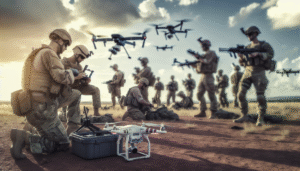
Already, this shift is being reflected in operational planning and doctrine updates. The Navy continues to experiment with concepts such as distributed lethality and integrated deterrence, which pair manned and unmanned systems across a wider geography. Additionally, moves toward enhancing the lethality and resilience of destroyers, submarines and Marine Corps expeditionary units suggest a Navy that is not abandoning carriers but seeking a diversified mix of power projection options.
Adm. Franchetti also pointed to lessons from recent global crises—such as tensions in the Red Sea and operations in the Indo-Pacific—as reinforcing the necessity of being able to respond across multiple domains and axes. Rapid force maneuvering, she noted, demands not just the right vessels, but the right mindset.
Her remarks reflect a broader Department of Defense push to maintain strategic advantage in an era of near-peer competition. As technology and adversary capabilities evolve, so too must the platforms and policies of America’s maritime forces.
The challenge going forward will lie in striking the right balance—maintaining carrier relevance while equipping the Navy with the tools and doctrines needed for 21st-century conflict. In the end, as the Military Times article suggests, speed, flexibility and unpredictability may matter more than ever in determining success on the high seas.