Navy Races to Deploy Maritime Drones in Months
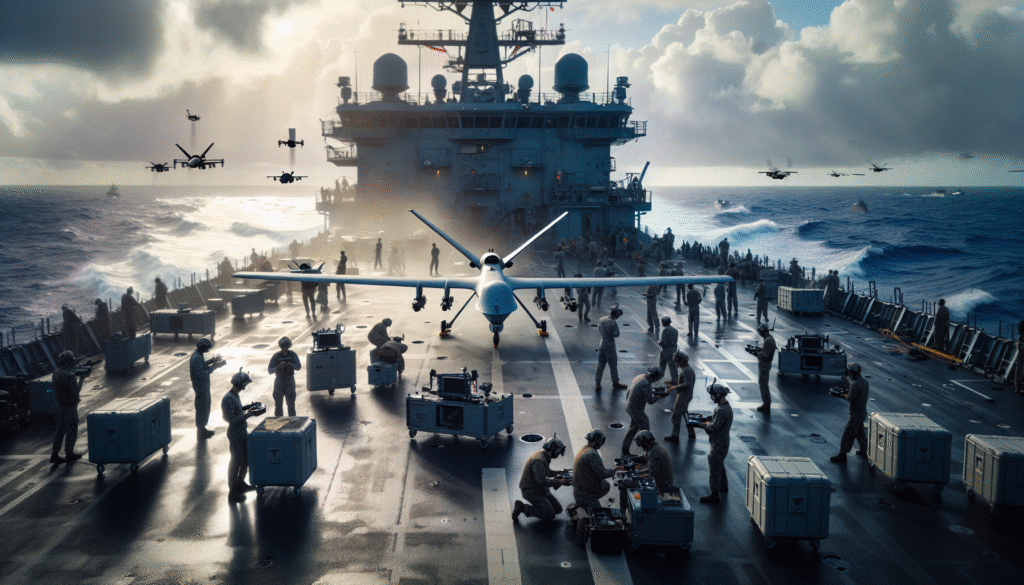
The U.S. Navy is accelerating efforts to integrate unmanned surface vessels into its operational fleet, aiming to dramatically shorten the production timeline for maritime drones as it pursues a more agile, hybrid force model. According to the article “Building Maritime Drones in Months—Not Years—Could Be Key to Creating Navy’s Hybrid Fleet,” published by Defense One, the shift represents a strategic pivot toward greater cost efficiency, operational flexibility, and technological responsiveness.
As great-power competition reemerges on the global stage, particularly with China’s expanding military capabilities, the Navy is under mounting pressure to modernize its fleet composition. Traditional shipbuilding cycles often span years and cost billions of dollars per vessel. Leaders within the Department of Defense now view unmanned systems as a means to enhance naval strength without incurring the logistical and financial burdens associated with manned platforms.
Unmanned surface vessels (USVs), in particular, offer a versatile suite of capabilities—from reconnaissance and mine countermeasures to electronic warfare and strike missions—without putting sailors in harm’s way. However, the challenge lies in rapidly scaling development and deployment while ensuring reliability and integration with existing fleet infrastructure.
Defense One reports that industry partners and Navy officials are exploring modular designs and commercial production techniques to reduce lead times for USVs from years to mere months. The evolving acquisition strategy seeks to mirror Silicon Valley’s iterative development model, in which early prototypes are field-tested and refined through continuous feedback—departing from the Navy’s historically risk-averse procurement ethos.
Rear Admiral Fred Pyle, director of surface warfare, emphasized the urgency of fielding these systems sooner rather than later, noting that delayed deployments could place the United States at a tactical disadvantage. “We don’t need to wait to build a perfect solution,” he told Defense One. “We just need to build something of value and get it into the hands of the warfighter.”
The Navy continues to experiment with a variety of USV types, ranging from small sensor-equipped vessels to larger, optionally-manned ships with offensive capabilities. Some of these platforms have already participated in multinational exercises, providing valuable data and operational insights. Officials hope that accelerating production timelines will allow for more extensive field testing, revealing capability gaps and system flaws that can be swiftly addressed.
The pivot to unmanned systems coincides with calls to rebalance fleet architecture amid rising costs and evolving threats. The Navy’s latest long-range strategic plans envision a future force composed of fewer traditional combatants and a higher percentage of autonomous platforms. Yet achieving that vision will require not only faster production but also significant doctrinal and cultural shifts within the service.
The Defense One report highlights that building trust in automation and artificial intelligence among naval commanders remains a key hurdle. Some advocates argue that the Navy must rethink traditional command-and-control paradigms to accommodate machine collaboration. Others caution that overreliance on unmanned systems could introduce new vulnerabilities, such as cyber interference or satellite disruption.
Nevertheless, policymakers and defense contractors appear increasingly aligned on the need for speed. With competitive timelines and adversaries like China advancing their own unmanned maritime programs, the Navy faces a narrowing window to transform intent into capability. In this context, as Defense One underscores, building maritime drones in months—not years—may indeed be critical to realizing a future hybrid fleet.