Navy Deploys V-BAT Drone in First Middle East Mission
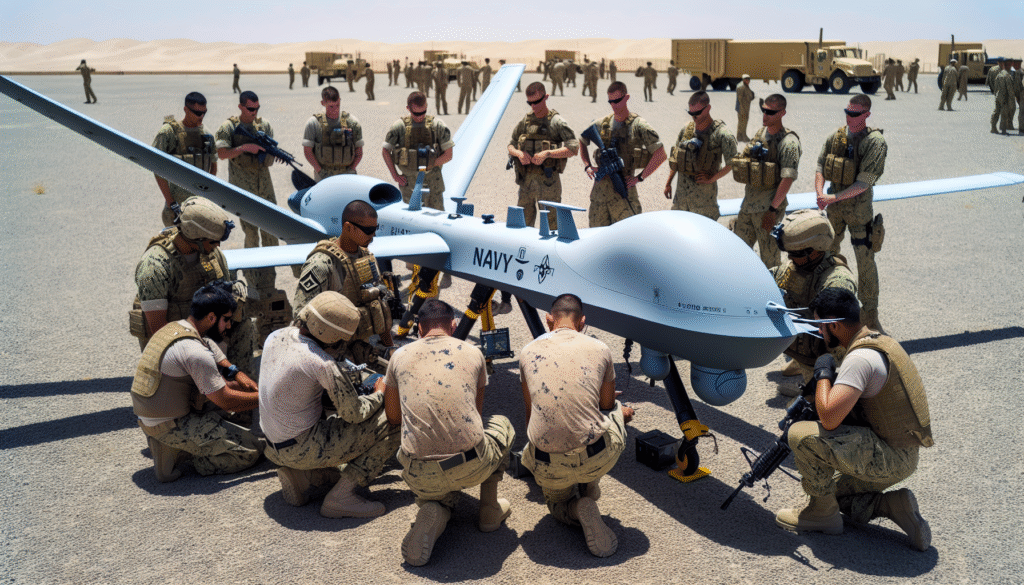
In a landmark moment for the U.S. Navy’s integration of autonomous systems, a ship-launched drone known as the V-BAT took its first operational flight from a Navy vessel deployed in the Middle East, signaling a significant step forward in maritime unmanned aviation. The drone, developed by Shield AI, was launched from the USS Lewis B. Puller and is expected to enhance the Navy’s intelligence, surveillance, and reconnaissance (ISR) capabilities in one of the world’s most strategically sensitive regions.
As reported by DefenseScoop in “Drone named after fallen Marine takes flight off Navy ship for the first time in the Middle East,” the V-BAT drone is named in honor of Marine Corps Staff Sgt. Christopher Slutman, known affectionately by friends as “Lucas.” Slutman was killed in action in Afghanistan in 2019, and the naming of the drone represents both a technological milestone and a commemorative gesture, linking innovation with service and sacrifice.
Shield AI’s V-BAT is a vertical takeoff and landing (VTOL) drone designed for shipboard operations that require minimal logistical support. Its ability to launch and recover in confined spaces—a critical factor aboard naval vessels—makes it a versatile tool for ISR missions in contested environments. The system is guided by Shield AI’s Hivemind autonomy stack, which enables the aircraft to navigate and make decisions without relying on GPS or external communications, a feature particularly valuable in electronic warfare scenarios.
This recent deployment marks the first time such a platform has been used operationally by the U.S. Navy in the Central Command (CENTCOM) area of responsibility, according to officials cited in the DefenseScoop piece. Shield AI co-founder and CEO Brandon Tseng, a former Navy SEAL, described the V-BAT’s inaugural mission from the deck of the Puller as part of the broader effort to field systems that provide “a decisive edge in dynamic theaters of operation.”
The driving impetus behind this development is the Navy’s increasing emphasis on leveraging autonomous systems to reduce operational risk and expand reach, especially in regions like the Persian Gulf where threat levels can escalate rapidly. The integration of V-BAT into standard maritime operations reflects both tactical necessity and evolving strategy as the Pentagon contends with great power competition and a shifting threat landscape.
Rear Adm. Mark Meyers, commander of Task Force 59, the Navy’s unit focused on integrating unmanned technologies in the 5th Fleet’s area of operations, emphasized the need for agility and experimentation in deploying these emerging systems. The successful launch of V-BAT contributes to CENTCOM’s growing portfolio of unmanned and AI-enhanced capabilities, which also includes maritime drones and autonomous underwater vehicles.
Fielding systems like the V-BAT also speaks to a broader strategic pivot within the Department of Defense. As China and Russia advance their own unmanned platforms, U.S. defense officials have pushed to accelerate procurement and testing of autonomous technologies that reduce reliance on human operators while expanding military effectiveness.
The milestone follows a series of other recent developments in the Navy’s embrace of unmanned systems, including joint exercises and cross-sector collaboration geared toward refining the operational use of AI in combat environments. Shield AI, which has secured substantial investments in recent years, has been at the center of this innovation wave, frequently highlighting its mission to build products that safeguard allied lives and extend military capability.
While the V-BAT’s first operational deployment is symbolically significant due to its naming, its success will ultimately be judged by performance metrics and its ability to deliver reliable situational awareness in austere, high-stakes environments. As the U.S. military continues to test and field autonomous systems across domains, the Middle East launch represents a notable step toward a future in which unmanned platforms play a central role in naval warfare.